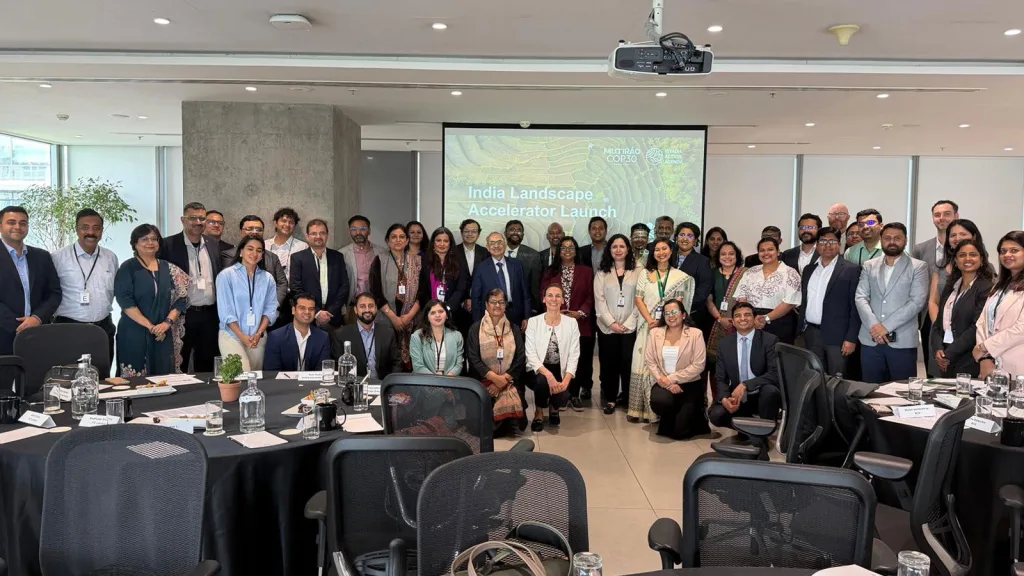
This impact story is part of a series featuring India Landscape Accelerator (ILA) member companies and their efforts to scale Climate-Smart agriculture (CSA) in Indian landscapes. The series highlights existing company-led initiatives, lessons for implementation, and opportunities for ILA to accelerate collective action.
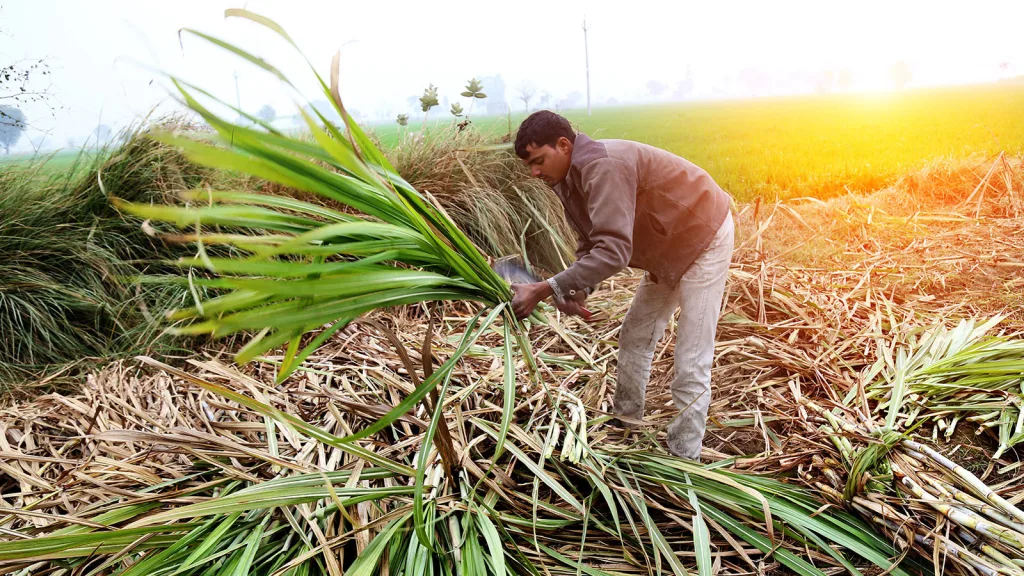
For ITC Limited, building a more resilient agricultural future starts with a simple idea: CSA must work for farmers as much as it works for the environment. Over several decades, the company has developed and implemented CSA models across multiple value chains, combining regenerative practices, digital advisory services, farmer collectives and market linkages to improve both agricultural productivity and environmental outcomes. Today, these efforts reach more than 1.2 million farmers across 19 states, making ITC’s CSA program one of the largest private-sector initiatives in India.
Creating value for farmers and landscapes
ITC frames its agricultural work around what it calls an integrated focus on “Farms, Farmers and Farming”, a strategy anchored in its broader Sustainability 2.0 agenda and the company’s stated credo of Responsible Competitiveness. The ambition is to make Indian agri-value chains more competitive, resilient and less resource-intensive, while enabling farmers to achieve higher and more resilient incomes rather than treating sustainability and prosperity as a trade-off.
ITC’s programs span a wide range of agro-climatic zones and value chains, from wheat, rice and potato systems in North India to soybean, pulses, spices and horticulture crops across Central, Western and Southern India. Underneath this variety sits a common toolkit of regenerative practices: zero tillage (ZT), broad-bed furrow (BBF), direct-seeded rice (DSR), alternate wetting and drying (AWD), climate resilient high-yielding varieties, organic farming, precision nutrient management and systematic residue management delivered through farmer field schools, demonstration plots and the ITCMAARS digital platform.
ITCMAARS (Metamarket for Advanced Agriculture and Rural Services) is ITC’s integrated physical-digital or “phygital” platform that combines digital tools with on-the-ground support to deliver tailored agricultural services to farmers. At its core is a mobile app that serves as a one-stop access point for personalized advisory and agricultural services through a flexible plug-and-play model. By providing hyperlocal, crop-specific advice and solutions, ITCMAARS helps farmers improve productivity, strengthen resilience to climate change and increase incomes, while supporting traceable, high-quality sourcing for ITC’s agri-food value chains. The platform involves ground-level engagement through Farmer Producer Organizations (FPOs) who provide physical staging points for input and output supply chains in villages.
Recognizing that resilience must be inclusive and gender-sensitive, ITC also places a strong emphasis on women farmers through its Women Empowerment Program. Through initiatives such as Women Farmer Field Schools, Drone Didis and Krishi Sakhis, the program expands access to knowledge, resources and decision-making opportunities, strengthening both productivity and rural livelihoods.
The targets for ITC’s CSA programs are concrete. ITC aims to expand CSA coverage to 4 million acres by 2030, up from roughly 3.17–3.2 million acres today; to reach 10 million farmers through 4,000 farmer producer organizations via ITCMAARS; and to extend watershed development to 2.2 million acres and biodiversity conservation to over a million acres by the same year.
Driving adoption through trust and innovation
The company’s philosophy goes beyond acreage counts. ITC insists on treating farmers not as passive recipients of aid, but as critical partners. The clearest expression of this philosophy is the company’s widespread CSA program. Designed to build resilience to climate risks while improving productivity, the program aims to help farmers increase yields and incomes, reduce greenhouse gas emissions and improve the efficiency with which natural resources are used.
Central to this approach is farmer capability building. Through Farmer Field Schools and digital platforms such as ITCMAARS and WhatsApp, farmers receive tailored agronomic advice, weather information, and guidance on climate-smart practices. This is reinforced through year-round technical support, engagement with local farmer collectives and convergence with relevant government schemes.
While results differ across crops, geographies and seasons, the overall evidence is encouraging, showing that resource conservation and farm productivity can advance together.
- In Uttar Pradesh, an external study found that program farmers achieved wheat yields 16% higher than control farmers while reducing cultivation costs by 28%.
- Research by ICAR found that climate-smart practices in rice and wheat reduced cultivation costs by more than 20%, increased yields by around 10%, and improved net returns by over 23% compared to conventional practices.
- Across targeted areas of up to 2.94 lakh acres, 96.5% of participating land avoided stubble burning, preventing an estimated 215,000 tonnes of carbon emissions.
- Water-efficiency initiatives generated potential water savings of more than 1,520 million kiloliters across 15 crops during 2025-26.
Adoption of CSA practices, however, is governed less by their demonstrated efficacy than by the pace of behavior change among farmers.
Adopting new practices takes time because it requires behavior change anchored on trust. Farmers need to experience the benefits over at least two seasons before adoption reaches critical mass.
– Prabhakar Lingareddy, Executive Vice President and Head – Social Investment
Outcomes must be observed across varying agronomic conditions before farmers can be reasonably expected to trust a departure from established, often generational, practice. It also underscores why ITC prioritizes peer demonstration over formal instruction within the program’s design. Evidence drawn from a neighboring farmer’s field carries greater credibility than advisory materials or extension guidance alone. Scaling CSA in India is therefore best understood not as a matter of technology transfer, but as a matter of building trust.
Turning proven models into shared solutions
What makes ITC’s experience relevant is not only the scale of its CSA program, but also the challenges the company says still need to be solved. Chief among them is measurement. While ITC already tracks farm-level greenhouse gas emissions across key value chains using global standards, it argues that India still lacks a standardized, smallholder-friendly MRV framework. Such a system would need to be adapted to local realities, including simplified data collection and interoperability with digital public infrastructure such as Agri Stack, Bhuvan and Soil Health Cards. Without this shared backbone, credible impact quantification and access to carbon and green-credit markets remain difficult to achieve at scale.
The second challenge is less technical and more collaborative. Over the past decade, ITC has developed and tested CSA models across more than 100 districts, generating proven approaches for various practices. As the company notes, these models are ready to be codified into playbooks that other value chain actors can adopt rapidly without rebuilding from scratch. The next step is creating mechanisms that allow companies operating in the same agricultural landscapes to coordinate investments and build on existing efforts.
This is where ILA can help accelerate the next phase of CSA scaling in India. By bringing together companies, financial institutions, government agencies, technical experts and implementation partners, ILA can help drive the development of an India-specific MRV backbone and transform individual success stories into landscape-scale change, accelerating the transition to CSA across landscapes and value chains.
Ultimately, ITC’s journey highlights an important lesson: demonstrating that CSA works is only the first step. The larger challenge is ensuring that proven models can be shared, standardized, scaled and amplified across entire landscapes. By combining implementation experience with collaboration, farmer-centric approaches and measurement innovation, ITC is helping explore what that next phase of agricultural transformation could look like in India.
Outline