In Brazil’s Cerrado, farmers, corporates and financiers now have a shared way to talk to one another.
At Climate Week NYC this September, members of the Action Agenda on Regenerative Landscapes (AARL) looked at two numbers that capture the moment. In the 2026 AARL Landscape Survey, 77% of member companies said they already co-finance regenerative landscape work, want to do more, or would if conditions improved. Only 20% use blended finance at scale.
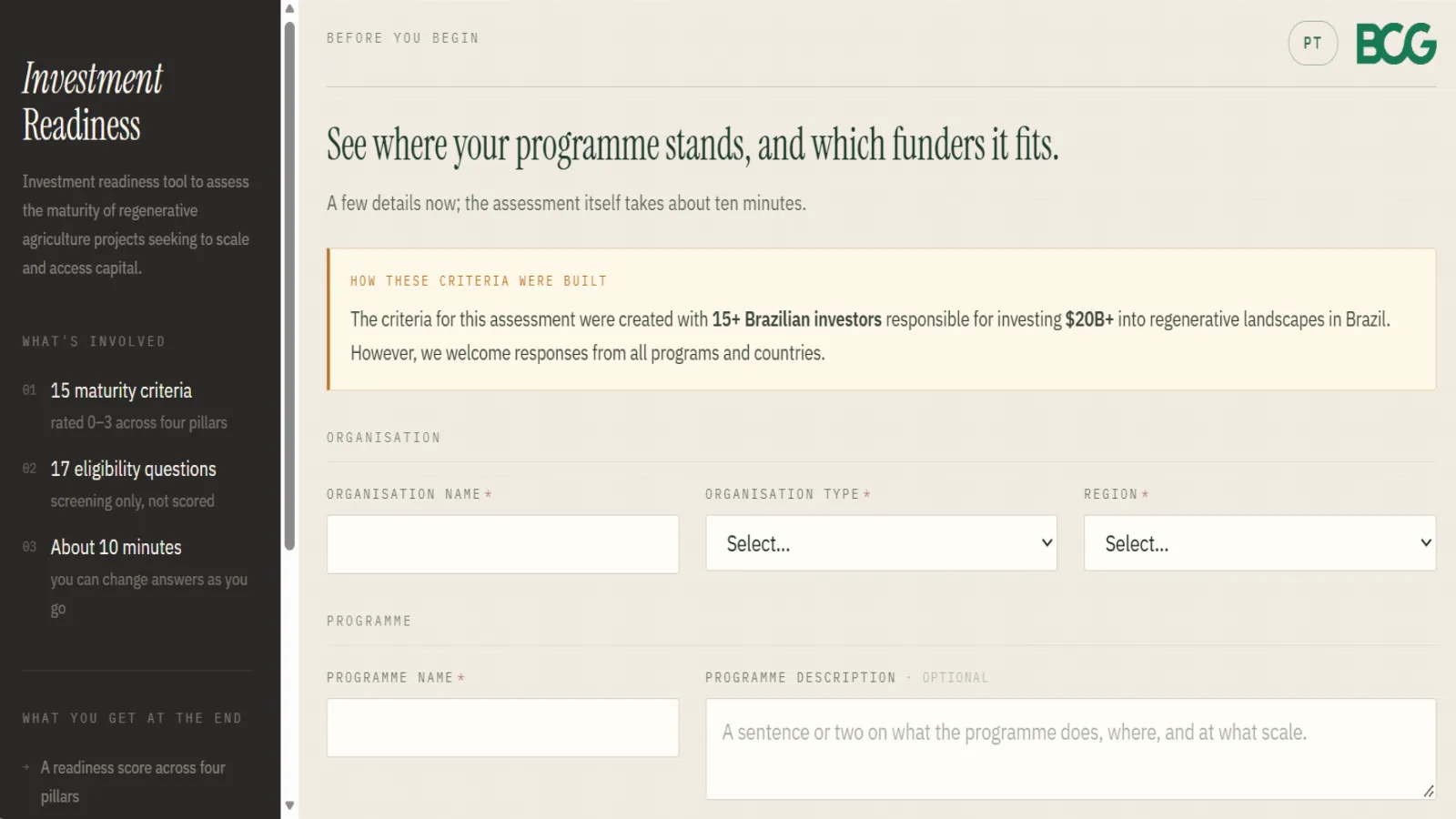
A gap separates wanting to co-invest from doing it. Programs still struggle to show finance teams what they are asking for and why the opportunity is investable. The Landscape Accelerator Brazil (LAB), a partnership of WBCSD, BCG and CEBDS under the AARL, set out to close that gap. Its answer is the Investment Readiness Tool, launched at Climate Week NYC.
Why good programs stall
Participants in New York described the gap in practical terms. There is still a disconnect between sustainability teams and CFOs. The financing ask is often too vague. Banks, meanwhile, frequently add a spread and require guarantees even when the money they lend is concessional.
LAB heard the same thing from its member companies. Corporates want to know which criteria investors use, where to focus when building a case, and which funders fit their project profile and maturity.
So, LAB worked from the other side of the table. It consulted more than 15 capital providers and four corporates, which together have mobilized over USD 20 billion in Brazil, and asked what it takes to get to yes. The tool is built on their answers.
The upside justifies the effort. BCG’s landscape studies for the Cerrado and Pará size the regenerative transition at roughly USD 93 billion, with an internal rate of return near 19% over ten years. The money and the market case exist; what programs lack is a format investors recognize.
How the tool works
For most corporate sponsors, the trigger is a question from the CEO or CFO: “Does this pay for itself? What does it cost per hectare, what does it return, and who finances the gap?” The tool structures the answer in four modules, each built around a question capital providers ask before committing.
1. How mature is the program? A self-assessment scores the program from 0 (non-existent) to 3 (at scale) on 15 criteria across four pillars: program design, economic proof-points, impact and monitoring, reporting and verification (MRV), and governance and operating model. Each level has a defined descriptor, which helps curb overly optimistic self-scoring.
2. Which funders are eligible? A 17-question checklist screens for biome, commodity, deforestation cut-off dates, land tenure, labor standards, signed off-take agreements and social inclusion. Several answers act as hard exclusion criteria. A ticket-size filter removes funders whose minimum investment does not match the capital sought. The result is how many of the 17 mapped funders remain eligible.
3. What type of capital fits? The score places the program on a financing curve: grants and technical assistance at an early stage, de-risking instruments and concessional capital at scale-up, commercial lending at scale. The diagnostic shows which criteria investors will weigh most heavily and what it takes to reach the next level on each.
4. Who to approach first? A matcher rates the fit with each facility as high, medium or low and flags unmet critical requirements. A searchable repository sets out each funder’s instruments and conditions.
The output is a readiness score, a prioritized list of gaps, a funder shortlist, and a clear view of what the program’s P&L still lacks, in place of a vague sense that more work is needed.
What New York added
The wider Climate Week conversations suggested the tool comes at the right moment. AARL survey respondents ranked shared MRV and traceability as their top unlock (62%), ahead of blended finance and guarantees (48%). Business wants common infrastructure before financial engineering, and a shared language between implementers and investors is part of that infrastructure.
Capital is also starting to move. Partners in Innovative Finance for the Amazon, Cerrado and Chaco (IFACC) reported about USD 1 billion disbursed across 20 financial products by the end of 2025. Investors in the AARL session described a “magic ratio”: a 10% corporate first-loss position can unlock up to nine times that amount in outside capital. Naturally, that only works if there are projects ready to receive it, as discussions suggested that the constraint is not a shortage of capital but a lack of investable, verifiable pipeline.
What comes next
The Investment Readiness Tool is a starting point. LAB is inviting user feedback as it builds a draft 2027 offer covering investment readiness, capital activation and matchmaking, MRV and policy traction, and an optional blended finance incubator.
The wider picture from New York is encouraging. AARL has moved from dialogue to place-based implementation through regional accelerators, from Brazil to India to Europe. What programs need is a shared language that helps them and funders meet halfway.
Back to the CEO’s question: “What does this do to our P&L, and who will finance it?” LAB members now have somewhere to begin. They can show where the program stands, what to fix first – starting with the farm-level P&L – and who to call. And the next time they sit across the table from a funder, they will know what they are looking for.
Outline