This impact story is part of a series featuring India Landscape Accelerator (ILA) member companies and their efforts to scale Climate-Smart agriculture (CSA) in Indian landscapes. The series highlights existing company-led initiatives, lessons for implementation, and opportunities for ILA to accelerate collective action.
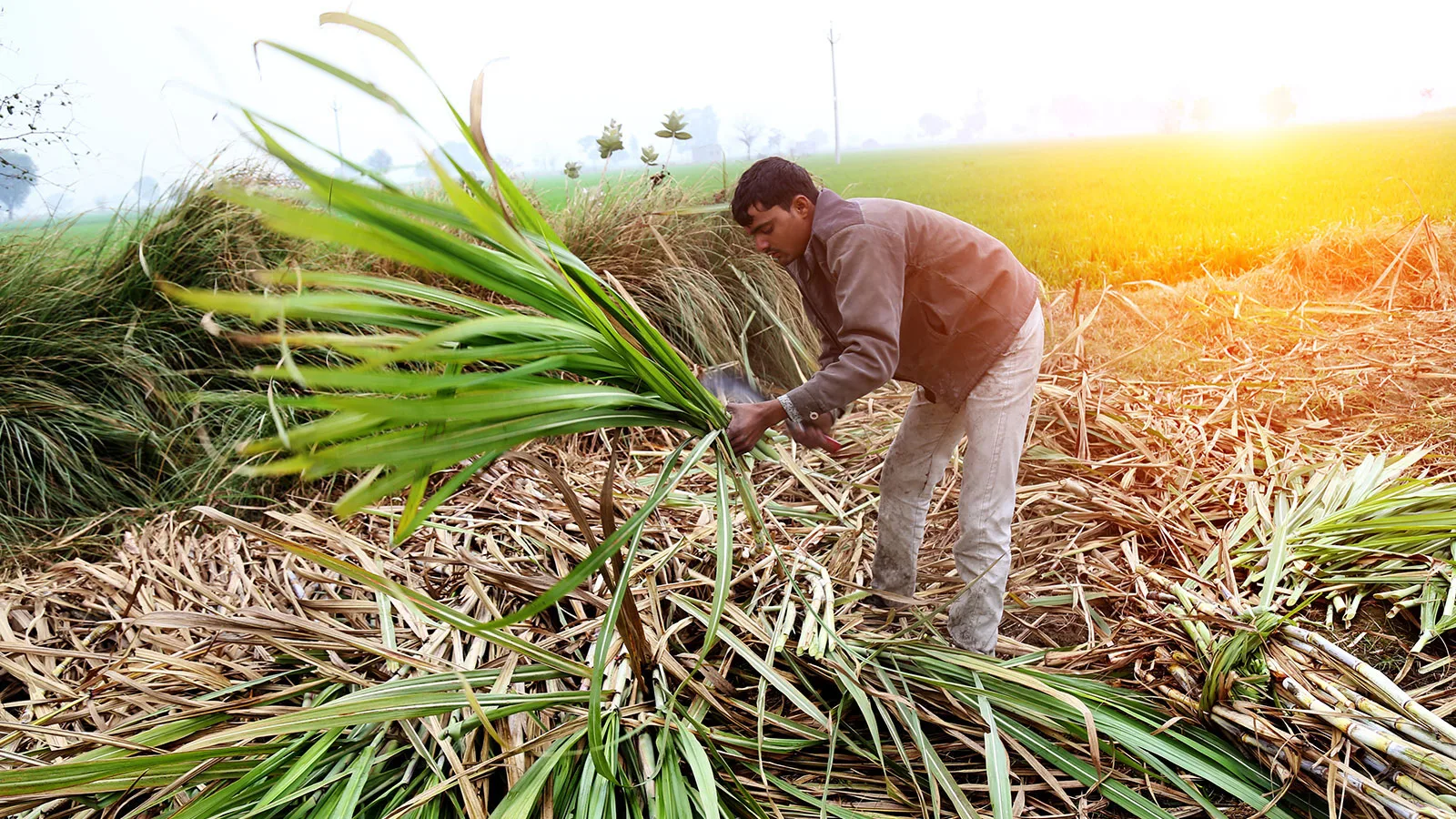
Sugarcane accounts for a disproportionately large share of India’s agricultural water footprint relative to the area it covers, with cultivation practices that traditionally rely on flood irrigation and intensive input use, placing pressure on both farmer profitability and local water resources. Recognizing these challenges, UPL Sustainable Agri Solutions (UPL SAS) has built its CSA strategy, treating the crop not as an isolated commodity but as a system to be redesigned in partnership with the farmers, mills, buyers and financiers across the value chain.
A value chain-led strategy across five pillars
UPL SAS has structured its India strategy around a value chain-led, systems-oriented model focused on sugarcane, rice and horticulture across Maharashtra, Uttar Pradesh, Karnataka and Andhra Pradesh. Rather than pursuing sustainability as a peripheral commitment, the company has structured its strategy around five interdependent pillars: water stewardship, climate mitigation, soil system regeneration, farmer resilience and livelihoods, and traceable deforestation-free supply chains.
Each pillar is paired with outcome-based, science-aligned targets framed explicitly in relation to regenerative agriculture principles, Scope 3 decarbonization and carbon market standards. Targets include, amongst others, a 25–40% reduction in water use, a 15–30% reduction in greenhouse gas emissions across priority crops, and a 10–20% increase in farmer incomes.
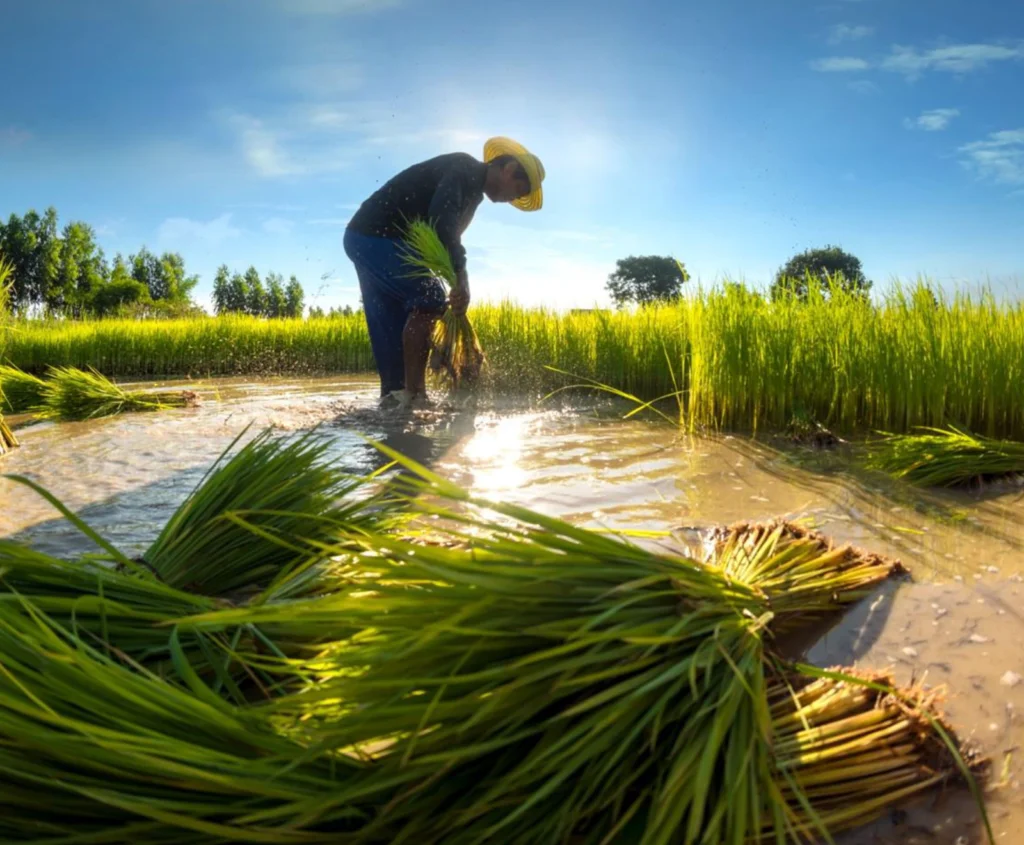
While this story focuses on sugarcane, UPL SAS applies similar climate-smart agriculture principles across other crop systems. Through its digital platform, nurture.farm, the company runs a Sustainable Rice Program that promotes direct-seeded rice (DSR) and alternate wetting and drying (AWD) to reduce water use and methane emissions. It has also implemented crop residue management solutions, developed with the Indian Agricultural Research Institute, that offer alternatives to crop stubble burning.
Shashwat Mithaas: Redesigning sugarcane production at landscape scale
Shashwat Mithaas, UPL SAS’s flagship sugarcane initiative, takes its name from the Hindi words for “sustainable” and “sweetness” and is built around a value chain-integrated model that brings farmers, sugar mills and downstream buyers into a coordinated system. The program aims to transition sugarcane cultivation toward lower emission, more water efficient and economically resilient sugarcane production across Maharashtra, Uttar Pradesh and Karnataka, with further expansion underway.
The program is supported by a digital backbone that enables traceability at both farm and mill levels. The company then layers in its ProNutiva approach to crop nutrition and protection, alongside regenerative practices such as soil moisture management and precision nutrient management, delivered through farmer training and demonstration plots.
Recognizing that transition can create financial risks for smallholders, the program also provides accidental and weather insurance and helps strengthen farmers’ market linkages. Together, and aligned with frameworks such as Verra and Bonsucro, these elements support adoption while helping meet the sourcing requirements of buyers.
On the ground, measurable results point to the potential of the program model. Participating farmers have seen improved water-use efficiency, particularly in water-stressed regions, alongside a 20–30% improvement in nutrient-use efficiency. Soil structure and moisture retention have also improved, supporting climate resilience while yields have held stable or increased. Partnerships with mills and value chain actors, including Olam Agri in Maharashtra and NSL Sugars, have provided the aggregation capacity needed to support farmer adoption at scale.
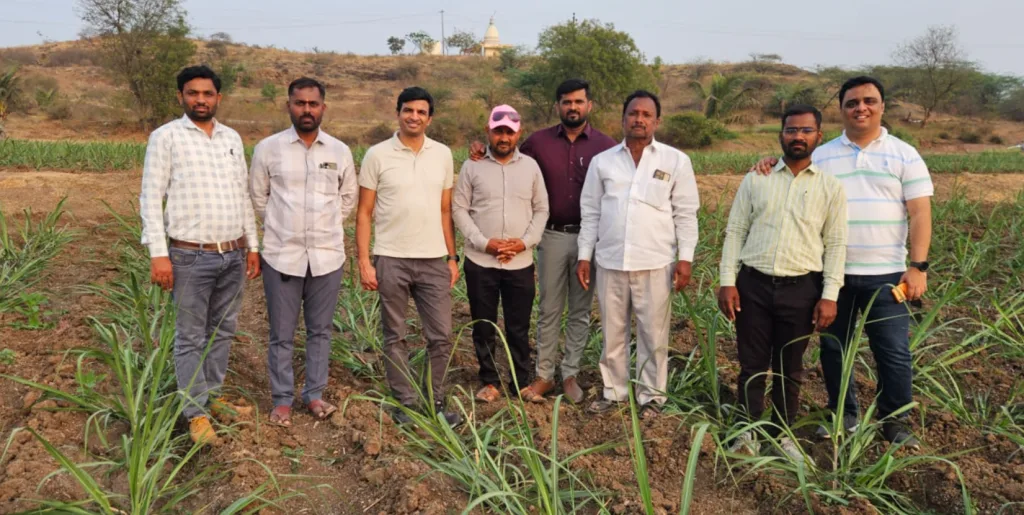
Field visit to a sugarcane farm in Maharashtra, highlighting farmer engagement, digital advisory tools and climate-smart agriculture practices supported by UPL SAS (image credit: WBCSD/D Aiama).
Insights from the field
During a field visit to a sugarcane production landscape in Maharashtra organized by UPL SAS, WBCSD observed firsthand how the company’s approach is being applied at farm-level. Discussions with farmers and local distributors highlighted the strong relationships supporting adoption, while demonstrations of the nurture.farm mobile application showed how digital tools are being used to access farm-level information and support decision-making. Farmers also pointed to tangible productivity and cost-saving benefits from the solutions being promoted, underscoring the importance of combining environmental outcomes with a clear economic case for adoption.
The company also recognizes the barriers that continue to constrain scaling. Entrenched flood irrigation practices and delayed behavior change, limited farmer awareness of the long-term value of soil health, the absence of financial premiums tied to sustainable practice, and the cost and complexity of MRV systems all remain key obstacles — compounded by uneven capacity across mill partners. UPL SAS frames these as system-level constraints that require shared solutions beyond any single company program.
The company also recognizes the barriers that continue to constrain scaling. Entrenched flood irrigation practices and delayed behavior change, limited farmer awareness of the long-term value of soil health, the absence of financial premiums tied to sustainable practice, and the cost and complexity of MRV systems all remain key obstacles — compounded by uneven capacity across mill partners. UPL SAS frames these as system-level constraints that require shared solutions beyond any single company program.
The case for a shared platform
This is where UPL SAS sees value in ILA. The company points to the need for standardized and interoperable MRV frameworks, blended finance mechanisms that de-risk farmer transitions, and coordinated action across companies, government, NGOs and financiers as the collaborative infrastructure still missing from India’s CSA landscape. As Harshal Pratap Sonawane, Head of Sustainability at UPL SAS, frames it:
UPL SAS is committed to supporting ILA as a high-impact platform to scale climate-smart agriculture in India, combining global ambition with local execution capability.
Within ILA’s platform, UPL SAS sees a key role in contributing implementation and innovation capacity through its farmer networks and mill partnerships, sharing integrated solutions that combine products, advisory, and sustainability frameworks, and supporting the development and validation of shared methodologies.
Shashwat Mithaas demonstrates how a value chain-integrated model can deliver measurable environmental and economic outcomes within sugarcane production landscapes. Through ILA, the opportunity is to translate those lessons into shared infrastructure that other actors, crops and geographies can build upon, rather than each actor having to develop solutions independently.
Outline