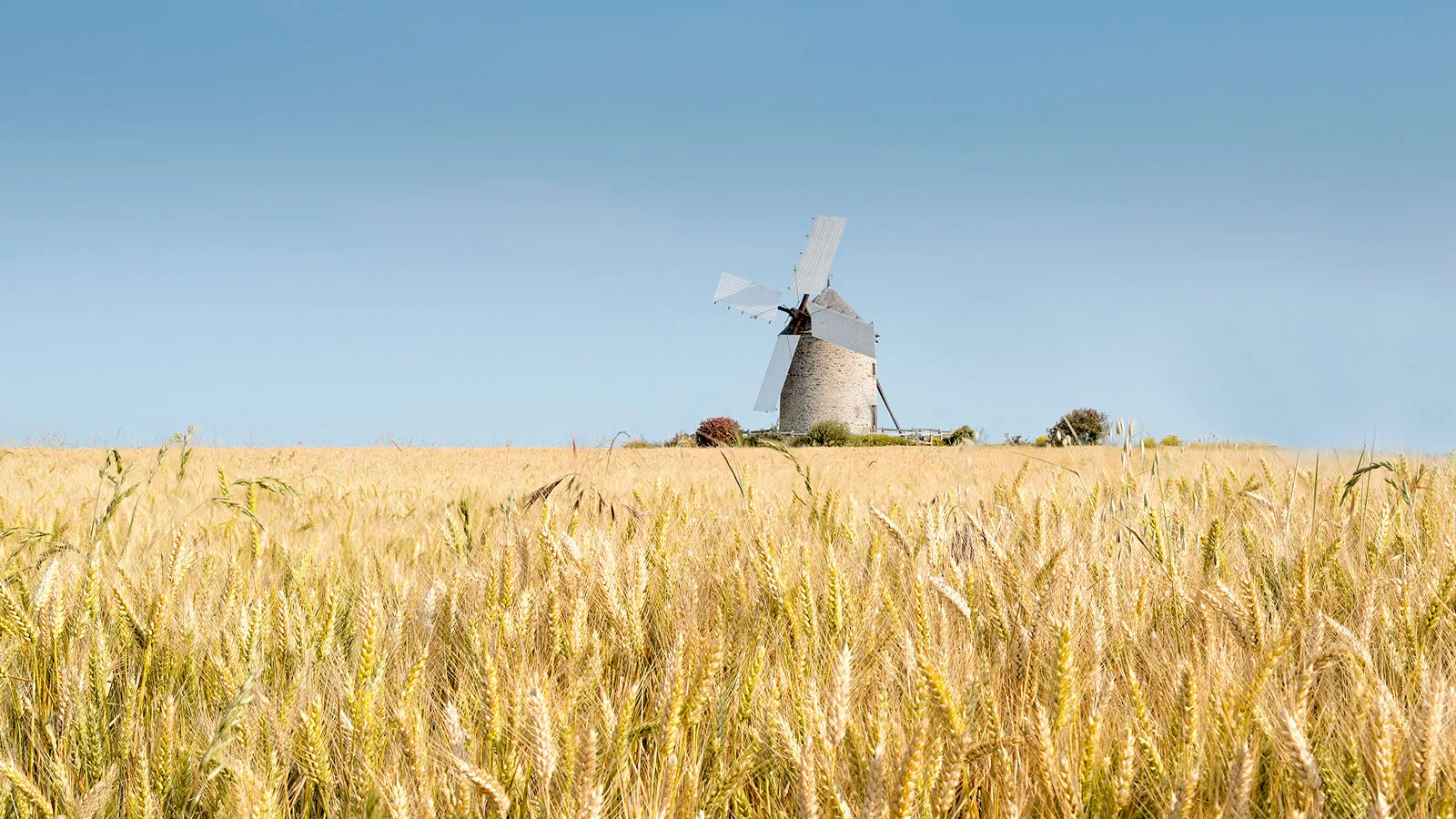
This summer, successive heatwaves and severe droughts across Europe delivered another stark warning to the global food system. From scorched arable land in Spain to historic crop shortfalls in France and Italy, climate volatility is no longer a future projection but an active supply chain disruption1. These extremes are compounded by a deeper, quiet crisis: over 60% of European Union soils are currently unhealthy, costing the Union €50 billion2 annually in degradation and €28.3 billion3 in annual yield losses. For agri-food value chains, investing in soil health is no longer an optional sustainability target; it is an operational necessity to mitigate physical risk and secure future sourcing. Regenerative practices, which improve water retention, temper extreme soil temperatures and stabilise yields4, are the primary mechanism to protect agricultural supply chains from mounting systemic pressure. In Europe, pioneer regenerative farms achieved 20% higher gross margins per hectare while using 61% less synthetic fertilizer and 75% less pesticides5. Yet only an estimated 15%6 of European cropland is currently managed under regenerative practices.
The OP2B Regeneration Map: a living tool for collective action
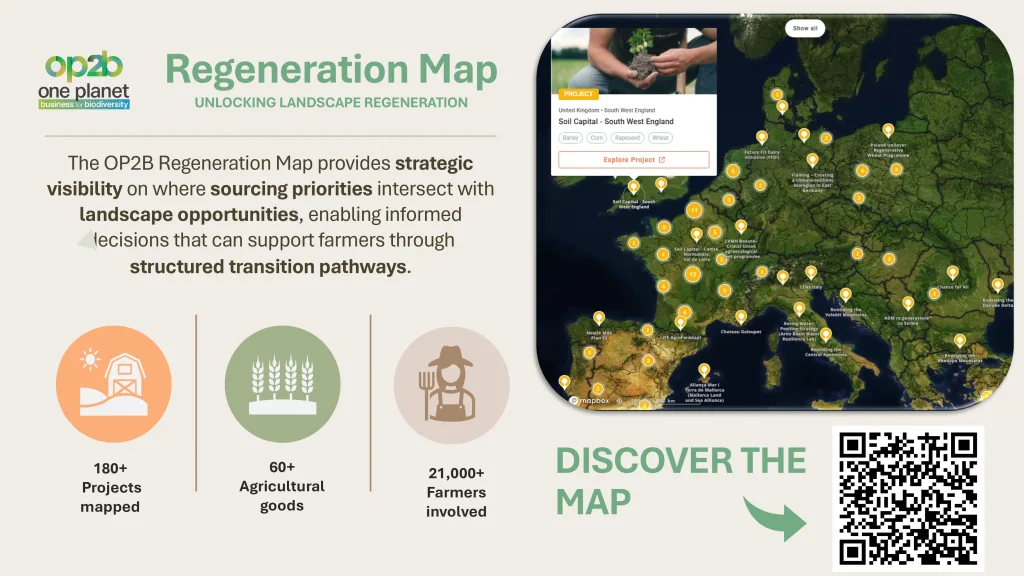
To scale these practices and build a collective movement, One Planet Business for Biodiversity (OP2B), a cross-sector coalition of leading companies across the agricultural value chain, launched the Regeneration Map in April 2026. The platform tackles project fragmentation by making investable opportunities for regeneration, conservation, and restoration visible and accessible.
The scale of the challenge is significant. According to the Sustainable Markets Initiative, keeping global warming aligned with a 1.5°C pathway would require regenerative agriculture to expand to approximately 40% of global cropland by 2030. At that scale, regenerative farming could avoid or remove around 600 million tonnes of emissions. Applied proportionately to Europe, this would correspond to approximately 40 million hectares of farmland transitioning to regenerative practices by 2030.7 The Regeneration Map is intended to help make this transition more actionable, by bringing together projects, partners and data in a shared European view.
The map is a dynamic, living tool built with more than ten implementation partners, including Landscape Enterprise Networks, SAI Platform, EIT Food, Rewilding Europe, Soil Capital and Earthworm Foundation, who supply project data on project financing, practices and outcomes.
Six months after the launch, it features over 180 projects across Europe, including 156 dedicated regenerative agriculture initiatives. Together, these projects support over 21,000 farmers and span 1.3 million hectares. This expansion showcases both new projects and improved disclosure. Crucially, 62% of the regenerative projects disclose what environmental and social outcomes they monitor. This gives companies and other value-chain actors decision-useful data on project scale, active partners and verification (MRV) systems, and establishes a baseline against which resilience and supply security can be measured.
Bridging the sourcing-to-soil gap and co-investing in white spaces
Europe faces a major transition funding shortfall: for arable land, only an estimated 2% to 6%8 of the capital needed for conversion to regenerative agriculture is currently in place.
The Regeneration Map gives teams visibility over where sourcing prioritiesintersect with landscape opportunities, enabling informed decisions that can support farmers through structured transition pathways, whereby full crop rotations are supported by value chain commitments. Its filterable datasets help users identify relevant initiatives, practices and investment models.
At the same time, it highlights geographic white spaces, regions where agricultural production faces climate and nature risks but no collaborative framework yet exists. OP2B offers businesses a pre-competitive platform to identify collaborative solutions that can help tackle shared environmental challenges in these white spaces, at landscape scale.
OP2B is also advancing landscape-scale financing models. In the East of England, for example, OP2B and EIT Food are implementing a farmer-centred blended-finance pilot to support the transition to regenerative agriculture at regional scale, with a view to replication across Europe.
The platform is open to all value-chain actors, members and non-members alike. To turn intent into action, OP2B offers custom analyses that highlight how active field initiatives can support corporate climate and nature ambitions by highlighting where investable landscape opportunities lie.
For Diageo, tools like this help us identify where collaboration can strengthen resilient agricultural landscapes, support our supply chains, and maximise the impact of collective investment in regenerative agriculture.
– Ewan Andrew, Chief Sustainability Officer, Diageo
Aligning private and public land-based investment priorities
OP2B developed the Regeneration Map as a dedicated, private sector-focused platform specifically to enable corporate investments in land. At the same time, several global initiatives (led by bodies like the UNCCD, FAO, and RAIZ) are developing evidence-based targeting tools to direct public-private sector land investments where they are most urgently needed. WBCSD and OP2B are actively engaging with them to ensure that these emerging tools can effectively enable public-private collaboration.
Ultimately, this macro-level targeting ensures that corporate investments are directed exactly where they will generate the highest ecological, social, and operational returns.
The path forward: enabling action across value chains
Building a climate-resilient supply base requires action across agricultural value chains. OP2B is continuing to refine the Regeneration Map as a platform that can help unlock private-sector and public-private investment in regenerative agriculture, conservation and restoration, supporting landscape resilience across Europe.
In the coming months, the coalition will focus on two priorities:
- Strengthening MRV alignment and project transparency: convening members and partners to share learning across priority geographies and crops and monitoring, reporting and verification (MRV) approaches. As this work develops, OP2B will explore ways to harmonize project-level information (including different levels of maturity, performance and verification) so that it can be decision-useful for a range of investor types.
- Landscape collaboration support: helping structure pre-competitive cooperation in agricultural zones under high environmental and climatic pressures to establish viable, long-term pathways to resilience
Securing the future of European food production has become urgent, and no company can achieve it alone. Every business with an agricultural sourcing footprint in Europe is invited to join.
OP2B will also continue to update and expand the Map’s project portfolio, drawing on feedback from users to ensure that information remains current, transparent and accessible to all actors. To add your regenerative agriculture projects data to the map, receive a demo, and explore partnership opportunities, contact Martina Asquini, Senior Associate, OP2B and Agriculture and Food, at asquini@wbcsd.org.
Footnotes
- Jon Henley, Angela Giuffrida and Stephen Burgen, “European farmers face ‘unprecedented crisis’ after successive heatwaves”, The Guardian, 17 August 2026. ↩︎
- One Planet Business for Biodiversity (OP2B), OP2B Regeneration Map, WBCSD, 2026. ↩︎
- European Investment Bank and European Commission, Investing in a Climate-Resilient Agricultural Sector in Europe (analysis prepared by Howden), 2025. ↩︎
- Soil Capital, Drought Resilience – Farming, Risk and Measurable Outcomes, 2 June 2026. ↩︎
- European Alliance for Regenerative Agriculture (EARA), Farmer-led Research on Europe’s Full Productivity, 2025. ↩︎
- One Planet Business for Biodiversity (OP2B), OP2B Regeneration Map, WBCSD, 2026. ↩︎
- Sustainable Markets Initiative Agribusiness Task Force, Scaling Regenerative Farming: An Action Plan (2022), as cited in Climate Asset Management, Scaling Regenerative Agriculture (June 2023) ↩︎
- WBCSD, Deloitte, PepsiCo and Unilever, Closing the Gap: An analysis of the costs and incentives for regenerative agriculture in Europe, 2025. ↩︎
Outline
Related
Content
Press release: OP2B and EIT Food collaborate on a farmer-centered regional finance pilot for scaling regenerative agriculture across Europe
16 July, 2026
OP2B Recommendations on scaling the agricultural transition through CRCF
16 June, 2026
OP2B Reinforces mission with strategic leadership appointments amid Europe’s agricultural turning point
5 December, 2025