Freshwater Accountability Navigator (FAN)
“Water is humanity’s lifeblood, from the food we eat, to the ecosystems and biodiversity that enrich our world, to the prosperity that sustains nations, to the economic engines of agriculture, manufacturing and energy generation to our health, hygiene and survival itself.” – UN Secretary-General António Guterres’ remarks to the United Nations Water Conference, March 2023
Freshwater accountability: key challenges and business opportunities
The need for companies to urgently address their water dependencies and impacts is clear. More than 50% of major listed companies are exposed to medium to high water stress, across their value chains. The effects of water stress can materialize into direct business impacts including production barriers; supply chain disruptions; reputational consequences – contributing to increased costs and threats to business continuity and resilience. Companies that prioritize water stewardship will increase the resilience of their value chains in the face of climate change, nature loss and other global disruptions, in turn contributing to global water security and accelerating progress on environmental and social goals. CDP reports that businesses that integrate water into long-term business and financial planning realize four times more water-related benefits and opportunities than those that do not.
Freshwater holds the key to achieving Vision 2050 – a world in which more than 9 billion people can live well, within planetary boundaries.
Water stewardship and sustainable water management allow populations to thrive, companies to succeed and ecosystems to provide essential services for society. The Planetary Boundaries framework used to describe the limits within which humanity can continue to prosper, shows that thresholds on freshwater use, climate, and land system change have been surpassed and pose increasing risk and uncertainty to humanity as well as dramatic changes in the global water cycle. These risks include declining levels of aquifers, pollution of groundwater, vulnerability to flooding, and sea level rise – posing a threat to ecosystems and ecosystems services globally. Regulatory and voluntary efforts (see Box 1), are underway but significant effort needs to be made to respond to these fully and take urgently needed action on water at the scale required.
Corporate action on water currently lags significantly in proportion to the scale of the challenge. One of the main reasons is the lack of a global binding regulatory framework on water, similar to the United Nations Framework Convention on Climate Change (UNFCCC). In the absence of a global framework on water, many national water-related regulations (local accountability mechanisms) can be weak, whilst companies have been expected to take ambitious voluntary action to manage their water dependencies and impacts effectively. In response, not-for-profit organizations have addressed this gap with voluntary tools and frameworks. These tools have helped companies all around the world take concrete action to tackle water risks and opportunities and implement best practices in sustainable water resource management. However, over time, the number of tools available has proliferated, and many companies are confused as to what tools and frameworks exist, what they enable, how they differ, which are most relevant to their business and therefore, which to prioritize. As a result, corporate accountability and action on water lacks alignment and transparency, and the application of leading practices is limited to a small number of companies.
WBCSD’s Freshwater Accountability Navigator (FAN) seeks to address this by helping companies to navigate the most commonly-used Freshwater Accountability tools and frameworks. It provides overviews of 20 tools and frameworks, including a description of what each tool or framework is designed to do, how it should be used, and what the expected outputs are. In addition, it categorizes the tools and frameworks in line with the widely-adopted High-level Actions on Nature (ACT-D).
Box 1: Framing water in the wider context of nature
“Nature comprises all non-human living entities and their interaction with other living or non-living physical entities and processes.” – SBTN Initial Guidance, based on IPBES Global Assessment, 2019
This definition emphasizes instrumental value of nature in providing resources that every living being needs to survive, thrive and prosper, and the services that society and the economy rely on for prosperity and wellbeing. It also recognizes that land, ocean, freshwater and atmosphere and the variety of life on Earth – biodiversity, a subset of nature that reflects the health and resilience of Earth’s systems – are all part of “nature” more broadly. Therefore, when we talk about acting for nature, we are talking about acting on issues related to climate change and equity as well.
In recent years, stakeholders from public, private and civil society sectors have made important calls for the protection of the world’s natural systems and the preservation of biodiversity. The Kunming-Montreal Global Biodiversity Framework (GBF), signed in 2022, is a landmark global agreement: through its adoption, 196 governments committed to put measures in place to halt and reverse nature loss, including placing 30 per cent of the planet and 30 per cent of degraded ecosystems under protection by 2030. Mandatory requirements are of immediate relevance to companies, such as the Corporate Sustainability Reporting Directive (CSRD), which will require large and listed companies operating in the European Union to publish regular reports on the social and environmental risks they face and on how their activities impact people and the environment. On the voluntary side, in 2023 the Science Based Target Network (SBTN) released an initial set of science-based targets for nature (including freshwater) and the Taskforce on Nature-related Financial Disclosures (TNFD) launched v1.0 recommendations for nature-related financial disclosures.
In addition, the United Nations Sustainable Development Goals (SDGs) lay out the world’s objectives on social and economic development while protecting the Earth’s resources. SDG 6 specifically focuses on water and lays out expectations for governments and other stakeholders to achieve full access to water and sanitation for all, promote good water governance, and protect vital water resources, among others.
Amid these international policy commitments, the private sector is also mobilizing. Supported by WBCSD, the Business for Nature coalition is calling for companies to integrate nature into corporate strategies through the “It’s Now for Nature” campaign. Momentum is building on the water agenda as well: business leaders made an open call to accelerate action on water at the 2023 UN Water Conference, the first such conference since 1977.
Water plays a crucial role in an effort to accelerate progress towards nature goals and commitments. Without water, essential ecosystems services cannot survive. By integrating water into business decision-making and overall strategic approach on nature, companies can actively contribute to the global ambition to halt and reverse biodiversity loss by 2030. WBCSD’s Roadmaps to Nature Positive outline the foundations for accelerating ambition and taking credible impactful action on nature, with step-by-step guidance for all businesses and high-impact sectors.
Introducing the Freshwater Accountability Navigator
The Freshwater Accountability Navigator (FAN), is a publicly available, streamlined and interactive guide designed to help businesses understand, and engage with, key tools and frameworks that support: the assessing of water-related impacts and dependencies; setting water targets; taking transformative action; and, disclosing water-related information.
The FAN summarizes key water-related tools and frameworks and helps sustainability professionals to identify which to use depending on their current level of water maturity and data readiness. It aims to provide clear guidance on what is expected of companies on their freshwater journey and improve companies’ use and management of freshwater resources. Additionally, where relevant, the FAN provides clarification on the data requirements of each tool or framework.
The FAN brings together tools and frameworks that address the following questions that companies face:
- How to assess a company’s water-related impacts and dependencies? Refer to Box 2 for distinction between impacts and dependencies.
- What process to follow to develop credible water-related targets?
- How to account for progress against targets?
- How to disclose and communicate water-related actions?
The FAN helps companies explore existing tools and frameworks – it does not introduce new content, nor does it recommend one tool/framework over another – this is the user’s responsibility.
The FAN was developed with the help of Quantis, a leading technical service-provider, and in collaboration with WBCSD members taking part in our Water Stewardship workstream within our Nature Action Imperative. An advisory panel was set up to provide oversight and guidance (see Acknowledgments). Together, we worked to select the tools and frameworks that are included in the FAN, guided by the following criteria:
Tool/Framework is actionable;
- The Tool/Framework l can be acted upon, i.e. the outputs can directly inform/be implemented in companies’ decision-making, governance, risk management, monitoring and tracking processing
- The Tool/Framework comes with clear data requirements
- The Tool/Framework provides clear guidelines on what a company should/shall do and how it can then be used
- The Tool/Framework addresses one or several of the FAN’s four question areas (see above)
- The Tool/Framework supports activity corresponding to one of the areas detailed by the ACT-D high-level actions for business.
The Tool/Framework provides a clear methodology;
- The Tool/Framework comes with an existing and applicable methodology (vs. a descriptive report or high level principles)
- The methodology is disclosed with a reasonable level of transparency
- The methodology is understandable and applicable for companies: clear guidelines, steps, clear results, etc.
The Tool/Framework has been peer-reviewed;
- The Tool/Framework has been externally reviewed by a third-party, external to the main contributor/initiator/developer.
Water-related regulatory frameworks are not included in the scope of the FAN, given that these are continuously evolving, although Box 7 provides an overview of key regulatory frameworks to be aware of. Owners of tools and frameworks covered by the FAN have been consulted and given an opportunity to review or make suggestions on their respective sections and their feedback has been integrated. It is the intention that the content of the FAN will be revised regularly, in line with the update of current tools and frameworks, or the release of new and relevant resources (Submission form).
By using the FAN’s Navigation Tree, companies will understand where to get started on their water journey, depending on their level of maturity. Additionally, the FAN helps companies understand where the latest and most relevant water-related tools and frameworks sit in the current water stewardship landscape, and how to use these tools and framework to most effectively assess water-related impacts, develop targets, implement appropriate actions, and disclose progress to drive positive impact.
The FAN is suitable both for companies that are starting their water journey, and for more mature companies that want to ensure that they are taking action in line with the latest and most advanced methodologies, frameworks and tools. It encourages a pragmatic approach for companies that are starting their water stewardship journey. Most companies will already collect some data related to their freshwater water impacts and dependencies. Companies should start with what they have rather than waiting to have the complete “perfect” data, even in the areas where they do not have a lot of water-related information available. The FAN is written with a non-technical audience in mind, for sustainability managers who already have basic knowledge on water, although having technical support by specialist entities will be helpful in making full use of it.
Having engaged with the FAN, sustainability professionals will build up both knowledge and awareness of latest relevant water-related frameworks and tools. In collaboration with technical experts, they will be aware of their company’s level of maturity on water and in a position to apply the most relevant water-related frameworks and tools as the company advances on its water journey.
See more
On the other hand, not acting on water poses important systemic risks for society and for the global economy. For example, an assessment of private sector impacts on water conducted by Ceres in 2022 revealed that the food products, textiles, and high tech and electronics sector are among the biggest contributors to groundwater depletion, metals contamination, plastic pollution, diversion and transfer of water, and eutrophication. The effects from these environmental impacts are disturbing global freshwater systems that are essential to economic, environmental and societal stability. The resources that these key industries deplete are the same resources they depend upon, leading companies to face high physical and financial risks. Additional concerns are around the low cost of water seen globally, however this is predicted to change, within increasing costs linked to increasing scarcity of water resources, resulting in broader systemic risks to the global economy and to investment portfolios. In short, being a responsible water steward is not only a matter of protecting the natural world but also of ensuring business continuity. Communicating such systemic risks, specific to the company’s sector or geography, is strongly encouraged when making the internal business case for water.
It is crucial to make internal decision-makers aware of the increased public scrutiny of corporate water stewardship actions globally. As laid out in Element 4:Disclose, existing and emerging disclosure frameworks require companies to be transparent in communicating their water-related actions and ambitions, and increasingly, regulatory frameworks require companies to publicly disclose such information on an annual basis. In 2022, over 8000 companies were requested to disclose through CDP’s Water Security questionnaire. Individual company scores are publicly accessible through the CDP website and shared with investors. Additionally, the Corporate Expectations for Valuing Water is being deployed as a tool for investors to engage with their investees on valuing water and responsible water stewardship. Disclosure is an implicit requirement for meeting all of the corporate expectations, underlining the important role of disclosure frameworks in helping companies to demonstrate how they assess, manage and respond to water-related risks.
The information collected in Element 1:Assess will help in building a case for systemic risks linked to water and aiding in public disclosures. For example, conducting a water footprint helps to reveal which sections of the value chain have the highest impacts and dependencies on water and aids in prioritizing where action is most needed, i.e. evaluating raw materials sourcing. Similarly, conducting a water risk assessment on priority sections within a value chain provides insight into high-risk locations, products and sourcing, and helps corporate make the case for action. Using these insights to steer water-related investments where change is most needed and where the return-on-investment is therefore the highest, will ensure that resources are used in an efficient and impactful manner. In addition, a cost-benefit analysis of not taking action over a defined period could be presented to management to support your business case. The analysis done using the Water Risk Monetizer within the Smart Water Navigator can be helpful in providing company-specific data to such an exercise. To find sector-specific information, Ceres and the Valuing Water Initiative’s sector-specific materiality briefs are helpful resources to complement internal cost-benefit analyses.
Box 2: Water impacts and dependencies
A company’s relationship with water can be categorized into its impacts and its dependencies on water.
Companies have an impact on water through their activities along their value chains, and these materialize as influence on the availability or quality of freshwater. Such examples include, water withdrawal from local water sources which can lead to their depletion, subsequently the purchase of products from manufacturing sites where their discharge wastewater contain harmful chemicals – both examples can have a negative impact. Ceres’ (2022) report on Global Assessment of Private Sector Impacts on Water, reveals how industry practices are driving five critical threats to global freshwater systems.
Companies depend on water to produce goods and services. These dependencies are present in production (in product manufacturing or as an input for purchased goods), in product use (where water is needed to use the product), or through the electricity a company uses (through the production of e.g. hydropower).
In the FAN, a company’s impacts and dependencies on freshwater are grouped into three distinct water impact and dependency categories:
- Water quantity (e.g., water scarcity, occurrence of severe weather events);
- Water quality (e.g., declining water quality in water basins surrounding a company’s operations / suppliers); and
- Access to water, sanitation, and hygiene (WASH) (i.e., to what extent company employees and surrounding local populations have access to WASH).
How to use and get started with the FAN
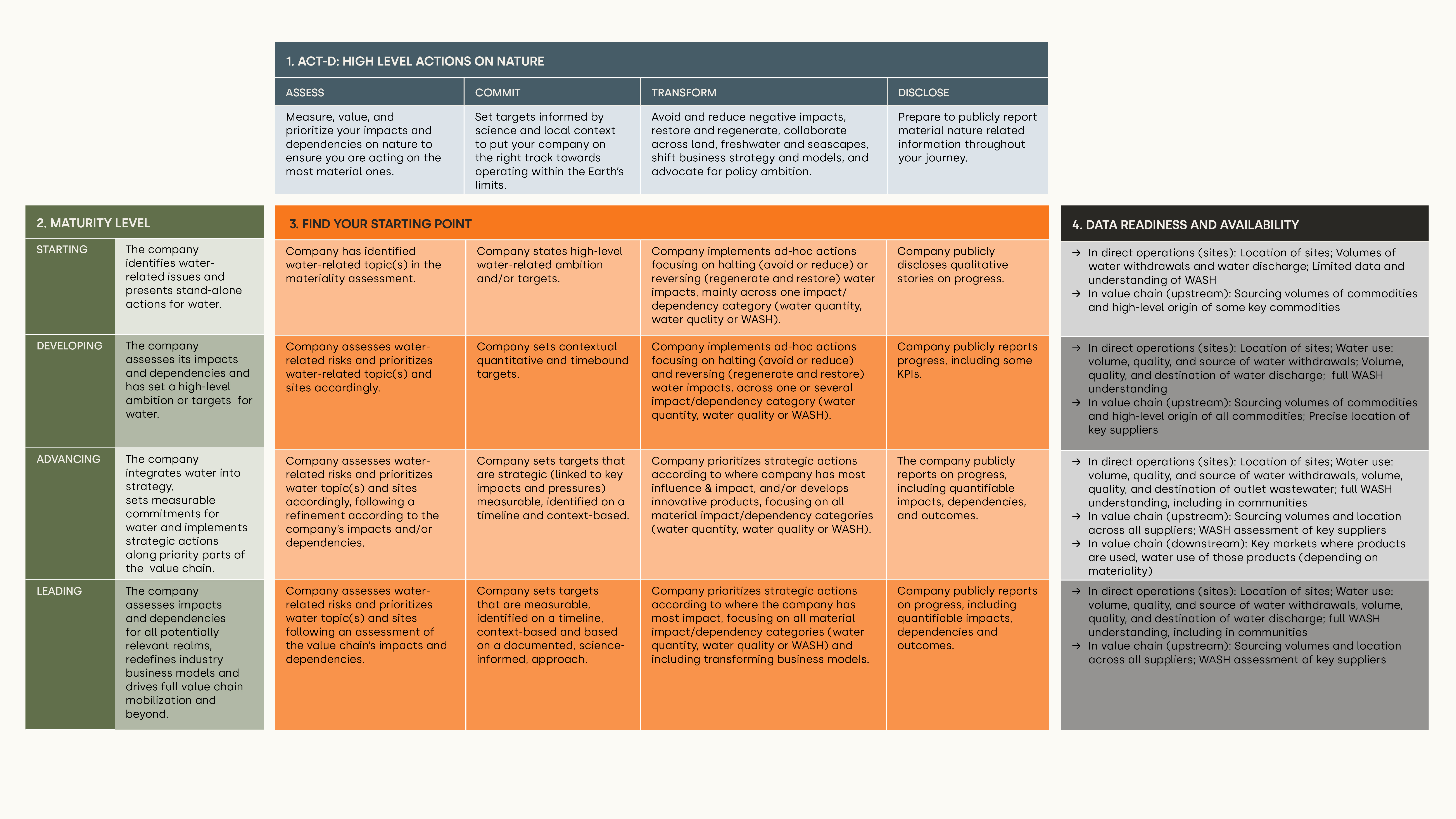
Before getting started with the FAN, an important first step is to reflect on the company’s water stewardship maturity level, as this will help to define which tools and frameworks to apply. The Freshwater Accountability Navigator – Navigation Tree has been designed to help with this task and is based on WBCSD’s four maturity levels on nature action, as defined in WBCSD’s Roadmaps to Nature Positive – Foundations for Business (see Annex 3, p.47). Across the ACT-D elements, we have outlined the actions that companies are taking at four levels of maturity: Starting, Developing, Advancing, and Leading. The FAN adapts these maturity levels to make them specific to water stewardship.
The FAN Navigation Tree will support companies in determining their objectives and help to guide users through the content of the FAN, by self-assessing their level of maturity on water-related topics linked to the following criteria:
- Identification of water-related issue related to the company and/or industry
- Current implementation of water-related actions
- Current undertaking of collective actions
- Level of disclosure
- Data readiness.
Where a company places itself on these maturity levels will determine where a company should focus first. In addition, using the Navigation Tree will also help companies: identify knowledge and data gaps; aide the setting of realistic targets, and chart a phased roadmap approach on closing any identified gaps.
For companies that identify themselves in the ‘starting’ maturity level, it is important to note that action can be taken well in advance of complete or “perfect” data being available. Even though more granular data can provide better insights and drive more targeted action, companies can start with existing and incomplete data, and complement it with credible data points from existing databases (a list of credible databases is outlined in Annex A). Companies should gradually work towards more detailed data collection and analysis as their maturity advances. The key is to strike a balance between using the best available information and continuously improving the quality and granularity of data to drive better outcomes.
Companies that want to understand, beyond water, how advanced they are on each of the ACT-D elements and gain insights on how to progress the business approach to align with emerging nature-related standards and frameworks should refer to WBCSD’s Roadmaps to Nature Positive.
ACT-D Framework
The ACT-D Framework was developed by WBCSD, Capitals Coalition, Science Based Targets Network (SBTN), the Taskforce on Nature-related Financial Disclosures (TNFD), the World Economic Forum, WWF and Business for Nature. It outlines the high-level actions that companies should take to halt and reverse nature loss and support companies in deepening their engagement with nature-related standards and frameworks.
The ACT-D Framework outlines the High-level Business Actions on Nature
- Assess: measure, value and prioritize impacts and dependencies on nature, both within direct operations and priority parts of the value chain, both up and downstream.
- Commit: set transparent, time-bound, specific, science-based targets (i.e., based on local limits).
- Transform: avoid and reduce negative impacts, restore and regenerate, collaborate across landscapes and seascapes, shift business strategy and models, and advocate for policy ambition.
- Disclose: track performance and prepare to publicly report material nature related information throughout the journey (aiming to track performance across all actions and publicly (and verifiably) report on all disclosure requirements).
Moving through the ACT-D elements should be considered as a continuous, cyclical process that is revisited regularly, rather than being a linear process that has defined start and end points.
Structure of the FAN
The ACT-D framework and the nature maturity levels have been used as a basis for the overall structure of the FAN, tools and frameworks are organized by the most relevant ACT-D element. Note some tools and frameworks may be applicable to more than one ACT-D element. For example, the same tool or framework could be suitable for assessing impacts and dependencies (Assess element) and setting targets (Commit element).
A water stewardship journey in line with ACT-D, will not, and does not need to look the same for all companies. Applying the relevant tools and frameworks outlined in the FAN will help ensure that a company’s water stewardship actions are credible and in line with stakeholder expectations.
Each tool and framework is categorized into the most appropriate ACT-D element visible in the FAN Navigation Tree results, and an overview of each is provided summarized into the outlined sub-sections (see Table 1). The self-assessment results will provide a condensed list of tools and frameworks that are relevant to the selected ACT-D element a company wishes to address and the maturity level on that element.
To help users understand the content in the FAN, a list of key definitions has been included in the additional resources section.
Table 1: sub-sections and their descriptions – used to summarize each framework and tool
| Sub-section | Description |
|---|---|
| Introduction | What is it, what areas of company activity does it cover, what does it allow the company to do, what guidance is it similar / related to, is external support required to implement it. |
| How to use | What steps need to be undertaken, how should the company get organized to use the tool/framework, what needs to be prepared in advance of its use. |
| When to use | At which stage of the water journey should the tool/framework be used, what benefits can it bring, does it relate to mandatory disclosures or not. |
| Data requirements | What type of data is needed, are data requirements aligned with other frameworks (when relevant). |
| Expected outputs | Outline of outputs that the company will get from using the framework, type and format of the final outputs. |
ACT-D Framework
Assess
Box 3: Getting a company’s ‘own house in order’ through the 5Rs (reduce, reuse, recycle, restore, replenish)
It is crucial to assess where a company’s water-related impacts and dependencies are the highest across its value chain, and to drive action in those prioritized locations. Nevertheless, companies are always advised to continuously improve their direct operations, given that these sites are part of their direct sphere of influence. Getting a company’s own ‘house in order’ is essential to becoming responsible water stewards.
The concept of circular water management and the ‘5Rs’ (reduce, reuse, recycle, restore and replenish water as much as possible within the company’s operations) should be used a guiding principle in this process, meaning. Today, there is a multitude of ways to apply technology and nature-based solutions to implement these principles, with entire factories that are entirely self-sufficient on water due to water reuse applications. Some examples of 5R applications can be found in Annex B, and more information on circular water management can be found in the Business Guide to Circular Water Management. Guidance on how to measure impact and performance of such circular practices are available in the publication Circular Transition Indicators v4.0; companies can learn more on how NbS deliver 5R outcomes and embedding this in a business case through the NbS Blueprint and its case studies.
Commit
Box 4: Typologies of water targets
Three typologies of water targets exist, at both site and corporate level:
- Non-contextual targets: generic water-related targets that are not specifically tailored to the local water context. These targets may be based on industry benchmarks, internal company goals, or general sustainability guidelines. Non-contextual targets do not consider the unique water challenges and opportunities of a particular region.
- Context-based targets: water-related targets that are customized and adapted to the specific characteristics of the local water context in which a company operates. These targets take into account factors such as water availability, quality, social equity, and business relevance. Contextual targets ensure that actions and strategies are relevant, effective, and responsive to the local water-related challenges and priorities. While no single methodology exists for setting context-based targets, more information can be found in the Setting Enterprise Water Targets – A Guide for Companies framework.
- Science-based targets: water-related targets that are based on scientific data, ecological thresholds, water resource availability, and other scientific insights. Science-based targets are by nature also context-based. By setting science-based targets, companies ensure that their water-related actions are informed by the best available scientific knowledge and contribute to sustainable water management. While they are the most accurate type of target in terms of local hydrological and ecosystem thresholds, they do not account for additional considerations that a company may want to consider, such as business relevance and social impacts. SBTN proposes a methodology to set science-based targets for nature for freshwater.
For water-related targets to be relevant and effective, targets should focus on the material water-related challenges, i.e. respond to and be adapted to the specific water-related challenges in that basin. Therefore, it is not recommended for a company to set non-contextual water targets.
Science-based targets for water are based on the state of the local water basin(s) that sites are located in, or where raw materials are sourced from, and that represent the company’s proportionate share of water use or impacts in those basins. Setting such targets requires a company to have knowledge of the water-related impacts and dependencies it has across its value chain. Building on the water footprint and water risk assessments that a company will have completed as part of Element 1: Assess, it can then select those priority basins that have surfaced as the most material and develop targets that are tailored to those basins. Therefore, science-based targets go beyond operational-level targets that are universal across all sites or sections of the value chain, and instead hone in on those sites or sourcing locations that have been assessed as highest priority.
For companies that are just starting on their water journey, it may take some time to collect the necessary information to be able to set context-based or science-based targets. In this case, while concurrently improving data availability, a strong recommendation is to focus on improving what is within a company’s direct influence, by putting in place and implementing water policies that outline minimum expectations for sound water stewardship in the company’s sites and in its relationship with suppliers, including on WASH, and raising awareness with employees. In addition, it is recommended that a company collaborates with customers and suppliers on their understanding of water-related impacts and dependencies, and what actions they have in place to address these. Such information can then influence the company’s wider water strategy.
Transform
Box 5: Collective action initiatives at local basin level
There are several global initiatives that facilitate and implement local collective action in prioritized basins. The types of local partnerships will vary from context to context. Companies are encouraged to research local initiatives in those basins that were prioritized in the Assess phase. The Water Action Hub is a global search tool that can be used to identify local initiatives. Data is aggregated by types of local water action at basin level. To find out more, companies are encouraged to visit:
Box 6: Building business cases for water stewardship through Nature-based Solutions
Nature-based Solutions (NbS) are actions to protect, conserve, restore, sustainably use and manage natural or modified terrestrial, freshwater, coastal and marine ecosystems, which address social, economic and environmental challenges effectively and adaptively, while simultaneously providing human well-being, ecosystem services and resilience and biodiversity benefits. They can play an important role in water security for entire watersheds, offering benefits such as improved water quantity and quality as well as managing water-related risks. However, NbS are often viewed as solutions to societal challenges alone; the business value is often unclear or underexplored, and as a result articulating a business case for using an NbS is difficult. WBCSD’s NbS Blueprint and Nature-based Solutions Map provide a six-stage process for companies to follow when building a value proposition for using NbS, enabling users to identify the right NbS for the challenge they face, list key benefits and costs and make informed decisions about the overall value of each available solution.
Disclosure
Disclosing information on water means providing robust, publicly available information related to internal governance, water-related impacts, dependencies, risks and opportunities, and how this knowledge translates into a company’s water stewardship practices, strategy, and ambition across the company. In many cases, the majority of global companies’ water-related impacts and dependencies concentrate in their value chains (related to raw materials sourcing and / or product use). As a result, disclosure frameworks increasingly require companies to share their awareness on impacts across the entire value chain and which strategies it has in place to address identified hotspots. Given the intrinsic and strong interconnections between climate, water, and biodiversity (and other nature-related topics), disclosure frameworks on both climate and nature will often include specific disclosures on water.
In the past, disclosure frameworks on nature- and climate-related topics have been largely voluntary and have been a way for companies to communicate their leadership in this space, as well as to respond to increasing pressure from investors and other stakeholders. Today, there is an increasing and irreversible trend for mandatory disclosures, as governments have recognized the inherent and systematic interconnection between planetary health, climate change, and thriving economies. In addition, investors have been calling for more advanced disclosures on nature-related topics. This recognition by governments and investors has been acknowledged in the recent Kunming-Montreal Global Biodiversity Framework (GBF): when adopted by governments, will require large and transnational companies to assess and disclose their impacts and dependencies on nature and biodiversity. As a result, it becomes increasingly important for companies to build more internal capacity and knowledge on relevant voluntary and mandatory disclosure mechanisms to be able to respond to disclosure requests and demonstrate continuous improvement over time. Box 7 indicates some key mandatory reporting frameworks which are currently in development.
Box 7: Key regulatory frameworks under development
Given the rapidly evolving mandatory disclosure landscape, corporate sustainability teams are advised to consult internal legal teams to identify relevant mandatory disclosure frameworks in their countries of operation. Although, under ACT-D Framework – Disclose, relevant international sustainability disclosure frameworks are presented, local regulations and mandatory disclosure frameworks will always take precedence.
Two key mandatory disclosure frameworks are currently under development and will be relevant for companies operating in the United States (U.S.) and in the European Union (EU):
- Corporate Sustainability Reporting Directive (CSRD): applicable to companies headquartered in the EU or operating in the EU. This directive will require companies to report on material environmental issues identified through a materiality assessment. It applies the concept of double materiality, i.e. how a company is affected by sustainability issues, and how companies’ activities impact society and the environment. The exact content of the reporting requirements is being defined in the course of 2023. More information can be found here.
- U.S. Securities and Exchange Commission (SEC) Climate Disclosure Rule: this rule will likely make climate-related disclosures, including a requirement for companies to disclose their environmental targets, mandatory for companies. More information can be found here.
Additionally, target 15 of the GBF asks governments to put in place policies asking for companies to assess and disclose biodiversity dependencies, impacts and risks, and reduce negative impacts on biodiversity.
FAN Navigation Tree
The FAN Navigation Tree
The FAN Navigation Tree is the primary method for companies to engage with the FAN. By inputting the ACT-D element that a company is seeking to address, and the company’s level of maturity, the FAN Navigation Tree is able to provide the following outputs:
- High-level recommendations
- List of relevant tools & frameworks
- Grouped data requirements
Using the FAN Navigation Tree
- The first step is to understand the company’s maturity level by using the FAN Maturity Matrix below. The matrix aligns descriptions for each ACT-D element (Assess, Commit, Transform, Disclose) against four maturity levels (Starting, Developing, Advancing, Leading). Companies can use the matrix to identify their level of maturity within the ACT-D element they are seeking to address.
- Proceed to the FAN Navigation Tree below, select the desired ACT-D element (1), the maturity level identified (2) and click “view results”. The FAN will then generate a tailored overview of the high-level recommendations, relevant tools & frameworks, and grouped data requirements.
FAN Maturity Matrix (click to expand)
Tools & Frameworks
Assess
Corporate water footprint: The ISO 14046 and Water Footprint Network (WFN) methods
A corporate water footprint is a quantitative measure of the total volume of water used by a company in its operations and throughout its value chain. It includes both direct and indirect water use, separated into water quantity and water quality impacts. Taking a life cycle approach, it comprises a company’s and its suppliers’ entire water use during the production and delivery of goods and services. It also includes the water used by customers during the use or disposal of those goods and services. As and where needed, water footprints can also be conducted for distinct sections of the value chain, e.g., for a company’s upstream value chain only.
The two leading and widely recognized tools to perform water footprinting are listed below, with the main difference between these two methods being their focus:
- The International Organization for Standardization (ISO) 14046:2014 method is focused on inventory and impact assessment and is designed to be compatible with other ISO standards. A water footprint according to ISO 14046 is a “metric(s) that quantifies the potential environmental impacts related to water.” Therefore, an ISO water footprint considers first the inventory and then the impacts associated with water use, both in terms of quantity (i.e. how much water is withdrawn, or consumed) and in terms of quality (i.e. water pollution, through e.g. substances emitted to water bodies). This water footprint assessment also includes a contextual element, i.e. it takes into consideration water scarcity levels in those countries where water is withdrawn. Companies wishing to undertake a water footprint according to ISO 14046 will require external specialist support as the framework is not open source.
- The Water Footprint Network (WFN) method considers volumetric estimations of water consumption through blue and green water footprints, while water pollution is expressed through the grey water footprint. This method is less complex and easier to apply but will not yield the same granularity of results as it relies on global datasets. It can be helpful for companies wishing to gain a high-level picture of their water footprint impact along their value chain.
The Water Footprint Network’s method is open source, while the ISO method is not. The output from both methods allows companies to map water impacts and dependencies across the value chain and to identify hotspots for which water-related risks should be assessed in detail (see water risk assessment tools). More broadly, a corporate water footprint assessment allows companies to identify ways to reduce the environmental impacts of a company’s water use, and to identify areas for improvement.
When to use
A water footprint is the initial recommended step on the ACT-D journey. The assessment should be performed when the company has at a minimum an understanding of its value chain, and more specifically its water use in direct operations and sourcing volumes of raw materials. This assessment should be an iterative process, performed at least every three years. As companies improve the visibility of their value chain, the assessment will be more granular and will provide more detailed insights for subsequent steps of the company’s water journey.
Data requirements
For both methods, the assessment requires water use information of a company’s entire value chain.
This information can be obtained through primary or secondary data, as described below:
Primary data: water use information on the volume of water withdrawals and wastewater discharge, and their source and destination. Impact from wastewater quality can be modelled with primary or secondary data. Primary data on water use is usually obtainable for the company’s direct operations as part of the company’s internal environmental reporting.
Secondary data: Inventory of all products and activities in weight, volume, or spend (tons, m3, USD, kWh, etc.), matched with water use information data from external sources.
- ISO 14046: Inventory of all products and activities information is then matched with datasets from globally recognized life cycle assessment (LCA) datasets (see Annex A). The datasets provide the water inventory of material and energy inputs, emissions, and waste, as well as water withdrawal, evaporation, and discharge linked with every product/activity.
- WFN: Inventory of all products and activities information is matched with the WFN’s WaterPub databases. These give the water inventory for green, blue, and grey water, linked to each activity/product.
All data must be complemented by geographical location data: water impacts are location dependent, therefore this parameter is considered in the analysis. Outside of direct operations, or where location data is not available, global averages can be used.
What to watch out for when performing a corporate water footprint assessment
Ultimately, ISO 14046 provides a comprehensive understanding of water inventory flows and related impacts, while the WFN provides a simplified method to assess some specific water uses in an easily communicable way. Even though conducting a water footprint with ISO 14046 will be a more complex and resource-intensive process, it will allow companies to have a more granular picture of how/why/where their water-related hotspots lie. Although one method is open source while the other is not, both are complex assessments which might require the company to be supported by an external or specialized sustainability advisor.
ISO 14046: 2014 Environmental management – water footprint – principles, requirements and guidelines
| Name | Developers / initiators | Water impact areas covered | Year of publication (latest update) |
|---|---|---|---|
| ISO 14046:2014 Environmental management – water footprint – principles, requirements and guidelines | ISO (International Organization for Standardization) | Water quantity, water quality | 2014, reviewed 2020 |
The ISO 14046 framework is a standard developed by the International Organization for Standardization (ISO) for water footprint assessment. A water footprint according to ISO 14046 is a life cycle assessment (LCA) which includes a water inventory analysis and water-related impacts. It considers all value chain stages (cradle to grave). When applied at the corporate level, it quantifies water use (water consumption and water pollution) and related impacts along a company’s entire value chain.
The assessment involves four stages:
- Goal and scope definition stage: defines the purpose of the assessment and the boundaries of the study.
- Inventory analysis stage: quantifies the amount of water used by the product, process, or organization at each stage of its lifecycle.
- Impact assessment stage: evaluates the potential impacts of water use in terms of water scarcity and pollution.
- Interpretation stage: summarizes the results of the assessment and identifies opportunities for improvement.
After having performed a water inventory analysis, a water footprint profile considers a range of potential environmental impacts associated with water. It is made up of two or more impact category indicator results comprehensively addressing water availability and water degradation issues.
The water impacts resulting from the analysis at minimum include:
- Freshwater scarcity footprint
- Freshwater eutrophication footprint
- Marine water eutrophication footprint
- Freshwater ecotoxicity footprint
- Marine water ecotoxicity footprint
- Freshwater acidification footprint.
Water Footprint Network (WFN) – Water Footprint Assessment
| Name | Developers / initiators | Water impact areas covered | Year of publication (latest update) |
|---|---|---|---|
| Water footprint assessment | Water Footprint Network | Water quantity, water quality | 2011 |
To perform a corporate water footprint assessment using the WFN methodology, there are several steps that need to be followed: (Note, the first two steps are similar to the other water footprinting method mentioned in this guidance ISO 14046: 2014)
- Goal and scope definition step: defines the purpose of the assessment and the boundaries of the study.
- Accounting step: quantifies the amount of water used by the product, process, or organization at each stage of its lifecycle.
- Sustainability assessment step: evaluates if water use is balancing human and ecological needs.
- Response formulation step: uses the outcome of the accounting and sustainability assessment steps to formulate recommendations for a response strategy to reduce the water footprint and improve its sustainability.
Ultimately, the indicators as outputs of the water footprint will be:
- Blue water footprint
- Green water footprint
- Grey water footprint
- Blue water scarcity footprint, which ultimately measures the environmental sustainability of the blue water footprint by comparing, water availability with consumption at location.
Water risk assessment tools: WWF Water Risk Filter and WRI Aqueduct Water Risk Atlas
Corporate water footprints have demonstrated that all companies, regardless of their sectors, rely on water, whether this is from direct operations or the rest of their value chains. Therefore, the availability and quality of water can significantly affect a company’s performance and assessing water-related risks is therefore important for companies to understand their potential exposure to risks, to identify opportunities to mitigate them and to develop effective strategies to manage them.
Water risks can be categorized into two broad categories: basin and operational. Basin water risks refer to risks associated with the state of a basin, while operational water risks refer to risks associated with sites water needs, uses and how it deals with water-related risks.
As detailed in WBCSD’s and WWF’s report Right tool for the right job: tools and approaches for companies and investors to assess water risks and shared water challenges, a number of water risk assessment tools are available. The two leading and widely recognized tools to perform water risk assessments at company value chain level are the Aqueduct Water Risk Atlas and the Water Risk Filter. For companies following the SBTN approach, indicators from both tools should be combined to prioritize value chain hotspots.
A water risk assessment can be performed without external support, provided that the company has enough visibility into the data requirements for the tool in question. Some companies opt to use external water advisory support to complete this assessment and to turn the outcomes into actionable insights, especially if the company does not have a dedicated team of water experts. External support is also advised when the visibility into a company’s value chain (especially upstream) is low, to help choose the right assumptions and the right data sets to explore water risks across the value chain.
When to use
A water risk assessment should be performed once value chain hotspots have been clearly identified in the corporate water footprint or through a materiality assessment (that can be conducted as part of SBTs for nature see Science-based targets for nature by SBTN – Steps 1 & 2). This will allow the company to focus its efforts on those sites or parts of the value chain that are most material to water.
Expected outputs
Assessing basin water risk for a company’s value chain hotspots provides a range of outputs and insights that can help identify and manage water risks in given locations. These outputs help inform decision-making and prioritize management interventions. For instance, if the results of the assessment reveal that a particular commodity or supplier is at risk, this information can be used to raise awareness within procurement teams and to engage with key suppliers to prioritize water management efforts. It is not recommended to switch operational sites or change suppliers based on the water risks they are facing, but rather to engage with them to better manage and mitigate these water risks.
What to watch out for when performing a water risk assessment
It is generally recommended to perform a water risk assessment in the value chain at least every three years, to take into account changes in supply, methodologies, and data.
Where location specific data related to sourcing of raw materials in unavailable, global recognized databases (such as those listed in Annex A) can be used to determine global country-level origin of agricultural raw materials. This allows companies to perform a country-level water risk assessment of some crops, which give a first sense of water risk in terms of global water supply, which can be further refined in a next iteration of the assessment.
WRI Aqueduct Water Risk Atlas
| Name | Developers / initiators | Water impact areas covered | Year of publication (latest update) |
|---|---|---|---|
| Aqueduct Water Risk Atlasment | World Resources Institute (WRI) | Water quantity, water quality, WASH, regulatory and reputational risk | Latest update 2023 |
The Aqueduct Water Risk Atlas is a free, publicly available web-based tool developed by the World Resources Institute (WRI) that provides comprehensive, high-resolution mapping of basin water risks at the global, regional, and local levels. It uses a variety of indicators, including water scarcity, water stress, and flood risk.
In addition to the Aqueduct Water Risk Atlas, the WRI Aqueduct platform also contains:
- Aqueduct Country Rankings: shows average exposure to three water risk indicators: water stress, riverine flood risk, and drought risk at a country and province level – helping users analyze and compare national water risk exposure.
- Aqueduct Food: helps users understand and identify current and future water risks to agriculture and food security. It combines water risk data with explicit global crop area and data on food production, demand, trade, prices, and hunger levels for every country in the world. By providing users with a better understanding of how population growth and climate change will affect global food systems, Aqueduct Food aims to enable proactive management of water related risks to food security.
- Aqueduct Floods: enables users to analyze current and future riverine and coastal flood risks worldwide by measuring flood impacts by urban damage, affected GDP, and affected population at the country, state, and river basin scale across the globe.
The risk assessment can be performed using the online tool. The Aqueduct Water Risk Atlas requires no login, allowing users to freely explore and utilize the tool without any additional steps or personal information requirements.
The tool assesses risk across three categories: water quantity, water quality, and regulatory and reputational risks. These are then divided into 13 risk indicators. The results of the analysis can be downloaded in a table format or in a shapefile format for more advanced GIS users.
To maximize efficiency and impact, it is recommended that the company focuses this assessment on the identified water hotspots within its value chain – as defined by a corporate water footprint. Precise location data is preferred (ex. GPS coordinates, address, city), but the assessment can be done with less granular data as well (ex. state, country). Of course the less granular the data, the less precise the results.
What to watch out for when using the Aqueduct Water Risk Atlas
For agricultural production/supply chains, when a company only knows state/country and commodities sources, users can use Aqueduct Food. Alternatively, when a company only knows the country of a non-agricultural commodity/activity, they can use Aqueduct Country Rankings.
WWF Water Risk Filter
| Name | Developers / initiators | Water impact areas covered | Year of publication (latest update) |
|---|---|---|---|
| Water Risk Filter | World Wildlife Fund (WWF) | Water quantity, water quality, WASH | Latest update 2023 |
The Water Risk Filter is a free, publicly available web-based tool developed by the World Wildlife Fund (WWF). It enables companies to assess their basin risks (linked to the nature and conditions of the basins in which the sites operate) and operational water risks (linked to sites dependance and impacts on water). In a future development of the tool, users will be able to identify potential mitigation measures. To complement its environmental risk tool offering, in 2022 WWF launched a Biodiversity Risk Filter. This tool uses data from 50 organizations including NASA, the World Bank, and IUCN to help investors and companies understand the risks they face from biodiversity loss.
The water risk assessment is done online through WWF’s Risk Filter platform. A login is required, which allows users to store the risk assessment data on the online platform.
Basin risk assessments are scored across three risk categories, which are further divided into 12 risk subcategories. These categories are measured according to 32 separate indicators.
Operational water risk assessments are recommended for sites in the company’s direct operations. Operational water risks are assessed by completing a short (10 questions) or a detailed (22 questions) questionnaire available on the online platform, or offline through an Excel-based document. The response data is converted into operational water risk scores.
It is recommended that companies assess risk for the value chain hotspots (i.e. locations of sites and suppliers at high level of water risk) identified using the corporate water footprint assessment. The data requirements for the WWF basin risk assessment are the same as when performing a basin risk assessment using the Aqueduct Water Risk Atlas. Precise location data is preferred (e.g., GPS coordinates, address, city), but the assessment can be done with less granular data as well (ex. State, country). Please note that the less granular the data, the less precise the results.
Operational risk assessments, on the other hand, require collecting qualitative information and operational data directly from sites through a questionnaire, including history of water-related challenges, water withdrawals, discharge volumes, sources, destination of water, water-related local regulation, basin stakeholder engagement, and more. This may require engaging internal stakeholders at the local level.
Assessing basin water risk with the Water Risk Filter provides a company with basin risk maps and risk profiles, as well as operational water risk profiles for each location assessed. Assessing operational water risk gives a company an overview of the actual water challenges faced by the sites, their water management practices, as well as their water stewardship maturity.
WASH Pledge Self-assessment Tool
| Name | Developers / initiators | Water impact areas covered | Year of publication (latest update) |
|---|---|---|---|
| WASH Pledge Self-assessment Tool | WBCSD / WASH4Work coalition | WASH | 2014 (2020) |
The WASH Pledge Self-assessment Tool sets out the requirements for companies to comply with the UN Human Rights to Water and Sanitation by compiling international best practice on access to water, sanitation and hygiene (WASH) provision in workplaces. It allows companies to identify gaps on WASH provision in their sites through self-assessments undertaken by sites. Companies can commit publicly to the WASH Pledge, meaning that they implement access to WASH at the workplace at an appropriate level of standard for all employees in all premises under their control, within three years of committing (with a signature). Under the Pledge, companies also commit to acting on WASH across their value chain, including with their suppliers, as well as in the communities that surround their workplaces and/or where their employees live.
The WASH Pledge is housed and supported by the WASH4Work coalition. It is a multi-stakeholder initiative hosted by The United Nations Global Compact’s CEO Water Mandate with a goal to mobilize company action on WASH. The Pledge was originally developed by WBCSD, as part of the organization’s efforts to advance the SDGs among its member companies. Since then, WBCSD transitioned the WASH Pledge resources and engagement to the WASH4Work initiative.
Advancements have been made in leading practices related to WASH, The Climate Resilient WASH Business Framework can be used alongside the WASH Pledge self-assessment tool to assess the risks of climate impacts on the continuation and resilience of WASH services. Additionally, the WASH Benefits Accounting Framework can be used alongside the WASH Pledge guiding principles related to accountability and reporting.
The WASH Pledge and the Self-assessment Tool should be implemented by any company to determine that they have full embedded WASH access in their operations and in their value chain and that would like to join the global movement on improving WASH access for everyone, everywhere. Taking the WASH Pledge ensures companies fulfil their commitment to the water stewardship pillar on access to water sanitation and hygiene (WASH). The WASH self-assessment tool is the starting point for companies to understand their current exposure to the risks of unsafe WASH in operations, across value chains and in the communities where companies operate. The WASH Pledge Guiding Principles toolbox and the WASH4Work initiative supports companies to complete the 5 steps of the WASH pledge from risk assessment, to prioritizing actions and implementation.
The company first needs to appoint a single point of contact (SPOC) at the company from the sustainability or HSE team, who will be responsible for rolling out the assessment across the company. At this stage, should the company want to publicly communicate on signing the WASH Pledge, executive level signature on the commitment will be required. The SPOC will then train all sites under direct company control on WASH and the WASH Pledge Self-assessment Tool. Following this, all sites are required to assess themselves using the tool. Individualized action plans then need to be established in order to close identified gaps. Following this exercise, it is considered best practice to integrate WASH Pledge requirements into existing HSE (health, safety and environment)/sustainability reporting systems. Some companies opt to use external water advisory support to complete this full process.
Sites are required to provide information on status of WASH access at the site; WASH access in surrounding communities and status of WASH provisions in supplier policies.
Site-level compliance score showcasing all gaps on WASH access at company sites.
What to watch out for when using the WASH Pledge Self-assessment Tool
As sites will self-assess, there may be discrepancies on reporting between different sites. For this reason, it is highly recommended to train sites before the self-assessment and to conduct quality control on their assessments. Depending on the level of awareness on WASH / water, corporate functions may have to provide strong support in ensuring sites close identified gaps.
Natural Capital Protocol
| Name | Developers / initiators | Water impact areas covered | Year of publication (latest update) |
|---|---|---|---|
| Natural Capital Protocol | Capitals Coalition | Water quantity, water quality | 2021 |
The Natural Capital Protocol, developed by the Capitals Coalition, is a decision-making framework that allows companies to identify, measure, and value their direct and indirect impacts and dependencies on natural capital. “Natural capital” is here defined as the stock of renewable and non-renewable natural resources (e.g., plants, animals, air, water, soils, minerals) that combine to yield a flow of benefits to people. The value of natural capital is not typically included in the price companies: buy or sell products, in their financial valuation or cash flows. By putting a value on natural capital, companies are able to improve their internal decision-making by including their impacts and dependencies on nature. The Natural Capital Protocol recommends that the information generated from using the Protocol be integrated into existing business processes, such as risk assessments, procurement, or financial planning – in short, it should be used to influence business decisions. Its use is not mandatory nor is it a formal reporting framework since the results are not required to be reported or disclosed externally. However, some companies have used it in external reporting. The Natural Capital Management Accounting (NCMA) methodology can be used to support further integration of natural capital accounting in business decision making.
Water-related impacts can be negative, for example: through water pollution owing to insufficient treatment prior to discharge, for example, or excessive withdrawal of freshwater in water-scarce areas. Impacts can also be positive, such as improved groundwater quality due to filtration and treatment processes that release water at a higher quality to the environment than the water that was extracted in the first place.
The Natural Capital Protocol is appropriate for use when companies wish to identify and demonstrate the value of natural capital to company stakeholders and integrate natural capital information into existing business processes, such as risk assessments, procurement, operational delivery plans, financial planning, or board papers. The Natural Capital Protocol can also be used to demonstrate the impact of a change (e.g., change of process, or supplier), in the form of an environmental return on investment. The result can help decision-makers understand the impact of a change using a single, understandable unit, namely cost. (Note that values will not always be expressed in monetary terms, but can be expressed more broadly as qualitative values to society, for example.)
Users are recommended to follow an iterative four-step process in the implementation of the Natural Capital Protocol. This includes Stage 1: Frame; Stage 2: Scope; Stage 3: Measure and value; and Stage 4: Apply. As the Natural Capital Protocol is a technical document, engaging external specialists may be required, and the Natural Capital Protocol outlines how and where such support may be needed. To support companies in implementing the Natural Capital Protocol, specific sector guidance has been developed to guide forest products, finance, apparel and food and beverage companies on their trajectory. In addition to sector-specific guidance, Capitals Coalition has launched a biodiversity guidance to help companies integrate biodiversity into natural capital assessments.
Data required will depend on the impacts and dependencies identified as material to the company. Depending on the scope chosen, the data needed may include site water use and discharge, and supply chain water use and discharge. Such information can be gathered through a water footprint (as per the corporate water footprint tools). Water use pricing data may also be needed.
Valuation of costs and benefits of natural capital (qualitative, quantitative, or monetary) with key assumptions.
What to watch out for when using Natural Capital Protocol
The Natural Capital Protocol allows for awareness raising on the values (monetary and otherwise) of natural capital to society, and communication of results should therefore be tailored to the relevant audience (e.g., executive) to maximize impact. As biodiversity and water are intrinsically linked, Capitals Coalition has developed complementary guidance in collaboration with UNEP-WCMC, such as the ‘Aligning Accounting Approaches for Nature’ or Align project, which creates a standardized approach for measuring and valuing biodiversity, to support companies in establishing comprehensive nature strategies.
Science-based targets for nature by SBTN - Steps 1 & 2
| Name | Developers / initiators | Water impact areas covered | Year of publication (latest update) |
|---|---|---|---|
Science-based targets for nature: technical guidance for freshwater Step 1 Science-based targets for nature: technical guidance for freshwater Step 2 | Science Based Targets Network (SBTN) | Water quantity, water quality | 2023 |
The science-based targets (SBTs) for nature framework allows companies to set integrated SBTs for all aspects of nature: biodiversity, climate, freshwater, land, and oceans. The methodology for climate o already been widely adopted by companies. Compared to climate, targets for biodiversity, freshwater, land, and oceans will depend on the local context. They will therefore require a detailed assessment of how a company depends on these natural resources locally and how it impacts the local state of nature (in the case of water, how a company impacts the conditions of a local water basin).
SBTs for nature cover companies’ entire value chain and comprise of a five-step process (similar steps to the ACT-D framework). The first two steps are the focus of this section:
- Assess (Step 1): identify which nature areas to set targets for and for which parts of the business; and
- Prioritize (Step 2): prioritize which places and parts of the business to get started on first.
Applying these two steps will give companies a picture of where in their value chain they have a material impact on water (or other nature areas), and which places should be prioritized for action. In addition, undertaking these outlined steps will lay the basis for setting SBTs for nature at a later stage (see Science-based targets for nature by SBTN Step 3). Currently, the methodology allows the assessment of companies’ own operations and upstream value chains; future iterations of the guidance will expand to cover downstream impacts.
In terms of water pressures, the framework currently covers:
- Under Resource use: water use (m3)
- Under Pollution: Water pollution (nitrogen and phosphorous pollution in discharged water)
SBTN plans to add additional freshwater pollution indicators to its scope in future iterations.
A company should use this framework when it wishes to identify water-related impacts across its value chain, and to identify a shortlist of locations with the highest urgency of action across for nature and people.
This framework provides thorough step-by-step guidance on how to identify impacts:
- Step 1a): Materiality screening: Determine the material pressures most likely to require target-setting, based on sector level information.
- Step 1b): Value chain assessment: Map the company’s value chain and estimate a company’s contributions to key environmental pressures across its value chain. Screen the state of nature in value chain locations to inform decisions about what to set targets on, for which parts of the business, and where in the value chain.
- Step 2a): Determine target boundaries: Determine where to act first, based on information about pressures and the state of nature from Step 1b.
- Step 2b): Interpret and rank: Establish rankings for each location within target boundaries.
- Step 2c): Prioritize: Define conditions for prioritization consistent with Step 3 requirements (see Science-based targets for nature by SBTN Step 3).
- Step 2d): Evaluate feasibility and strategic interest: Complement the prioritization from steps (2b) and (2c) using environmental criteria and additional societal considerations as well as feasibility and financial materiality, i.e. how much the company risks to incur financial losses.
In the Step 1 and Step 2 guidance, SBTN lists detailed requirements and recommendations. The main requirements are listed below.
- Step 1a): List of economic activities included in the company’s direct operations, list of high impact commodities (HICs) produced or purchased by the company and list of goods and services procured from upstream suppliers (tier 1).
- Step 1b): Location data for all direct operations and upstream activities in scope. Primary/observational data on pressures (water use and water pollution) for direct operations and upstream, where possible. Volume or spend data needed for upstream to estimate pressures where observational data not available. State data for all locations will be collected using required tools (for freshwater). Secondary estimates of the state of nature values per location as per the SBTN Unified Water Availability and Water Pollution datasets.
- Step 2a): Data collected during Step 1b) organized by pressure category.
- Step 2b): Same as Step 2a)
- Step 2c): Output data from steps 2a) and 2b), and documentation to explain time-bound plan to increase target coverage to other priority locations identified in the process.
- Step 2d): Information to justify plans for target setting, including evidence of feasibility and barriers to implementation.
1) Companies will have a global map of their value chains, paired with data on their pressure contributions and the health of nature in the locations where they have operations. They will know the relative importance of different environmental pressures and action in different places within their value chains.
2) Companies will have a clear plan of where to begin setting targets first. As an outcome of Steps 1 and 2, companies will know the relative importance of different environmental pressures within their value chains, and where different types of action (e.g., avoidance, reduction, and restoration) are most needed. This information can be critical for companies’ overarching target-setting strategies and will enable companies to meaningfully engage with the appropriate methods available for taking baseline measurements and setting targets in science-based targets for nature by SBTN Step 3 covered in Element 2: Commit.
Smart Water Navigator: Water Risk Monetizer
| Name | Developers / initiators | Water impact areas covered | Year of publication (latest update) |
|---|---|---|---|
| Ecolab, S&P Global Trucost, Microsoft | Water quantity, water quality, WASH | 2014 (2021) |
The Smart Water Navigator is a publicly available online tool that allows companies to assess water risks, set site-specific and context-based water targets, and develop water action plans.
It consists of two modules: the Water Risk Monetizer and the Water Action Assessment.
- The Water Risk Monetizer quantifies in monetary terms the risks related to water availability and water quantity, based off local water basin datasets and user inputs, and benchmarks facilities in terms of water use efficiency.
- The Water Action Assessment is based on a simple, 13-question assessment that ranks facilities on its Water Maturity Curve and offers a practical guide to smart, sustainable water practices, providing a roadmap that can help facilities improve the way they use water.
These two modules can help a company understand the value of water to its direct operations and identify ways to improve water management practices at site level. The combination of the Smart Water Navigator and other relevant tools can be a valuable resource for managing water quality risks and achieving sustainable water management practices.
The tool is free to use. Users need to create an account on the Smart Water Navigator platform, which allows them to manage one or a portfolio of facilities.
The Water Risk Monetizer can be used when a company wants to understand the value of water to its direct operations and make informed decisions to prioritize locations. At the facility level, it can be used to prioritize projects by integrating the true cost of water into return on investment (ROI) calculations for water investments.
The Water Risk Monetizer is available through the Smart Water Navigator’s online platform, through which users can manage a portfolio of several facilities. Users fill in a form with facility information related to water use.
Incoming and outgoing water risk and a monetary value in the form of an incoming and an outgoing risk-adjusted water price across a three-, five- and 10-year time horizon. The Water Risk Monetizer also calculates several other indicators, such as the potential loss in revenue and the likelihood for these costs being realized, as well as a water risk ranking.
At enterprise level, a benchmarking chart is available to compare the water performance of various sites within the company’s facility portfolio. This analysis enables companies to prioritize and identify suitable water use efficiency strategies for each location, with the goal of bringing them closer to the industry or organizational average or median water-intensity and helping them align with best practices in water management.
What to watch out for when using the Smart Water Navigator’s Water Risk Monetizer
The only indicator used to determine water risk in the calculation of the water quantity premium is Aqueduct’s Baseline Water Stress. This is not aligned with the SBTs for nature methodology, which determines water availability and water quality risks with multiple indicators. Ecolab’s Smart Water Navigator does not directly measure water quality, yet offers valuable insights and tools that can indirectly assess and manage water quality risks by: highlighting water-stressed regions and potential pollution concerns, integrating existing water quality data for analysis, assessing financial risks associated with water quality issues, providing guidance on improving water stewardship practices and encouraging the use of complementary tools for direct water quality measurements.
Smart Water Navigator: Water Action Assessment
| Name | Developers / initiators | Water impact areas covered | Year of publication (latest update) |
|---|---|---|---|
| Ecolab, S&P Global Trucost, Microsoft | Water quantity, water quality, WASH | 2014 (2021) |
The Smart Water Navigator is a publicly available online tool that allows companies to assess water risks, set site-specific and context-based water targets, and develop water action plans.
It consists of two modules: the Water Risk Monetizer and the Water Action Assessment.
- The Water Risk Monetizer quantifies in monetary terms the risks related to water availability and water quantity, based off local water basin datasets and user inputs, and benchmarks facilities in terms of water use efficiency.
- The Water Action Assessment is based on a simple, 13-question assessment that ranks facilities on its Water Maturity Curve and offers a practical guide to smart, sustainable water practices, providing a roadmap that can help facilities improve the way they use water.
These two modules can help a company understand the value of water to its direct operations and identify ways to improve water management practices at site level. The combination of the Smart Water Navigator and other relevant tools can be a valuable resource for managing water quality risks and achieving sustainable water management practices.
The tool is free to use. Users need to create an account on the Smart Water Navigator platform, which allows them to manage one or a portfolio of facilities.
The Water Action Assessment should be used when companies want to learn more about the water management practices and maturity of their facilities and want to set ‘on-the-ground’ actions to improve water management at site level.
The Water Action Assessment is available through the Smart Water Navigator’s online platform, through which users can manage a portfolio of several facilities. Users answer 13 questions in a multi-choice questionnaire related to a site’s water management practices.
Information on water management, water targets, and water stewardship at the facility level.
Wastewater Impact Assessment Tool (WIAT)
| Name | Developers / initiators | Water impact areas covered | Year of publication (latest update) |
|---|---|---|---|
| WBCSD, ICRA, The Earth Genome, Future H2O | Water quantity, water quality and GHG emissions of wastewater treatment and sludge disposal | 2023 |
The Wastewater Impact Assessment Tool (WIAT) goes beyond wastewater and also helps companies understand the water use (water quantity). WIAT allows for a site-level assessment of the pressures/changes on the state of nature and the impacts on climate, biodiversity, and water security, resulting from industrial wastewater and water use. It does so by taking the data at a site level and calculating impact and levers of action for three key indicators: water quality, water availability and GHG emissions from wastewater treatment. Additionally, WIAT pulls in contextual data, from credible and widely used global data sources such as World Resource Institute’s Aqueduct tool, to further understand the change in the state of nature within a local context. The result is a visualization of the impacts at a site level, with the ability to view and compare multiple sites side by side – allowing for prioritization of where action is most needed to have the greatest positive impact.
The output of the tool is aligned with the SBTs for nature methodology (e.g. includes water quality and quantity indicators) and therefore can inform the setting of SBTs for nature (Step 3). WIAT aids with Step 1 (Mapping value chain and assessing level of pressure) and Step 2 (Interpret and Prioritize) of SBTs for Nature’s freshwater methodology. WIAT enables users to have all data and analysis in one place and to understand where they may be lacking data to apply SBTs for nature. WIAT goes beyond SBTs for nature, as it includes GHG emissions associated with wastewater management, taking into consideration the fuel input to run wastewater treatment plants (GHG Protocol Scope 2 category) and sludge disposal pathways (GHG Protocol Scope 3 category) – the breakdown between Scope 2 and Scope 3 emissions is given in the tool.
WIAT is also aligned with two key reporting frameworks, CDP and GRI, and provides ready-to-use data points (answers), allowing users to simply copy and paste from WIAT into corresponding CDP or GRI frameworks.
The WIAT should be used when a company wants to understand the impact of its water withdrawals and wastewater discharge at site level. The tool can be used to compare sites’ performance and for prioritizing where action is most needed to have the greatest positive impact.
The WIAT is an online tool, it is completely free, publicly and requires no login, allowing users to freely explore and utilize the tool without any additional steps or personal information requirements. Data is not stored or saved in the tool and only the user sees their results, hence your data is 100% confidential.
Site information can be entered directly through the web interface or by using the available Excel templates. To begin with, select Documents in the menu bar to view the ‘User Manual’ user guide, or watch a video tutorial under How to Use the tool. All data and calculations used in the tool are fully disclosed and available under Documents, entitled ‘Methodology: Science and Methods’. See short introduction video on how to use the tool.
Some basic data is mandatory at a site level, for example: location of site (simply drop a pin or enter address or GPS coordinates), volume of water withdrawal, consumed and discharged, pre-treatment and where water is discharged to. WIAT allows for different data types: User Data, Estimated, Modeled or No Data –the more primary data the more credible the results. Where information is not available, the tool provides estimates based on the industry classification of the site. The tool is very sophisticated, and the more data provided at a site level, the more credible the results.
For each site (and comparison site by site), WIAT provides a visual report with calculations, on the three key indicators: water quality, water availability and GHG emissions from wastewater treatment. It therefore analyses the change in the state of nature as a result of the sites’ industrial activities. The results can be overlayed with global contextual data to further understand risks and opportunities at a local level.
Commit
Setting Enterprise Water Targets (context-based water targets)
| Name | Developers / initiators | Water impact areas covered | Year of publication (latest update) |
|---|---|---|---|
| WRI, Pacific Institute, CDP, The Nature Conservancy (TNC), WWF | Water quantity, water quality, WASH | 2021 |
The framework ‘Setting Enterprise Water Targets: a Guide for Companies’ describes the suggested process that companies need to undergo to set context-based water targets at enterprise / company level that respond to local water challenges, and that are in line with best practice and stakeholder expectations. Enterprise water targets cover a company’s entire value chain and require a company to do preliminary analysis on its water impacts and dependencies, as well as its risk exposure, prior to setting targets. While it is aligned in principle with the science-based targets for nature guidance, enterprise water targets only cover water-related impacts and do not require primary data at basin level. Where a company does not have internal water expertise, external support will be required to carry out some of the steps laid out in the guidance. A practical example of how to use this framework can be found in this case study conducted by Cargill in 2022.
‘Setting Site Water Targets Informed By Catchment Context: a Guide for Companies’ is a complementary resource, that outlines a suggested process for companies to set context-based water targets at site level. This non-prescriptive guidance can be used alongside an enterprise approach to craft targets at basin-level. A practical example on how to use this framework can be found in this case study conducted by H&M in 2021.
Practitioners should always aim to link enterprise water targets to site targets and action plans that respond to the shared water challenges and stakeholder priorities, engage stakeholders at all stages of setting targets, view target-setting as an iterative process, and use the best available information to guide the targets’ implementation.
For setting enterprise water targets, the suggested process includes the following steps:
- Assess water materiality and prioritize sections of the value chain;
- Assess water-related risks and prioritize locations; and
- Set and disclose enterprise water targets.
When a company wishes to set context-based enterprise water targets across the full value chain and/or site water targets informed by catchment context
Companies are recommended to conduct steps 1-3 in a sequential manner, and the guidance points to open-source tools to carry out each of the steps.
The following data are needed from companies:
- Water use across a company’s value chain (either through reported values from sites and customers / suppliers) or estimated values (e.g. water footprint statistics)
- Locations of company owned sites, supplier and customer sites
Estimation of contribution to shared water challenges in key basins - When complementing with site-level targets: various qualitative (and when possible, quantitative) pieces of information related to a given site’s water-related operational risks, dependencies, impacts and challenges (i.e., risk assessment, mapping of physical scope, stakeholders’ interviews, etc.)
- Prioritized sections of the value chain based on water impacts and dependencies
- Prioritized locations highly material for the company from a water perspective
- Enterprise water targets
- When applicable: site-level targets
What to watch out for when using the Setting Enterprise Water Targets guide
The guide provides a high-level overview of the process of setting enterprise water targets; companies are encouraged to bear in mind that the approach will still have to be tailored to their individual context and will require an internal and external engagement process to create the targets. These recommendations are valid for Setting Site Water Targets Informed By Catchment Context guide.
Science-based targets for nature by SBTN - Step 3
| Name | Developers / initiators | Water impact areas covered | Year of publication (latest update) |
|---|---|---|---|
| Science Based Targets Network (SBTN) / Global Commons Alliance | Water quantity, water quality (N and P only) | 2022 (2023) |
Setting science-based targets for freshwater using the SBTN methodology is a new approach and will require intensive internal ownership and detailed data collection and assessment. Therefore, those companies that are mature enough to go through this process are encouraged to start the process for a section of their value chain or a select number of hotspots and then scale up.
SBTN has a five-step process to set SBTs for nature. Step 1: Assess and Step 2: Interpret & Prioritize, align best with Element 1: Assess. Step 3 refers to Measure, Set & Disclose, which is followed by Step 4: Act and then Step 5: Track. This chapter focuses on Step 3 and the technical guidance provides information on how to measure baselines for specific indicators and set science-based targets for freshwater. It focuses on two impacts (called ‘pressures’ in the SBTN vocabulary) on nature:
- Water quantity: freshwater withdrawals from surface water bodies and groundwater
- Freshwater quality: load of nitrogen (N) and phosphorus (P) to surface water bodies
These two impact areas have been selected because: they are the most relevant for the most common impacts that most companies have on water; and methods are available to define targets that link these impacts to a healthy state of nature. The scope of the technical guidance includes the companies’ direct operations and upstream activities, meaning that it does not provide guidance on how to set downstream freshwater targets at this stage.
This target setting method is relevant for any company that has sufficient maturity to go through the complex process of setting local science-based targets, and has a high level of visibility to their value chain (upstream and owned sites). Completion of Step 1 and Step 2 of SBTN are prerequisites to undertaking Step 3.
SBTN Step 3 has four sub-steps outlined for companies to set freshwater targets (for both quantity and quality):
- Determine a) the freshwater quantity and / or quality modeling approach (e.g., will the company use a locally or globally developed modeling approach; for Tier 1, a company will need to reach out to local stakeholders to see if any local measurements and models have already been developed) AND b) the respective threshold values representing the desired state of nature.
- Aggregate the total pressures (i.e., water consumption and / or nutrient load) from all its activities across this basin for the time period specified.
- Record baseline values for the relevant pressures.
- Set company-specific freshwater quantity and / or quality targets for the given basin.
Given that modeling is required to determine the desired state of nature (i.e., the healthy local threshold for a given basin), Step 1 will require local stakeholder consultation to find out whether local models (paired with locally based thresholds) specific to the basin in question are available.
Minimum data requirements to measure the baseline are:
Freshwater quantity
- Direct operations: water use (in volume / month)
- Supply chain: water use (in volume / month) – preferable if available; alternatively: blue water footprint, through secondary data (in volume per year)
Freshwater quality, for direct operations and supply chain
- Discharge flow and nutrient concentration for point source pollution, in volume per month and mass of nutrient per volume
- Locally developed model results or grey water footprint for nonpoint sources, in mass of nutrient load per month or volume per year if based on grey water footprint
In order to measure and establish a baselines, data sets are required over a five year (full years) period of operation at a given site or purchases of a given commodity.
- Setting targets through the Science Based Targets Network means companies have the tools to assess their impacts on the environment – freshwater and land, driving positive change for nature and increase companies’ positive impact on freshwater (quality and quantity). In order to get validated as being science based, targets will need to be submitted for review. Water quantity targets: Site/basin specific targets based on the maximum allowable level of basin-wide withdrawals, allocating a portion of this amount to the company’s operations.
- Water quality targets: site specific target based on the maximum allowable load of nutrients for all nutrient sources in a basin, allocating a portion of that amount of pollution (at basin level) to the site’s operations.
What to watch out for when using the SBTN Step 3 framework
The SBTN Step 3 framework is highly dependent on contextual information. It is strongly recommended to have in-house hydrological expertise to identify local hydrological models and / or work with a specialized environment consultancy with knowledge of the local context in question. The framework is not final and is currently being tested by companies, in order for SBTN to refine the methods in Q4 2023.
Transform
Alliance for Water Stewardship (AWS) Standard 2.0
| Name | Developers / initiators | Water impact areas covered | Year of publication (latest update) |
|---|---|---|---|
| AWS and its members | Water quantity, water quality, WASH | 2014 (2019) |
The AWS Standard 2.0 is a site-level standard that certifies sound water stewardship practices. It is structured around five site-level water stewardship outcomes: good water governance, sustainable water balance, good water quality status, important water-related areas and WASH. The standard has been developed in a multi-stakeholder fashion, together with businesses, multilateral agencies, governments, and civil society. The standard can be implemented by any site, regardless of size, sector or basin location. The standard allows sites to understand the water-related challenges and address these through local collective action. It helps demonstrate to consumers, local communities, investors, and other stakeholders that the site is in line with the globally defined benchmark (i.e., the AWS standard) for responsible site-level water stewardship.
When undertaking the implementation of the standard, sites are encouraged to follow a five-step process:
- Gather and understand data on shared water challenges;
- Commit and plan: develop a water stewardship plan;
- Implement the site’s water stewardship plan;
- Evaluate performance against the plan; and
- Communicate and disclose the site’s stewardship efforts.
The AWS Standard is a sustainability standard for use by operational facilities to help them assess, commit to, transform and disclose against site and catchment scale water related challenges together with local stakeholders. The AWS Standard is also used by companies to inform the structure of their water-related strategies directing action towards reporting or disclosure. Certification against the standard means a site has been independently assessed as meeting global best practices on water stewardship.
The AWS Standard is built around five steps, gathering and processing site and catchment data, developing and committing to a plan, implementation, evaluation of progress, and disclosure of end performance. An additional guidance on WASH (one of the five AWS outcomes) is also available. In order to implement the standard, a site-level task force needs to be in place, and AWS Standard Systems training may be required. A typical first step in starting the process is conducting a gap analysis that evaluates where the site stands relative to standard requirements. Many sites opt for external support from a professionally accredited individual to support the implementation and preparation for certification. Once the site has gone through the five-step process, it can seek certification through an audit by Water Stewardship Assurance Services (WSAS), the uniquely designated AWS auditing body.
Both quantitative and qualitative data related to water quantity, quality, WASH, water-related ecosystems and local water governance are required. The localized datasets gathered via the AWS Standard are designed to inform company assessment at a HQ level and are interoperable with other water stewardship products listed in FAN.
Local site trained in water stewardship and aware of local water challenges across the five dimensions. As with SBTN Step 3, the Standard helps guide companies to assess and take systematic action on water quality and quantity (each are interoperable, using similar datasets). The Standard helps users in the implementation of a water stewardship plan, adopting best practices, take concrete actions and collaboration with local stakeholders to tackle shared water challenges. In addition the AWS Standard expands the focus to also incorporate wider challenges on important water-related areas, access to water, sanitation and hygiene for workers and communities and governance of water including regulation.
Becoming certified against the AWS Standard incorporates the only site-based independent auditing of water stewardship performance. As such the AWS Standard represents the current high-benchmark point for claims being made by companies around their site-level achievements.
What to watch out for when using the AWS Standard 2.0
The success of implementing the standard at a site will be enhanced by building ownership and awareness of the local site team. It is recommended to at least one individual at the site with AWS, and to allocate sufficient resources locally to follow the five-step process. Creating a site-level task force has been seen to be effective in driving the implementation process.
What to watch out for when using the AWS Standard 2.0
The success of implementing the standard at a site will be enhanced by building ownership and awareness of the local site team. It is recommended to at least one individual at the site with AWS, and to allocate sufficient resources locally to follow the five-step process. Creating a site-level task force has been seen to be effective in driving the implementation process.
Science-based targets for nature by SBTN Step 4
| Name | Developers / initiators | Water impact areas covered | Year of publication (latest update) |
|---|---|---|---|
| Science Based Targets Network (SBTN) | Water quantity, water quality, WASH | Initial guidance (2020) |
Step 4 of SBTs for nature is laid out through the action framework AR3T. It formalizes five types of mitigation and conservation strategies designed to cover the ways companies can minimize, eliminate, or make up for their negative impacts.
In Step 4 of the target-setting process outlined by SBTN, companies take action to achieve their targets. Companies are expected to employ strategies that cover the whole range of categories in the AR3T Action Framework developed by SBTN to prevent, minimize, eliminate and remediate their impacts. Step 4 encourages companies to improve the conditions of sites in which they operate and drive positive change.
- Avoid: prevent impact from happening in the first place; eliminate the impact entirely.
- Reduce: minimize impacts, but without necessarily eliminating them.
- Regenerate: take actions within existing land uses to increase the biophysical function and / or ecological productivity of an ecosystem or its components, often with a focus on a few specific nature contributions to people (e.g., regenerative agriculture often focuses on carbon sequestration, food production, and nitrogen and phosphorus retention) (adapted from FOLU 2019).
- Restore: initiate or accelerate the recovery of an ecosystem with respect to its health, integrity, and sustainability, with a focus on permanent changes in state (adapted from Society of Ecological Restoration).
- Transform: take actions contributing to system-wide change, notably to alter the drivers of nature loss, e.g., through technological, economic, institutional, and social factors and changes in underlying values and behaviors (adapted from IPCC 2012 and IPBES 2019c).
Once targets are set, the AR3T framework can be used to plan and begin action towards the reduction of freshwater use and improve water quality.
Location-specific, time-bound plans for action to meet targets.
Volumetric Water Benefit Accounting (VWBA)
| Name | Developers / initiators | Water impact areas covered | Year of publication (latest update) |
|---|---|---|---|
| WRI, LimnoTech, Quantis, Valuing Nature | Water quantity, water quality, WASH (drinking water only) | 2019 |
VWBA is a methodology that allows companies and implementers of water stewardship projects to quantify the volumetric water benefits from water stewardship activities and communicate about them. As such, the methodology is quite technical, and its use is intended for on-the-ground practitioners who have a technical background in water.
Volumetric Water Benefits (VWBs) are the volumes of water resulting from water stewardship activities, relative to a unit of time, that improve the conditions of a local basin. Water stewardship activities can be understood as such activities that positively contribute to basin health, and / or contribute to addressing shared water challenges, and therefore contribute to the targets set out in Sustainable Development Goal (SDG) 6. Examples include water reuse, which will reduce water withdrawals from a local basin; agricultural best management practices, which reduce runoff and thus positively affect water quality; or wetland protection and restoration, which contribute to maintained or increased water recharge.
The method includes recommended indicators and calculation methods for each water stewardship activity, as well as communication guidelines. External support may be required to implement the methodology and communicate about it, unless a company has local hydrological and project implementation expertise in-house. A Practical Guide to Implementing Water Replenishment Targets was developed in 2021 and can be used to complement the VWBA methodology as a practical resource to facilitate its application.
VWBA proposes a three-step process for implementation:
- Identify shared water challenges and understand local context;
- Define water stewardship project activities and partners; and
- Gather data and calculate volumetric water benefits.
Note that at the time of developing this Freshwater Accountability Navigator, similar guidance is being developed for water quality projects and is expected to be available in 2024.
This guide should be used when a company is implementing water stewardship activities either alone or together with other actors, or through an implementation partner, and wants to quantify the results from these activities.
Implementers are asked to apply the three-step framework to quantify results. This includes selecting project activities and partners (where applicable), determining allocation (i.e. in the case of group projects, who can claim how much of the benefit resulting from the project), documenting the baseline, and applying the appropriate indicator and calculation method at the level of each project in question. VWBA also includes guidance to help companies track and communicate progress towards meeting enterprise goals/targets.
Identification of shared water challenges (through publicly available tools including but not limited to government agencies, regulators and other third-party estimates, as well as local knowledge) and determination of baseline
What to watch out for when using the VWBA
Applying the VWBA methodology requires specialized hydrological skills as well as project implementation support. Companies are recommended to identify local specialized environmental project implementation support. VWBA is currently being updated. Interim guidance on project selection and making claims was released in November 2023. Additional interim guidance on tracking and reporting and updated activities/indicators/methods, followed by a formal VWBA 2.0 update, is expected in 2024.
Disclose
CDP Water Security Disclosure – principles, requirements and guidelines
| Name | Developers / initiators | Water impact areas covered | Year of publication (latest update) |
|---|---|---|---|
| CDP Water Security Disclosure | CDP | Water quantity, water quality, WASH | 2010 (2024) |
CDP is a global voluntary disclosure system mandated by a pool of 740+ signatory investors and 280+ large purchasers. CDP has collected corporate disclosures on water security since 2010, which until 2023 were collected through the water security questionnaire. In 2024, CDP rolled out a new multi-environmental issue format for the CDP full corporate questionnaire, combining all three existing questionnaires across water security, climate change, and forests, into one questionnaire.
The multi-environmental issue questionnaire covers much of the same content that was covered in the water security questionnaire, while now allowing for more holistic disclosure across climate and nature. In addition to the three core topics, the multi-environmental issue questionnaire includes introductory content on plastics and biodiversity.
Water security disclosure through CDP covers a company’s water strategy, and their actions related to water quantity, water quality, water risk, governance mechanisms and supply chains. Most questions are identical across industry sectors. Sectors that are considered high impact from a water perspective are presented with additional sector specific questions.
Through the disclosure process, companies can identify strengths and weaknesses in relation to their water accounting, target setting, water risk management processes and inform the development of a robust water strategy. With over 4800 companies reporting to CDP on water security in 2023, disclosure also enables for benchmarking against peers. Going through the disclosure process can help to engage internal company stakeholders and establish internal processes for enhanced data collection and action on water.
- Corporate water accounting metrics such as water withdrawals, water discharges, water consumption, emissions to water, water treatment, and provision of WASH services to all workers.
- Value chain engagement activities (e.g. whether / how the company engages with suppliers on water, whether suppliers are assessed according to their impact on water security, whether supplier policies / requirements are in place).
- Assessment procedures: Risk, opportunity, dependency and impact assessment procedures (e.g. which tools are used, frequency of assessments, coverage across the value chain).
- Risks, opportunities and responses to them (e.g. water-related risks and opportunities identified and measures put in place to respond to them).
- Water governance and business strategy (e.g. whether water-related issues are integrated into strategy and financial planning, water-related capital, and operational expenditures).
- Targets (e.g. what water-related targets are in place, what progress was made).
- Verification (e.g. whether verification is in place for information reported through CDP).
Alignment with other standards and frameworks: CDP’s multi-environmental issue questionnaire is mapped to several other standards and frameworks, including the Taskforce on Nature-related Financial Disclosure (TNFD), the European Sustainability Reporting Standards (ESRS), the Global Reporting Initiative (GRI 303 – Water and Effluents), and the CEO Water Mandate. Disclosers can view which CDP water security data points are aligned with these other standards and frameworks to help streamline their reporting requirements.
Companies’ answers to questionnaire are scored by CDP and its scoring partners on a scale from D to A, based on a publicly available scoring methodology.
Usually 3 months after submission, companies receive their score and a score feedback chart which indicates the performance across the different modules of the questionnaire.
Responding companies are scored across four consecutive levels that represent the journey towards environmental stewardship. A ‘D’ score (also called the ‘Disclosure’ level) signals that the company has disclosed partial information but failed to reach the level of completeness needed to progress to a ‘C’ score. A ‘C’ score (or ‘Awareness’ level) means that the company’s answers demonstrate awareness of how water-related issues intersect with the business. Companies that score a ‘B’ (or ‘Management’ level) have addressed the water impacts of their business and ensure good water management. To score A (or ‘Leadership’ level), companies must show leadership on water-related issues, and disclose clear actions and targets on water.
The scoring allows companies to identify areas of improvement and to compare with competitors.
What to watch out for when using the AWS Standard 2.0
The success of implementing the standard at a site will be enhanced by building ownership and awareness of the local site team. It is recommended to at least one individual at the site with AWS, and to allocate sufficient resources locally to follow the five-step process. Creating a site-level task force has been seen to be effective in driving the implementation process.
Global Reporting Initiative (GRI) 303: water and effluents
The GRI Standards enable organizations to publicly disclose its most significant impacts on the economy, environment, and people, including impacts on their human rights and how these are managed. Such disclosures enhance transparency and increase accountability.
The GRI Standards are a modular system of interconnected standards comprised of three groups of standards: the Universal Standards; the Sector Standards; and the Topic Standards. GRI 303: Water and Effluents 2018 is one of the Topic Standards and contains disclosures for companies to report information about their water-related impacts and how they manage these impacts. This Standard can be used by any organization regardless of size, type, sector, geographic location, or reporting experience. GRI 303 refers to a companies’ water withdrawal, consumption and wastewater discharge.
It is structured into two sections:
Topic management disclosures (to provide information on how the company manages its water-related impacts)
- Disclosure 303-1: Interactions with water as a shared resource
- Disclosure 303-2: Management of water discharge-related impacts
Topic disclosures (to provide information on the company’s water-related impacts)
- Disclosure 303-3: Water withdrawal
- Disclosure 303-4: Water discharge
- Disclosure 303-5: Water consumption
Information is to be compiled by a central function at corporate level, but data collection will be required at site/facility level. External support may be required to collect some of the data. A company reporting in accordance with the GRI Standards is required to report the following disclosures if it has determined water and effluents to be a material topic:
- Disclosure 3-3 Management of material topics in GRI 3: Material Topics 2021, and;
- Any disclosures from GRI 303: Water and Effluents 2018 that are relevant to the organization’s water-related impacts (Disclosure 303-1 through Disclosure 303-5).
If an organization cannot comply with particular reporting requirements, it is in certain instances permitted to omit the information, provided that a valid reason is given for the omission (GRI 101: Foundations 2021 provides more information on permitted reasons for omissions and how to use them).
The below provides a synthesis of the data required. For the full, detailed list, please refer to the Standard itself.
303-1: Interactions with water as a shared resource
- Description of how the organization interact with water, including where and how water is withdrawn, consumed, and discharged
- Water-related impacts that company has caused or contributed to, or that are linked to operations, products and services (e.g., run-off)
- Description of how water-related impacts are addressed (water stewardship)
- Explanation of process for setting water-related goals and targets
- (recommended) Overview of water use in company’s value chain
- (recommended) List of catchments where company causes significant water-related impacts
303-2: Management of water discharge-related impacts
- Description of any minimum standard set for the quality of effluent discharge, and how these standards were determined
303-3: Water withdrawal and 303-4: Water discharge
- Total water withdrawal from all areas in megaliters, breakdown by source
- Total water withdrawal from all areas with water stress in megaliters
- Breakdown of water withdrawal from each of the sources listed above by freshwater and other water sources
- Total water discharge to all areas in megaliters, breakdown by source
- Total water discharge to all areas with water stress in megaliters
- Breakdown of water discharge to each of the sources listed above by freshwater and other water sources
- Contextual information necessary to understand how the data has been compiled
- Priority substances of concern for which discharges are treated
- (recommended) Breakdown of total water withdrawals in megaliters by withdrawal source at each facility in areas with water stress; breakdown of total water discharge to all areas in megaliters by level of treatment, and how treatment levels were determined
- (recommended) Total water withdrawal in megaliters by suppliers with significant water-related impacts in areas with water stress; percentage of suppliers with significant water-related impacts from water discharge that have set minimum standards for the quality of their effluent discharge
- (recommended) The number of occasions on which discharge limits were exceeded
303-5: Water consumption
- Total water consumption from all areas in megaliters
- Total water consumption from all areas with water stress in megaliters
- Change in water storage in megaliters, if water storage has been identified as having a significant water-related impact
- Contextual information necessary to understand how the data have been compiled
- (recommended) Total water consumption in megaliters at each facility in areas with water stress
- (recommended) Total water consumption in megaliters by suppliers with significant water-related impacts in areas with water stress
What to watch out for when using the AWS Standard 2.0
The success of implementing the standard at a site will be enhanced by building ownership and awareness of the local site team. It is recommended to at least one individual at the site with AWS, and to allocate sufficient resources locally to follow the five-step process. Creating a site-level task force has been seen to be effective in driving the implementation process.
Sustainability Accounting Standard Board (SASB) Framework Application Guidance for Water-related Disclosures
| Name | Developers / initiators | Water impact areas covered | Year of publication (latest update) |
|---|---|---|---|
| Sustainability Accounting Standards Board (SASB) | Water quantity and water quality | 2023 |
The SASB Standards are a set of 77 industry-specific sustainability accounting standards intended to help companies disclose information to investors about sustainability-related risks and opportunities that could reasonably be expected to affect the company’s cash flows, its access to finance or its cost of capital over the short, medium or long term. The SASB Standards may be used to disclose water-related information in accordance with IFRS S1 General Requirements for Disclosure of Sustainability-related Financial Information or IFRS S2 Climate-related Disclosures.
SASB Standards reference measurement approaches already in use by industry, across more than 200 global and industry-specific standards and organizations, which helps streamline SASB reporting with global corporate transparency efforts.
The SASB Standards should be applied by professionals responsible for financial, governance and sustainability reporting. Generally, with basic knowledge on water, companies can apply the SASB Standards internally without seeking support from specialized water advisors.
Of the 77 SASB Standards, 27 contain disclosure topics and metrics related to water management. Most of these include two disclosure requirements:
To disclose on water through the SASB standard, a company must answer over 80 questions on its water usage, water risks, and strategy:
- A quantitative metric requiring disclosure of the total amount of water withdrawn, the total amount of water consumed, and the percentage of each that was in areas of high water stress (as defined by the WRI’s Aqueduct tool); and
- A qualitative discussion and analysis of how the company manages water-related risks.
Some SASB Standards contain additional water-related disclosure requirements based on specific industry context. For example, the SASB Standard for Oil & Gas Exploration & Production contains additional metrics regarding hydrocarbon content in discharged water.
Taskforce on Climate Related Financial Disclosures (TCFD) and Nature Related Financial Disclosure (TNFD) – principles, requirements and guidelines
| Name | Developers / initiators | Water impact areas covered | Year of publication (latest update) |
|---|---|---|---|
| Taskforce on Climate Related Financial Disclosures (TCFD) Taskforce on Nature Related Financial Disclosures (TNFD) | Financial Stability Board (FSB) – 31 members from G20 | All (to be defined by the company) | TCFD: 2015 (2023) TNFD: 2023 |
The TCFD and TNFD recommendations help organizations disclose information on their climate and, more broadly, nature-related dependencies, impacts, risks and opportunities. Risks here covers both physical and transitional risks. The recommended disclosures are structured around four pillars: Governance, Strategy, Risk and impact management*, and Metrics and targets. Under these pillars are a set of 11 disclosures common to both TCFD and TNFD, and three TNFD-specific disclosures.
*TCFD refers only to Risk management here.
TCFD covers water to the extent that it relates to climate change, such as climate-induced droughts or flooding. TNFD additionally includes a wider set of dependencies, impacts, risks and opportunities related to water. Dependencies may relate to ecosystem services such as water supply, water purification, water flow regulation and flood mitigation, for example, or environmental assets such as a lake or a river. Impacts on nature could arise from an organisation’s use of water or release of pollution to water bodies, for example. These dependencies and impacts in turn give rise to water-related risks and opportunities.
TCFD
The Taskforce divided climate-related risks into two major categories: (1) risks related to the transition to a lower-carbon economy and (2) risks related to the physical impacts of climate change. This framework mostly looks at the cost of inaction and is built around four recommendations that represent core elements of how companies operate: governance, strategy, risk management and metrics and targets. The four recommendations are supported by 11 specific disclosures. Although mostly focused on climate, the framework encourages companies to report on water use and water efficiency.
In addition to the general recommendations, TCFD has developed sector-specific recommendations for banks, insurance companies, asset owners, asset managers, energy, transportation, materials and buildings, agriculture, food and forest products.
TNFD
TNFD is the counterpart of TCFD focusing on nature, namely land, freshwater, ocean, and atmosphere. The TNFD framework was published in September 2023 after a two-year development phase. It provides companies with a risk management and disclosure framework to identify, assess, respond to, and disclose their nature-related issues. The framework is built on four thematic blocks: nature-related dependencies, impacts, risks, and opportunities, which are collectively referred to as “nature-related issues.” Close alignment with the approach, structure, and language of TCFD was fostered throughout the development phase, leading to the following outcomes:
- The four pillars of the TCFD Recommendations – Governance, Strategy, Risk Management (including Impact Management), and Metrics and Targets – were retained.
- All 11 TCFD recommended disclosures were integrated into the TNFD recommended disclosures, providing maximum consistency of content and enabling report users to start reporting on nature-related issues alongside, or integrated with, climate-related issues.
- The approach taken to incorporate value chain impacts (Scope 3 climate reporting) was adapted to the nature context as direct operations, upstream, downstream and financed.
TNFD defines five main drivers of change on nature: climate change; resource exploitation; land and sea use change; pollution; and invasive alien species. The framework considers that nature is made of stocks, or “environmental assets,” such as forests, wetlands, coral reefs, etc. that can represent financial impacts, dependencies, risks and opportunities for a company.
Regarding water, companies will have to disclose the locations of their assets / activities in both direct operations and in upstream and downstream value chains, that are in areas of water stress. Companies should provide the key indicators and metrics used to measure and manage dependencies and impacts on water, including volumes and concentrations of key pollutants in the wastewater discharged, water withdrawals and consumption from areas of water stress.
The TCFD questionnaire is particularly useful when a company wants to assess, address, and report on its risks, dependencies, and impact related to climate. The TCFD recommendations cover water to the extent climate change creates water-related risks and opportunities for organizations. The TNFD recommendations incorporate all of an organization’s water-related dependencies, impacts, risks and opportunities as a key part of the disclosures.
Emerging regulatory frameworks (see Box 7 : Key regulatory frameworks under development) are also increasingly aligned with TCFD / TNFD, so that synergies in reporting can be created.
Companies should consult and use TCFD and TNFD recommendations to define sections in their own sustainability report. The TNFD recommendations provide a structure for nature-related disclosures. Organizations should explain the scope of disclosures, including which recommendations are disclosed against, under general requirement 2. The TNFD recommendations also align with the ISSB IFRS-S1 in calling for organizations to disclose risks and opportunities that could affect entities whilst also considering costs and efforts to entities.
What to watch out for when using TCFD / TNFD
TCFD began as a voluntary initiative but soon gained critical importance for the climate disclosure regulatory framework. Multiple jurisdictions follow the TCFD recommendations, including the European Union, Singapore, Canada, Japan, and South Africa. Also, the United Kingdom and New Zealand are mandating climate-risk disclosure in line with the TCFD, starting in 2025 and 2023, respectively.
As for TNFD, as the framework is still under development, it is too early to provide any additional recommendations.
Additional Resources
Annex A: Globally recognized databases
The table below lists credible databases that companies can use to supplement existing and incomplete data when starting their water journey. It is recommended that companies identified as “starting” in their maturity level act with the data they have, rather than wait to have the complete “perfect” data. Although more detailed data can provide better insights and drive more targeted actions, companies can begin with available data and gradually work towards more detailed data collection and analysis. Striking a balance between using the best available information and continuously improving the quality and granularity of data is key to driving better outcomes over time.
| Database name | Description |
|---|---|
| FAOStat | FAOStat is an online database provided by the Food and Agriculture Organization (FAO) of the United Nations (UN) that contains a wide range of statistics and data related to agriculture, food, and natural resources. The database provides access to over 3 million time-series and cross-sectional data relating to more than 245 countries and territories, covering a wide range of topics such as agricultural production, trade, food security, land use, and water use. The database is regularly updated with the latest data and indicators and provides various tools for data retrieval, analysis, and visualization. |
| EarthStat | EarthStat provides a range of geographic datasets that support efforts to address the challenge of feeding a growing global population while minimizing the environmental impact of agriculture. The datasets cover a variety of important factors such as cropland and pasture area, greenhouse gas emissions, water depletion, nutrient application, and other agricultural impacts on the environment. This makes EarthStat a valuable resource for companies seeking to assess the water-related risks and opportunities associated with their agricultural operations and supply chains. By providing reliable and up-to-date information, EarthStat can help companies make more informed decisions and take proactive steps towards sustainable resource management. |
| LCA databases | Several globally recognized lifecycle assessment databases provide users with secondary data on the environmental impacts, including water impacts, of various products, services, and materials. A few key databases are (this is a non-exhaustive list):
|
| WaterPubs | WaterPub is a repository hosted by the Water Footprint Network. It contains peer-reviewed papers which contain the water footprint of various crop products. |
| JMP | Particularly useful when a company is considering WASH in its value chain, the WHO/UNICEF Joint Monitoring Programme (JMP) is the custodian of global data on Water Supply, Sanitation and Hygiene (WASH) and is responsible for monitoring the Sustainable Development Goal (SDG) targets related to WASH. Its global database includes estimates of annual progress, at a country level, in household drinking water, sanitation, and hygiene since 2000. JMP reports focus on inequalities in service levels between rural and urban areas, sub-national regions, rich and poor and other population sub-groups where data permits. |
Annex B: Example applications of the 5Rs principles
| 5 R principle | Definition | Example of action |
|---|---|---|
| Reduce | Reduce water losses and boost increase efficiency. | Upgrading to water-efficient technologies, fixing leaks, avoiding wasting water. |
| Reuse | Reuse water, with minimal or no treatment, within and outside of the facilities boundaries, for the same or different processes. | Using water output (or wastewater) for a different purpose, depending on the quality of the output water. E.g., use high grade water output for boiler feed or irrigation; intermediate grade for cooling towers or process water; low grade for flushing or cleaning of vehicles and non-production floors. |
| Recycle | Recycle resources and wastewater (treated by membrane or reverse osmosis to a very high quality) within and outside of the facilities boundaries. | Treat wastewater to obtain a higher grade of water, fit for domestic, industrial, or agricultural purposes. |
Restore | Return water of a specific quality to location where it was withdrawn. | Directly or indirectly restore water quantity and water quality at location where it was withdrawn. Directly: Recharge groundwater with treated wastewater. Indirectly: Collaborate with other water users in the basin where the water is taken from to implement water stewardship activities. E.g., restoring degraded ecosystems such as wetlands, rivers, and lakes to improve water quality and quantity, and to provide habitat for wildlife; implementing sustainable land-use practices such as reforestation and erosion control to improve water infiltration, improve water quality, and reduce soil erosion. |
| Recover | Extract resources (other than water) out of wastewater and put them to use. | Recover resources such as nutrients, energy, and metals from wastewater and sludge. |
Definitions of key words and terminology used in the FAN:
- Blue water scarcity footprint: A blue water scarcity footprint takes into account the availability of water (measured through e.g. water stress) in the water basin where blue water is withdrawn.
- Commodities (UE): A commodity is a good sold for production or consumption just as it was found in nature. Commodities include crude oil, coal, copper or iron ore, rough diamonds, and agricultural products such as wheat, coffee beans or cotton; they are often traded on commodity exchanges.
- Direct water use: The amount of freshwater that is directly extracted from a water source and consumed or incorporated into a product, process, or activity. For example, if you use water from a tap to fill a glass for drinking, the water used directly in this case is the amount that fills the glass.
- Impact/dependency category (WBCSD / Quantis): Impact/dependency categories are specific categories of water-related challenges that can have an impact on a company and/or on which a company can depend. There are 3 main impact/dependency categories:
- water quantity (e.g., water scarcity, occurrence of severe weather events);
- water quality (e.g., declining water quality in water basins surrounding a company’s operations / suppliers); and
- access to water, sanitation, and hygiene (WASH) (i.e., to what extent company employees and surrounding local populations have access to WASH).
- Indirect water use: The hidden or virtual water consumed during the production or supply chain of a product, process, or activity. It includes the water used to grow crops, feed livestock, produce energy, manufacture goods, and provide services that are involved in the entire life cycle of a product. Indirect water use is often associated with activities that require water input at different stages but may not involve direct extraction or consumption by the end user. For example, the water used to irrigate crops used for animal feed are considered in the indirect water use of a food product.
- Life cycle approach: Consecutive and interlinked stages of a product (or service) system, from raw material acquisition or generation from natural resources to final disposal. Life cycle stages include acquisition of raw materials, design, production, transportation/delivery, use, end-of-life treatment, and final disposal. A life cycle assessment approach compiles and evaluates the inputs, outputs and the potential environmental impacts of a product system throughout its life cycle.
- Material (WBCSD / Quantis): The concept of materiality is intended to generate information that is useful for decision-making both by reporting companies and the intended audience. Topics that are “material” to a company therefore refer to topics that have a a strong impact on a company.
- Nonpoint source pollution: Sources of pollution that are delivered to the receiving water in a diffuse manner, e.g., through fertilizer and pesticides application (SBTN).
- Point source pollution: Any single identifiable source of pollution from which pollutants are discharged, such as a confined channel or discharge pipe (SBTN).
- Pressures: Human activities that directly or indirectly change the state of the environment and ecosystem (e.g., water withdrawals, wastewater discharge quality) (SBTN).
- State of nature: The general conditions of nature in physical, chemical, or biological terms (e.g., water availability, water pollution) (SBTN).
- Tier 1 suppliers: Suppliers are referred to as Tier 1, Tier 2, Tier 3, Tier-n suppliers, depending on their distance from a company. Tier 1 suppliers are the suppliers a company is directly dealing with.
- Value chain (WBCSD / CISL): A value chain refers to the full lifecycle of a product or process, including material sourcing, production, consumption and disposal/recycling processes.
- Water discharge (Quantis / GRI): Water discharge is the sum of effluents, used water, and unused water released to surface water, groundwater, seawater, or a third party, for which the organization has no further use, over the course of the reporting period.
- Water stewardship (UNIDO): Water stewardship is defined as using water in a way that is socially equitable, environmentally sustainable and economically beneficial.
- Water withdrawal (Quantis / GRI): Water withdrawal is the sum of all water drawn from surface water, groundwater, seawater, or a third party for any use over the course of the reporting period. It is the amount of water that is withdrawn from the environment to be used in a company’s operations. This amount focuses on withdrawals and does not take into account the amount that is then released.
Note: The scope of the FAN is freshwater and excludes oceans. The terms ‘freshwater’ and ‘water’ are used interchangeably in this navigator and are always intended to refer to ‘freshwater’.
What is the Freshwater Accountability Navigator (FAN)?
The Freshwater Accountability Navigator (FAN) helps companies to identify, understand and navigate existing water-related tools and frameworks. The FAN includes a Navigation Tree which is the primary method for companies to engage with the FAN. By identifying the ACT-D element (Asses, Commit, Transform, Disclose) that a company is seeking to address, and the company’s level of freshwater accountability maturity, the FAN Navigation Tree is able to provide the following outputs:
- High-level recommendations
- A list of relevant tools and frameworks
- Grouped data requirements.
The FAN does not create new tools or frameworks: it summarizes existing resources, helping companies to quickly identify and understand the relevant tools and frameworks that can support ACT-D-linked action on freshwater accountability.
What is the FAN’s intended audience?
The FAN is suitable both for companies that are starting their water journey, and for more mature companies that want to ensure that they are taking action in line with the latest and most advanced methodologies, tools and frameworks. It encourages a pragmatic approach and is written with a non-technical audience in mind, such as sustainability managers that already have basic knowledge on the water agenda. However, specialist technical support will help users to extract maximum value from the FAN.
Why was the Freshwater Accountability Navigator created?
Companies are contending with new accountability regulations and frameworks that include water in their scope (e.g. CSRD, SBTN, TNFD), together with considerable growth in the number of freshwater accountability tools and frameworks. To support companies navigate this rich and evolving ecosystem, we have recognized the need for a go-to place providing succinct guidance covering when and how to use the available water-related tools and frameworks. The FAN addresses this gap by providing companies with overviews of the when and how to use a selection of relevant tools and frameworks.
How does the FAN make it easier to navigate the Freshwater Accountability space?
Through a Navigation Tree, the FAN uses two factors to help companies identify and understand relevant tools and frameworks:
- The specific nature accountability activity that they are seeking to advance on (Assessing dependencies and impacts; Committing to targets; taking Transformative action; Disclosure)
- The company’s maturity in the above areas.
Recommendations are offered specific to what the company is seeking to achieve and its maturity level, coupled with high-level overviews of the relevant tools and frameworks, and the linked data requirements. By consolidating all this information in one place, the FAN helps harmonize user guidance and accelerates corporate engagement in the freshwater accountability space.
Why is the FAN structured around the ACT-D Framework?
The ACT-D framework summarizes the key steps of a nature journey. Helps business understand how to contribute, and take action, to halt and reverse nature loss in line with the Global Biodiversity Framework (the Biodiversity Plan). The framework is an iterative process consisting of four elements: Assess, Commit, Transform and Disclose (assess relationships with nature, commit to action and target setting, transform practices, and disclose nature-related information). ACT-D was developed collaboratively by Capitals Coalition, Business for Nature, WBCSD, TNFD, Science Based Targets Network, WEF and WWF. Approaching freshwater accountability in line with ACT-D will help companies to integrate their water and nature action strategies.
How was the FAN developed?
WBCSD commissioned Quantis and their technical experts to develop the FAN. Two groups were set up to support the process and provide feedback on the content: a WBCSD member group to help shape the content and structure of the FAN; and, an advisory group of partners to ensure complementarity to existing work.
The member group was made up of representatives from the following companies: Aptar Group Inc., Arcadis, Bayer, Chevron Corporation, Inter IKEA Group, Nutrien, Pricewaterhouse Coopers LLC (PwC) and Tetra Pak International SA. The advisory group consisted of Capitals Coalition, Ceres, Global Commons Alliance and World Benchmarking Alliance.
Throughout 2023, WBCSD and Quantis held workshops with members and partners to review and refine frameworks and tools to be included, as well as the structure and content of the FAN in line with most prominent user/business needs. Once the selected tools and frameworks had been reviewed and summarised, WBCSD set about the development of the web-based FAN tool, including its interactive “Navigation Tree”. The owners of the tools and framework presented in the FAN were consulted and asked to provide feedback on the summaries of their respective tools/frameworks. This process was finalized in January 2024.
How will the FAN be kept up to date?
Tool and framework owners are encouraged to use the submission form to either propose a new tool or framework for inclusion in the FAN, or to share an update related to an existing tool or framework already found in the FAN.
What is the purpose of the Navigation Tree?
The Navigation Tree is the primary method for companies to engage with the FAN. Users first select the ACT-D element they are seeking to address and then self-assess their water-related maturity level on that ACT-D element. Based on these inputs, the FAN Navigation Tree then gives users a high-level recommendation for their maturity level and selected ACT-D element, as well as a list of tools and frameworks most relevant to their position and a quick glance into the individual data requirements for each tool and framework listed.
How are the summaries of each tool and framework structured?
All summaries follow the same structure, starting with an overview including key information and a general description, followed by when to use, how to use, data requirements, expected output(s) and where applicable specific outputs of the tool and what to watch out for.
How were the tools and frameworks featured selected?
There are three selection criteria by which a tool/framework was considered for inclusion in the FAN:
- The tool/framework is actionable;
- The tool/framework provides a clear methodology;
- The tool/framework has been peer-reviewed.
Only tools meeting all three criteria were included in the FAN.
The selection criteria are covered in detail within “Introducing the FAN”.
Are all tools and frameworks exclusive to one ACT-D element?
No – while each tool is categorized once within the most relevant ACT-D element, a tool may be applicable to more than one ACT-D element. For example, a tool/framework could be suitable for assessing impacts and dependencies (Assess) as well as setting targets (Commit).
Where can I find the complete list of tools and frameworks included in the FAN?
See the tab “Tools and Frameworks” for a complete overview of all the tools and frameworks covered in the FAN. The Navigation Tree helps users to understand the ACT-D element that the tools and frameworks relate to.
What benefits does the FAN offer companies?
The FAN is a free, publicly available, online tool that maps a selection of the most relevant guidance and frameworks in the water stewardship space for companies, and provides some clarity on what each guidance and framework covers and requires. The Navigation Tree helps companies identify their starting point of action and provides further guidance. Companies can make use of additional knowledge such as insights into creation of internal business cases for water action, framing water in the context of business, typologies of water targets and more. Furthermore, companies can use the FAN to align suppliers within value chains around common terminology and understanding of existing freshwater tools and frameworks, as well as selecting the relevant tools and frameworks for suppliers to engage with depending on their maturity level.
How can the FAN help companies that do not have complete data?
Companies are encouraged to start with what they have rather than waiting to have the complete “perfect” data. The Navigation Tree provides some more clarity on the minimum data readiness for the tools and frameworks reviewed.
The FAN is designed to be intuitive and user-friendly. Step-by-step instructions are provided in the Navigation Tree to help companies generate high-level recommendations, relevant tools, and grouped data requirements. Nonetheless, we have edited a short video, taken from our presentation at World Water Week 2023, to help introduce the FAN to new users. The video below covers an introduction to the FAN highlighting the main challenges in corporate water stewardship that the FAN is designed to address; the elements of the FAN (i.e. the structure, the categorization of tools and frameworks under ACT-D, the business case for water action); and, a break down of the individual tools and frameworks under each ACT-D element. It also includes a panel discussion covering the benefits and value of the FAN.
Disclaimer
The Freshwater Accountability Navigator has been developed in the name of WBCSD. Like other WBCSD publications, it is the result of collaborative efforts by representatives from member companies and external experts. A wide range of member companies reviewed drafts, thereby ensuring that the document broadly represents the perspective of WBCSD membership. Input and feedback from stakeholders was incorporated in a balanced way. This does not mean, however, that every member company or stakeholder agrees with every word. The report has been prepared for general informational purposes only and is not intended to be relied upon as accounting, tax, legal or other professional advice.
Acknowledgements
WBCSD would like to thank the following member companies for providing insights and collaboration: Arcadis, Aptar Group Inc., Bayer, Chevron Corporation, Inter IKEA Group, Nutrien, PricewaterhouseCoopers LLP (PwC), Tetra Pak International SA.
WBCSD is grateful to the following organizations for their support and guidance as part of the FAN Advisory Board: Capitals Coalition, Ceres, Global Commons Alliance (Accountability Accelerator), World Benchmarking Alliance.
Technical expertise was provided by Quantis.
About WBCSD’s Nature Action imperative
WBCSD’s Nature Action Imperative supports members to accelerate credible corporate action, and mainstream nature in business strategies & decision-making: building the tools and guidance needed to define credible business contributions to Nature Positive (halt and reverse nature loss by 2030); preparing to engage with the emerging performance and accountability system for nature; and catalyzing investments into nature assets. To learn more about the Imperative and related projects, visit Nature Action.
About WBCSD
The World Business Council for Sustainable Development (WBCSD) is a global community of over 220 of the world’s leading businesses, representing a combined revenue of more than USD $8.5 trillion and 19 million employees. Together, we transform the systems we work in to limit the impact of the climate crisis, restore nature and tackle inequality. We accelerate value chain transformation across key sectors and reshape the financial system to reward sustainable leadership and action through a lower cost of capital. Through the exchange of best practices, improving performance, accessing education, forming partnerships, and shaping the policy agenda, we drive progress in businesses and sharpen the accountability of their performance.
Follow us on LinkedIn and X.
www.wbcsd.org
Copyright © WBCSD, June 2024
It is the intention that the content of the FAN will be revised regularly, in line with any updates of current tools and frameworks, or the release of new and relevant resources. If you wish to submit a new tool/framework to be included in the FAN or share updated text for a tool/framework already in the FAN, please use the Submission form.
If you would like to ask a question or share your thoughts on the FAN, please use the General contact form.
For additional questions please get in touch with our team at nature@wbcsd.org