Inside Brazil’s search for a workable model to finance regenerative landscapes

What would it take to turn a landscape’s regenerative potential into projects that can attract and absorb capital at scale?

Published

29 September, 2026

Type

General

Share:

A coffee producer in Minas Gerais plants cover crops, switches to biological inputs, protects the springs on his farm, and comes through a drought with yields intact. None of that shows up when he walks into a bank to ask for a loan to fund the next round of improvements. The financial system is not yet fully consistent when it comes to recognizing or tracking regenerative agriculture, so the producer’s investment remains invisible on paper. Left unaddressed, that blind spot becomes something larger: a growing supply chain risk for every company that buys from them.

That gap was the starting point for a workshop on 2 September at Fazenda Rainha da Paz in Patrocínio, Minas Gerais, held as part of the Fórum Regeneração Territorial hosted by Cerrado das Águas. A few days after the platform launched its new strategic positioning, representatives from all sectors – corporates, financiers, producers, public institutions and civil society organizations met to work through a practical question: what would it take to turn a landscape’s regenerative potential into projects that can attract and absorb capital at scale?

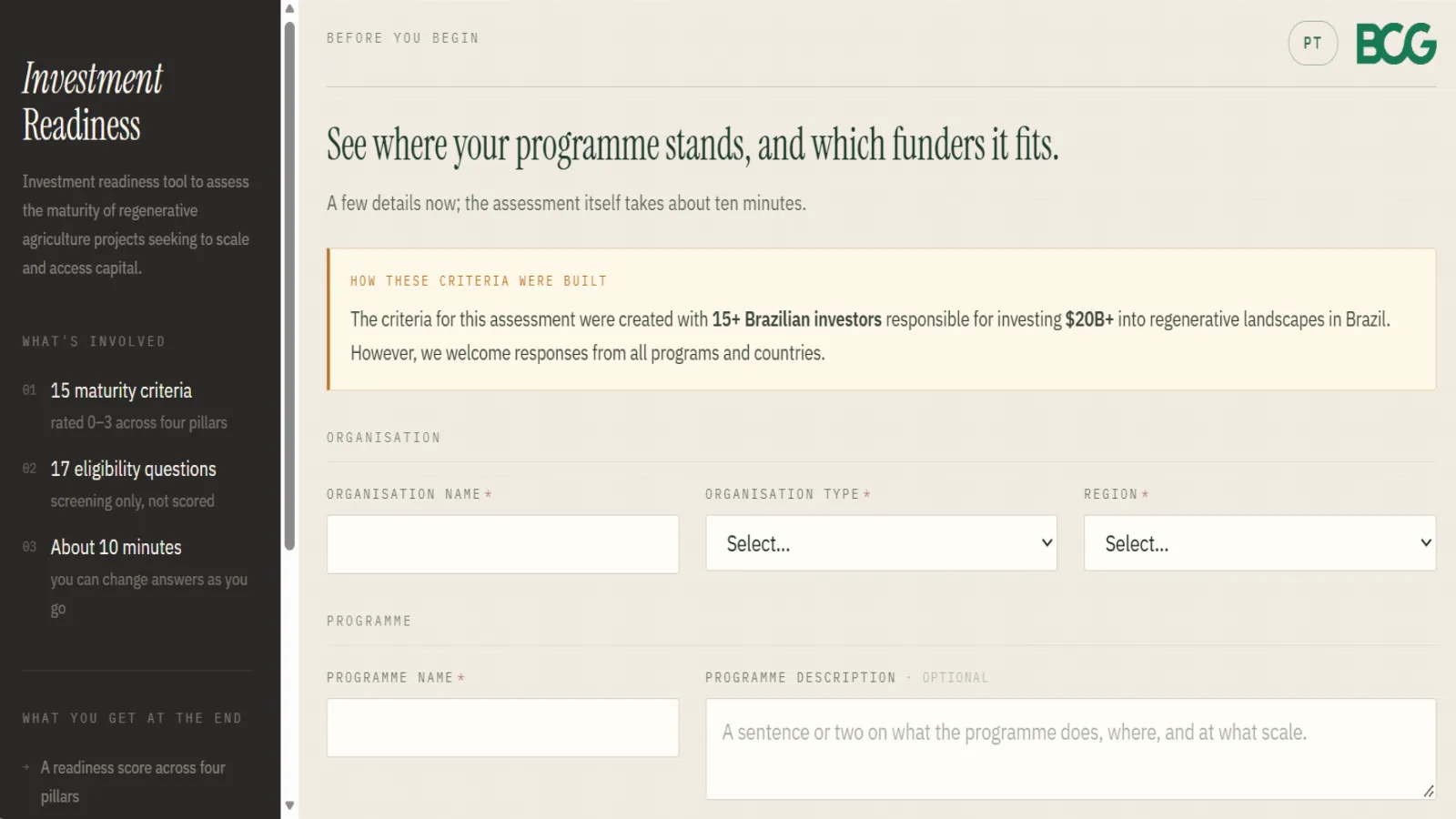
The workshop brought together two pieces of work. Throughout 2026, the Landscape Accelerator Brazil (LAB), a private-sector-led initiative developed by WBCSD, BCG and CEBDS, helped Cerrado das Águas build its investment pathway, drawing on a diagnostic with more than 15 Brazilian and international investors about what capital needs to see in regenerative agriculture before it commits. At the same time, LAB, Regen10 and Olab ran the Brazil 360 Engagement, asking coffee and soy producers what they need to make the transition, using the Regen10 Outcomes Framework to organize the analysis. The workshop put both sets of findings in front of the people who finance, buy and regulate, so each could leave with a clearer sense of their own role.

This builds on a wider agenda. Earlier in 2026, the Money Talks dialogues, the FOLUR/World Bank soy and livestock discussions and the Brazil of Solutions Summit kept running into the same obstacles: fragmented projects, costly and disjointed MRV (monitoring, reporting and verification), too little risk sharing, thin investment pipelines, and financial products that do not match how long an agricultural transition takes. For companies, the problem is a practical one. Their climate, nature and regenerative agriculture commitments depend on changes on farms and across landscapes, far from corporate offices. The Cerrado Mineiro offered a way to examine those obstacles in one real landscape, starting with what producers had to say.

What producers told us

Co-steered by LAB and Regen10*, with producer engagement led by Olab, the Brazil 360 Engagement combined data, interviews and in-person validation. The study focused on coffee producers in the Triângulo Mineiro and, to a lesser extent, on soy and rotational crop producers in MATOPIBA and Mato Grosso. This was the first practical application of the Regen10 Outcomes Framework, using its twelve social, environmental and economic dimensions to interpret local realities and test LAB’s investment assumptions, without imposing checklists.

Many of the producers consulted already use practices associated with regenerative agriculture: cover crops, biological inputs, no till, crop rotation, better soil and water management. The problems start when they try to scale up.

Coffee producers, shaped by recent droughts and frosts, named four priorities: water and irrigation infrastructure, affordable credit, specialized technical assistance and reliable market rewards. They see regenerative management as insurance for the farm’s long-term future, but face high upfront costs, financing that is hard to access, and markets that do not consistently pay for the value they create. A smaller set of interviews with soy producers, reached mainly through partner networks, raised similar economic concerns: margins, infrastructure, differentiated credit, MRV that is actually useful, and research adapted to local conditions. The sample was small, so these findings should be read as early signals rather than a full picture of the value chain.

Two findings matter most for the financing debate:

  • The biggest barriers often sit outside the producer’s control. A producer can rebuild soil but can’t make a bank count that resilience in a credit assessment, and data that never affects lending, insurance or prices isn’t worth much.
  • Governance rarely comes up on its own. Producers talked mostly about soil, water, crops, inputs and economics. Landscape coordination only entered the conversation when a facilitator raised it, even though many of the outcomes regenerative agriculture promises, related to water, biodiversity and resilience, depend on collaboration across neighboring properties.

Putting the pieces around the same table

The workshop was designed around these findings. Participants started in the coffee fields, where the farm’s owner walked them through his own transition history. Olab and LAB then presented what they had heard from producers and investors, and where the two sides don’t meet. The rest of the morning was spent in small groups on three questions:

  1. how to finance the transition,
  2. what data, technical assistance and market access are needed to unlock that finance, and
  3. how to govern regeneration across a landscape, the topic producers had rarely raised on their own.

The decisions that make regenerative agriculture financeable depend on each other, but they are usually made separately. Producers know what works best in their contexts. Companies hold the supplier relationships; have a direct commercial interest in the stability and productivity of the landscapes they source from and need measurable progress on their climate and nature targets. Banks decide which risks to finance and what terms. Public institutions shape rural credit, insurance, and regulations. Landscape organizations such as Cerrado das Águas have the relationships, implementation capacity and local legitimacy to coordinate across farms. Getting them around one table turns a broad financing problem into a concrete discussion of who needs to do what.

What we heard in Patrocínio

Transition risk sits with producers, and cash flow is the real bottleneck

Participants described a system in which producers carry the cost of a transition that the whole value chain depends on. Producers steward the land, and they absorb price pressure on both what they buy and what they sell. The constraint they kept returning to was not interest rates, but cash flow. Simulations shared at the table suggested that even a steep rate cut would not solve the problem for producers living from one harvest to the next. The transition brings positive returns, but usually only after four to five years (seven to ten for some practices), with possible losses in the early years, and current grace periods do not fit that timeline. Headline rates can also mislead: one participant described a “subsidized” credit line signed at 6% that ended up at 14%, once collateral, fees and structuring costs were added.

The proposals were specific. Grace periods that match the length of the transition, multi-year disbursements linked to agreed deliverables, and credit paired with technical assistance and management support. Terms could reward performance, so producers who meet agreed indicators get lower rates, longer tenors or less collateral, with Embrapa, Brazil’s agricultural research agency, validating those indicators as a neutral party. Participants also pointed to weak financial management, more than climate, as the main cause of default, and suggested segmenting producers by profile (structured financial management or not, land tenure status, crop and scale) rather than by size alone.

The shortage is bankable projects, not capital

Financial institutions in LAB’s diagnostic said clearly that the capital exists and is looking for projects to back. What is missing is origination — that is, the business cases, governance and financial statements needed to earn trust. Rates are high because perceived risk is high, and risk models built on historical data struggle when the climate itself is changing.

One idea was to account for a “financial return on resilience,” since much of the value of regenerative practices comes from steadier results and smaller losses in bad years, not only from higher yields. Pricing that resilience properly still requires absorbing early risk, and participants pointed to a first loss tranche of 10 to 20% as the missing piece. Development banks and multilaterals can offer tenor and rate but will not take on agricultural project risk on their own.

Participants suggested moving part of the public funds used for interest rate equalization into guarantees and subordinated capital. They also noted that Brazil’s rural credit rules still do not link lending to regenerative practices.

Companies can anchor demand with offtake agreements and join pre-competitive consortia with clearly assigned roles, starting with a memorandum of understanding and leaving heavier legal structures for later. Having companies involved is what brings in other capital, from concessional funds to family offices and impact investors.

One question was left open: can commercial lenders move away from pricing against Brazil’s interbank rate plus a spread, or will the transition have to rely on other kinds of capital?

Data only pays for itself when it is practical

Participants described too many data requests and methodologies, often with no practical way to collect the data and no use for it afterward. Indicators set by funders tend to be linear and disconnected from how farms actually work. Some inputs, manure for example, are bought informally and simply can’t be documented. Much of the resistance to monitoring comes from this. The data doesn’t help anyone make a practical decision, and it’s often too costly to collect.

Participants called for a minimum set of generalizable indicators that combine practices and outcomes, staged by maturity so requirements follow each producer’s transition. They also called for “tropicalizing” MRV tools designed for temperate agriculture, adapting them to tropical systems, using modelling to cut down on expensive primary sampling, and working with local scientists. The governance table added a warning that when project funding ends, producers often can’t afford to keep monitoring on their own.

Markets are still the weak link. Demand for regenerative products in Brazil is perceived as low, and certification is often too expensive to be worth it. Participants saw more potential in making the case around resilience and lower climate risk, in research linking regenerative practices to nutrient density, and in public de-risking policies whose effects tend to last once producers have seen the results. Technical assistance was the other gap. Few agronomists know regenerative practices, and training needs to reach Embrapa and financial operators alike.

Landscape governance is infrastructure, and someone has to fund it

The governance discussion started with a clear diagnosis: perceived mistrust and unequal power between actors are common, and fragmentation makes both worse, as each company looks at its own supply chain and loses sight of the broader landscape. Projects run on short cycles and are designed to be replicated, while landscapes need specific, long-term work. Models that arrive already decided meet resistance. Trust builds slowly, through listening to producers and following through on what was agreed.

What producers experience on the ground is fragmented demands from multiple buyers, with no coordinated support behind them. Participants agreed that companies should address this by building on established platforms like Cerrado das Águas instead of starting new initiatives, since those with working governance and clear short- to long-term goals find it easier to attract co-investment. Producer associations need to stay neutral and ensure resources are shared fairly. Companies were asked to give producers a single point of contact instead of one per commodity, and to pool resources on common questions such as cover crop research, to cut costs and avoid duplicated effort.

Across all three tables, the same principle kept surfacing: the solutions that hold are the ones shaped with producers, not for them. Participants also noted that international funders could pay for the governance process itself, not only for practices on farms. The Regen10 Outcomes Framework counts inclusive participation and fair representation among the outcomes that regeneration must deliver, and producers in the room made the same point.

Where this leaves the work

The workshop showed that credit, origination, data, markets and governance form an interconnected system, in which no single barrier can be solved in isolation. More than a set of ready-made answers, the event validated an approach: aligning producers, investors, companies and government to make the sector’s mismatches visible and actionable.

This learning is guiding Cerrado das Águas’ expansion into an integrated regeneration platform, spanning soil, water, biodiversity and community, and is shaping how the Regen10 Outcomes Framework is applied in a second 360 Engagement now being scoped in Kenya.

For businesses sourcing from these landscapes, the practical challenge remains: which part of that system sits within your sphere of influence, and what would acting on it actually require?

* The Brazil 360 Engagement was co-steered by LAB and Regen10, with producer engagement led by Olab. It combined secondary data, producer interviews and in-person validation. Most of the work focused on coffee producers in the Triângulo Mineiro, with a smaller strand covering soy and rotational crop producers in MATOPIBA and Mato Grosso.

This was the first time the Regen10 Outcomes Framework was applied in a real landscape. The team used its twelve environmental, social and economic dimensions as a lens for interpreting the results, not as a checklist handed to producers. The engagement doubled as a pilot for future Regen10 360 Engagements elsewhere, and as a test of LAB’s investment assumptions against what producers actually described.