

Whole Life Carbon in Cities

A Framework to Accelerate Market Transformation​

Enhance comparability, provide a global insight and replicable framework​

Establish a level playing field that enables and steers net zero investment​

Foster effective public private collaboration to drive an ambition loop ​

Driving Decarbonization through City-Level Whole Life Carbon Processes​

Cities can accelerate decarbonization in the built environment by implementing whole life carbon policies, aligning standards and methodologies, and acting as test beds for innovative approaches. By fostering public–private collaboration, establishing enabling policies, and steering investment toward low-carbon solutions, they enable industry to transition in line with net-zero pathways while scaling best practices globally.

With this framework, we take the first step toward answering three critical questions:

  • How do cities implement whole life carbon processes?
  • How can greater consistency and comparability accelerate the net-zero transition by creating an ambition loop
    between businesses and policymakers?
  • How can this contribute to market transformation in the built environment?

By applying a consistent assessment framework across cities, we help local authorities strengthen their approaches and benchmark their progress, while giving businesses clearer signals on expectations, performance direction, and emerging best practices. This supports more confident investment, innovation, and the scaling of low-carbon solutions aligned with net-zero pathways.
Explore Cities

Click on a city to explore its approach to whole life carbon and the policies and initiatives in place.​

Criteria Set Up and the 6 Pilot Cities

Bogotá, Cape Town, London, New York, Paris, Shanghai

Cities are playing a pivotal role in advancing whole life carbon (WLC) action in the built environment – yet progress remains uneven.

This white paper introduces a practical, criteria‑based framework to assess how cities are translating WLC ambition into action, enabling clearer comparison, greater consistency, and stronger market signals.​

Applied across six global cities, it highlights leading practices, persistent gaps – particularly on embodied carbon – and the power of city‑level leadership to accelerate innovation. By strengthening consistency and comparability, the work supports market transformation, equipping cities, policymakers and businesses with a shared language to reduce uncertainty, guide investment, and scale low‑carbon solutions​.

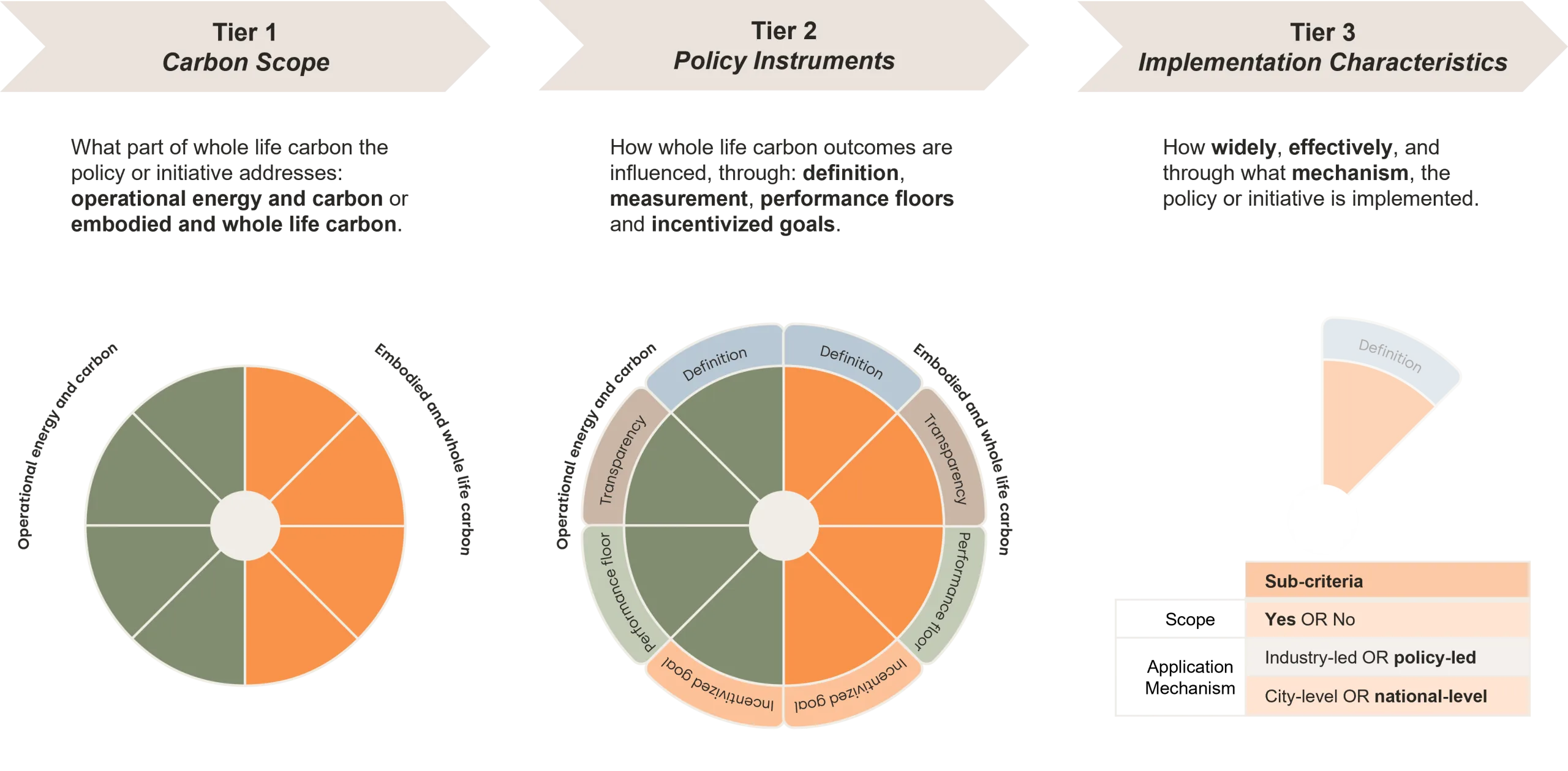
Establishing the Framework: A Whole Life Approach


Detailed Framework: Explore All Criteria

​ ​ ​ ​ ​ ​ ​ ​ ​ ​ ​ ​

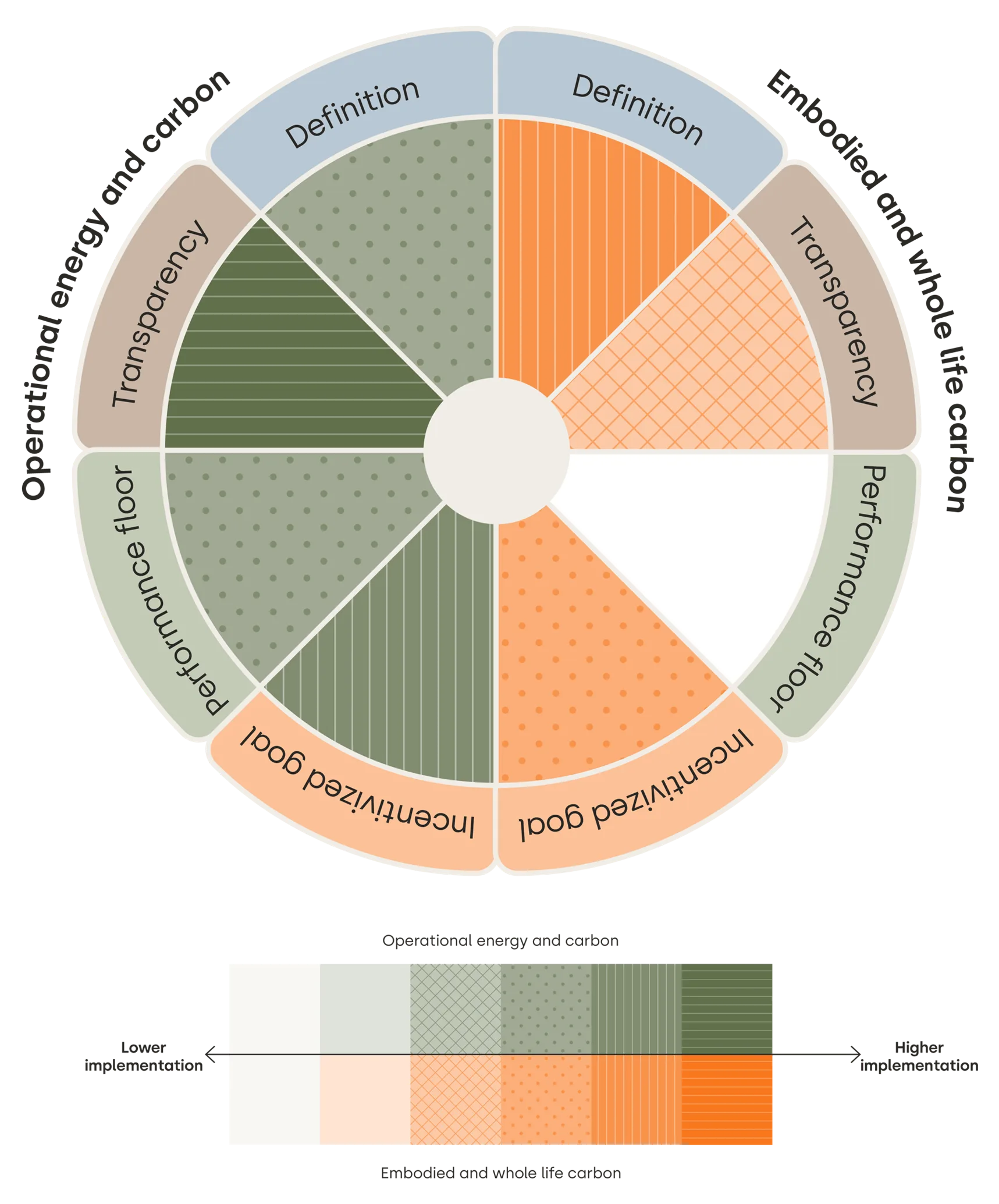
Operational Energy and Carbon – Definition

Established standards for measuring and reporting operational energy and/or carbon
Implementation Characteristics Criteria Choice indicating maximum implementation
Scope Yes OR No Yes
Application mechanism Industry-led OR policy-led Policy-led
City-level OR state-level OR national-level National-level
Effectiveness Performance-based AND/OR prescriptive (code-compliance-based) Performance-based
Modelled AND/OR actual performance Actual performance

Operational Energy and Carbon – Transparency

Assessment of operational energy and/or carbon
Implementation Characteristics Criteria Choice indicating maximum implementation
Scope Yes OR No Yes
Major developments AND/OR minor developments Major developments and minor developments
New buildings AND/OR refurbishments AND/OR existing buildings in operation New buildings and refurbishments and existing buildings in operation
Application mechanism Industry-led OR policy-led Policy-led
City-level OR state-level OR national-level National-level
Effectiveness Performance-based AND/OR prescriptive (code-compliance-based) Performance based
Modelled AND/OR actual performance Actual performance
Low enough to drive improvement OR not Low enough to drive improvement
Third-party verification OR not Third-party verification
Comprehensively enforced OR not Comprehensively enforced
Static OR tightening Tightening
1.5C aligned OR not 1.5C aligned

Operational Energy and Carbon – Performance Floor

Minimum requirements for operational energy and/or carbon
Implementation Characteristics Criteria Choice indicating maximum implementation
Scope Yes OR No Yes
Major developments AND/OR minor developments Major developments and minor developments
New buildings AND/OR refurbishments AND/OR existing buildings in operation New buildings and refurbishments and existing buildings in operation
Application mechanism Industry-led OR policy-led Policy-led
City-level OR state-level OR national-level National-level
Effectiveness Performance-based AND/OR prescriptive (code-compliance-based) Performance based
Modelled AND/OR actual performance Actual performance
Mandatory OR voluntary Mandatory
Third-party verification OR not Third-party verification
Requirement to enter operational performance data in database OR not Requirement to enter operational performance data in database
Operational performance database publicly available OR not Operational performance database publicly available

Operational Energy and Carbon – Incentivized Goal

Market incentives for optimal operational energy and/or carbon
Implementation Characteristics Criteria Choice indicating maximum implementation
Scope Yes OR No Yes
Major developments AND/OR minor developments Major developments and minor developments
New buildings AND/OR refurbishments AND/OR existing buildings in operation New buildings and refurbishments and existing buildings in operation
Application mechanism Industry-led OR policy-led Policy-led
City-level OR state-level OR national-level National-level
Effectiveness Performance-based AND/OR prescriptive (code-compliance-based) Performance-based
Modelled AND/OR actual performance Actual performance
Low enough to drive improvement OR not Low enough to drive improvement
Third-party verification OR not Third-party verification
Static OR tightening Tightening
1.5C aligned OR not 1.5C aligned
Strength of incentive: Strong (direct financial, high) OR Medium (direct financial, low) OR Weak (indirect) Strong incentive

Embodied and Whole Life Carbon – Definition

Established standards for measuring and reporting embodied and whole life carbon
Implementation Characteristics Criteria Choice indicating maximum implementation
Scope Yes OR No Yes
Application mechanism Industry-led OR policy-led Policy-led
City-level OR state-level OR national-level National-level

Embodied and Whole Life Carbon – Transparency

Assessment of embodied and whole life carbon
Implementation Characteristics Criteria Choice indicating maximum implementation
Scope Yes OR No Yes
Major developments AND/OR minor developments AND/OR refurbishments Major developments and minor developments and refurbishments
All building elements OR only major building elements All building elements
Pre-construction AND/OR post-construction Pre-construction and post-construction
Upfront OR whole life carbon whole life carbon
Application mechanism Industry-led OR policy-led Policy-led
City-level OR state-level OR national-level National-level
Effectiveness Mandatory OR voluntary Mandatory
Third-party verification OR not Third-party verification
Requirement to enter whole life carbon data in database OR not Requirement to enter whole life carbon data in database
Whole life carbon database publicly available OR not Whole life carbon database publicly available
Benchmarks to compare against OR not Benchmarks to compare against
Number of region-specific EPDs >1000

Embodied and Whole Life Carbon – Performance Floor

Minimum requirements for embodied and whole life carbon
Implementation Characteristics Criteria Choice indicating maximum implementation
Scope Yes OR No Yes
All building elements OR only major building elements All building elements
Major developments AND/OR minor developments AND/OR refurbishments Major developments and minor developments and refurbishments
Pre-construction AND/OR post-construction Pre-construction and post-construction
Upfront OR whole life carbon Whole life carbon
Application mechanism Industry-led OR policy-led Policy-led
City-level OR state-level OR national-level National-level
Effectiveness Low enough to drive improvement OR not Low enough to drive improvement
Third-party verification OR not Third-party verification
Comprehensively enforced OR not Comprehensively enforced
Static OR tightening Tightening
1.5C aligned OR not 1.5C aligned

Embodied and Whole Life Carbon – Incentivized Goal

Market incentives for optimal embodied and whole life carbon
Implementation Characteristics Criteria Choice indicating maximum implementation
Scope Yes OR No Yes
All building elements OR only major building elements All building elements
Major developments AND/OR minor developments AND/OR refurbishments Major developments and minor developments and refurbishments
Pre-construction AND/OR post-construction Pre-construction and post-construction
Upfront OR whole life carbon Whole life carbon
Application mechanism Industry-led OR policy-led Policy-led
City-level OR state-level OR national-level National-level
Effectiveness Low enough to drive improvement OR not Low enough to drive improvement
Third-party verification OR not Third-party verification
Static OR tightening Tightening
1.5C aligned OR not 1.5C aligned
Strength of incentive: Strong (direct financial, high) OR Medium (diect financial, low) OR Weak (indirect) Strong incentive


This is the generic framework showcasing all criteria assessed; click on the map to view a specific example.

Tier 2 – Policy Instruments

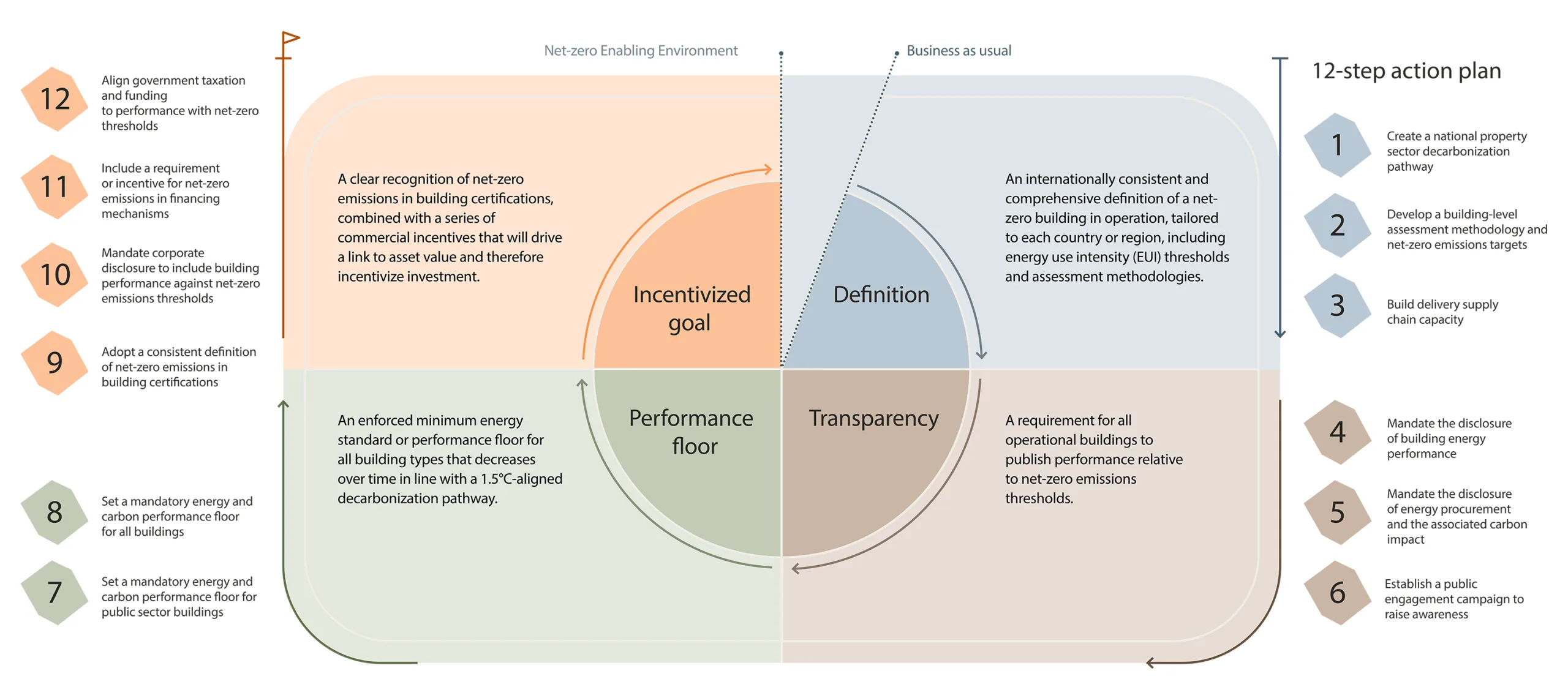
From A 12-Step Action Plan to Enable Net-Zero Operational Buildings​

Tier 2 of the framework in inspired by the action plan published in 2025 for policymakers and industry to create an enabling environment for achieving net-zero buildings.

Get in touch

Mert Ogut

Mert Ogut

Manager, Built Environment

Victoria Falcone

Victoria Falcone

Senior Associate, Built Environment

Get in touch for more details!

Contact us