How advanced sorting and curated complementary demand can unlock domestic processing value, strengthen supply-chain resilience, and enable alloy-level circular aluminum supply.
Demonstrating a New Model for Aluminum Circularity
The North America Aluminum Initiative was launched by WBCSD’s Critical Materials Collective (CMC) to evaluate whether advanced sorting technologies, combined with demonstrated downstream demand interest, could create a scalable pathway for transforming mixed aluminum scrap that is typically exported or downcycled into high-quality, grade-specific secondary supply.
Recycling aluminum saves 95% of the energy required for primary production and a similar percentage of greenhouse gas emissions1, making end-of-life scrap one of the industry’s greatest opportunities for decarbonization and domestic value creation.
Yet in the United States, approximately 71% of recovered aluminum scrap2 –excluding 3xxx series, which has higher recycling rates–remains mixed and downcycled, limiting reuse in high-performance applications such as automotive, electronics, and engineering alloys. This results in the loss of material value, carbon savings, and processing opportunity.
The challenge is not solely one of technology, but of a misaligned value chain. Collectors lack visibility into specific company requirements, recyclers lack sufficient market certainty to justify investment in advanced sorting infrastructure, and manufacturers struggle to secure traceable, grade-specific secondary aluminum at scale.
To explore whether these barriers could be overcome, the initiative brought together recyclers, technology providers, remelters, downstream offtakers, and other industry stakeholders to evaluate advanced sorting technologies–including X-Ray Transmission (XRT) and Laser-Induced Breakdown Spectroscopy (LIBS)–while simultaneously assessing technical feasibility, commercial conditions, and the potential for complementary downstream demand.
Because no single participant can address these barriers independently, the initiative was designed as a cross-value-chain collaboration. Unlike traditional recycling projects focused on a single industry, product, or technology, the initiative evaluated technology, economics, and demonstrated downstream demand in parallel, establishing a framework for understanding how alloy-level aluminum circularity could scale and where significant domestic processing value could be created and retained.
To safeguard the integrity of the initiative, all company-specific data was independently collected and analyzed by McKinsey & Company under a clean-room protocol, with only anonymized and aggregated findings shared among participants.
AT A GLANCE
| 95% | 2 Mt | 4.5 Mt CO2 | ~$2B |
Lower emissions potential using end-of-life aluminum scrap | U.S. aluminum scrap exported annually, primarily as unsorted mixed material3 | Estimated annual emissions-reduction opportunity associated with expanding domestic processing of exported aluminum scrap3, 4. | Estimated annual U.S. processing value potentially available through domestic Zorba processing.5 |
THE CHALLENGE
Value Leakage Through Downcycling and Export
North America’s aluminum recycling system is largely optimized for bulk scrap handling rather than alloy-level recovery. While significant volumes of aluminum are successfully recovered, much of that material cannot be returned to equivalent high-performance applications because mixed scrap lacks the alloy segregation needed for direct remelting into alloy-specific products.
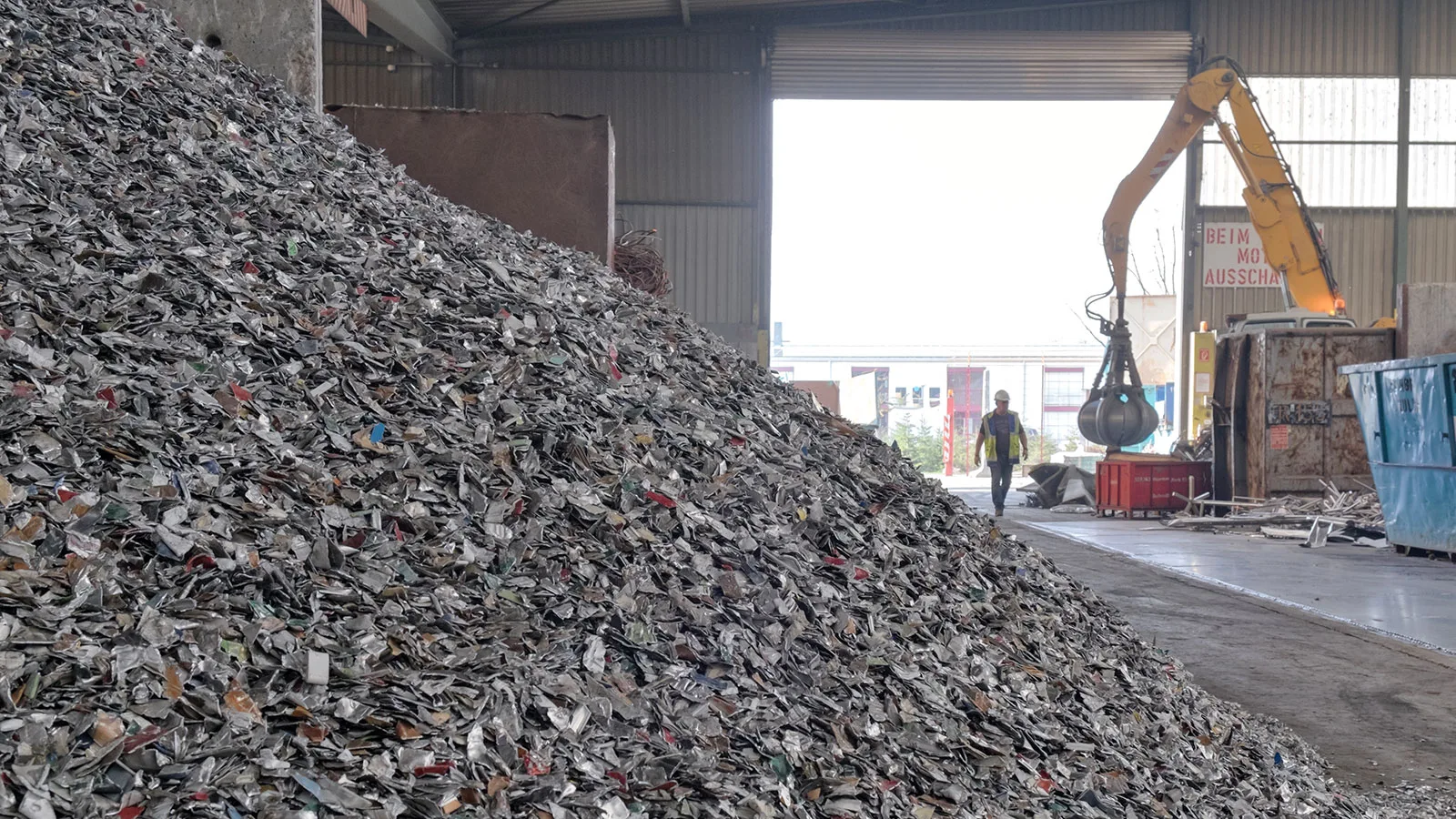
At the same time, roughly 2 million metric tons of U.S. aluminum scrap are exported annually3, much of it as mixed Zorba—a shredded non-ferrous scrap mix containing aluminum, copper, zinc, stainless steel, and other metals. Zorba represents one of the largest underutilized feedstocks in the North American recycling system and, rather than being upgraded domestically, much of this material is exported for manual sorting and downstream processing overseas.
The result is not simply the export of material, but the export of processing value created through sorting, alloy segregation, and remelting. Markets with established processing capacity and end-market demand capture those benefits, while U.S. infrastructure and investment remain comparatively underdeveloped.
THE OPPORTUNITY
Advanced Sorting Meets Aggregated Complementary Demand
Advanced sorting technology is a critical enabler, but it is only one part of the commercial equation. Likewise, downstream demand without sufficient sorting capability cannot unlock higher-value material recovery. The commercial opportunity emerges when these two elements are brought together as an integrated system: sorting technology capable of separating mixed aluminum into alloy-specific streams, paired with a diverse set of potential offtakers whose independently expressed demand profiles span complementary alloy families and applications.
The initiative evaluated an integrated aluminum value chain consisting of four interconnected stages, each designed to reinforce the others and strengthen the overall system:
Collection – Scrap collectors gain more consistent downstream demand from shredders and sorters, supporting sustained collection volumes and reducing dependence on export markets.
Shredding and Sorting – Sorting hubs deploy XRT and LIBS equipment to identify and separate aluminum by alloy family at industrial throughput. Investment in alloy-sorting infrastructure is supported by diversified downstream demand.
Remelting – Remelters gain access to traceable, high-quality segregated scrap supported by clearer downstream demand signals.
End-use Consumption – Offtakers gain potential access to high-recycled-content aluminum with lower embodied carbon, supported by traceable segregated scrap sources and more resilient upstream supply.
A distinguishing feature of the initiative was the exploration of curated complementary demand rather than simple volume aggregation. Data independently collected from participating companies—including Apple, Trane Technologies, Volvo Cars, and participating companies across the industrial, technology, and packaging sectors—was used to construct an illustrative scenario of potential complementary demand interest spanning electronics, automotive, engineering, industrial, and packaging applications. Because these companies operate in distinct end markets, their respective requirements span multiple alloy families, grades, and product specifications, creating the potential for demand across a broader set of recovered material streams.
Key Concept
Curated complementary demand refers to the aggregation of independently expressed demand from manufacturers with complementary alloy requirements across multiple industries. By matching demand to the range of recovered material streams, recyclers may be able to maximize overall value recovery rather than relying on a single alloy family or end market.
This demand profile does not represent a committed transaction, but rather it illustrates how complementary end-market requirements could provide stronger signals for differentiated alloy streams than demand concentrated in a single buyer, alloy family, or application.
TECHNICAL VALIDATION
Two Processing Pathways for High-Value Secondary Aluminum
To evaluate technical and commercial feasibility, the initiative assessed two recycler operating models representing different feedstock sources, processing configurations, and business models. Rather than identifying a single optimal solution or validating a completed commercial deployment, the objective was to test whether XRT and LIBS technologies could be adapted to multiple recycler types while producing differentiated secondary aluminum streams.
The first case evaluated a vertically integrated recycler that generates Zorba feedstock through automotive shredding and other mixed metal waste operations. The second evaluated a recycler processing Twitch feedstock generated from existing recycling operations (including auto shred streams such as Zorba) or sourced through the spot market. Together, the cases show how different feedstock strategies can support alloy segregation while improving the value of material that is often exported or downcycled.
Configuration A: Vertically Integrated Recycler Processing Zorba Feedstock
The first configuration evaluated a recycler operating an automotive shredder and integrated mixed-metal processing facility. By shredding end-of-life vehicles and other mixed metal products onsite, the recycler generates its own Zorba feedstock—a mixed non-ferrous scrap stream containing aluminum, copper, zinc, stainless steel, and other metals. Because the recycler controls both feedstock generation and downstream processing, it can leverage its existing collection network while capturing additional value through alloy segregation.
The modeled processing configuration applies a sequence of advanced separation technologies:
- Stage 1 removes heavy metals from the mixed Zorba stream, producing a cleaner aluminum-rich fraction known as Twitch.
- Stage 2 separates cast aluminum from wrought aluminum, often referred to as “Vesper,” isolating higher-value wrought material for further processing.
- Stage 3 analyzes the chemistry of individual wrought aluminum pieces and identifies target alloy families.
- Air-jet separation diverts identified alloys into dedicated product streams, such as 6063 and broader 6xxx-series fractions, while the remaining wrought material continues as a balanced secondary stream.
This staged process has the potential to upgrade material traditionally exported or downcycled into alloy-specific products suitable for direct remelting into high-performance applications. Because the configuration begins with Zorba, it can capture value from multiple streams—including heavies, mixed cast aluminum, and segregated wrought alloys. Under the market assumptions evaluated during the initiative, the technical-economic model indicated potentially attractive economics; however, those results remain sensitive to feedstock values, output pricing, operating assumptions, tariffs, and end-market demand, and should not be interpreted as representing a confirmed recycler business case. The modeled business case indicated the potential for strong operating margins5, illustrating how full valorization of all recovered materials, combined with complementary downstream demand, can support commercially attractive processing economics.
Configuration B: Recycler Processing Twitch Feedstock
The second configuration evaluated a recycler beginning with Twitch—a more concentrated aluminum stream generated through existing recycling operations (including auto shred streams such as Zorba) or procured through the spot market. Unlike the first case, this recycler does not rely on an integrated automotive shredder and instead focuses on maximizing value from an already aluminum-rich feedstock.
In this configuration, the sorting sequence is optimized for Twitch:
- Stage 1 identifies alloy chemistry and separates wrought aluminum from cast aluminum.
- Stage 2 the segregated wrought fraction passes through XRT, which performs density-based separation to produce multiple polished alloy outputs.
- Potential product streams include 6063, 3x shred (a recycled aluminum fraction derived primarily from 3xxx-series alloys), and future 6xxx-series fractions, creating differentiated products from material that would otherwise remain mixed.
This configuration does not benefit from the additional value associated with recovered heavy metals; rather, it offers a second pathway for upgrading mixed aluminum scrap. Under the January-December 2025 market assumptions evaluated in the model, the configuration generated positive modeled margins. Its economics were more sensitive than the Zorba-based case to feedstock pricing, alloy output values, and broader market conditions, reinforcing the importance of diversified end markets and stable demand for multiple fractions.
Technical Validation Across Multiple Operating Models
Together, the two configurations indicate that XRT and LIBS can be deployed across different recycler operating models and feedstock strategies. The specific processing sequence changes with feedstock composition and site configuration, but both pathways can produce alloy-specific streams, improve utilization of mixed scrap, and increase the availability of secondary aluminum capable of meeting downstream manufacturing requirements.
These findings suggest technical and economic potential, not a final commercial outcome. Further engagement with recyclers, remelters, equipment providers, and potential offtakers would be required to confirm site-specific economics, contracting structures, product qualification requirements, and deployment readiness.
BUSINESS CASE INSIGHTS
What the Technical-Economic Assessment Suggests
The modeled configurations suggest that advanced sorting can support commercially attractive processing economics when recovered material streams are fully valorized and matched with viable end markets. The assessment did not assume direct subsidies or concessional pricing, but its results should be understood as scenario-based modeling rather than validated recycler margins or a forecast of commercial performance.
Three distinct value streams are central to the modeled economics: heavy metals separated early in the process; mixed cast aluminum directed to appropriate markets; and segregated wrought alloys matched to specific downstream requirements.
No single stream carries the economics alone. The value proposition depends on recovering and marketing the full portfolio of outputs. Upstream access to suitable feedstock and downstream market confidence reinforce each other. Strong collection networks improve scrap access, while a diversified set of end-market requirements may improve the ability to place each sorted fraction. This dual anchor can reduce investment risk, although additional validation with market participants remains necessary before site-level deployment decisions are made.
WHAT WE LEARNED
Insights and Findings Summary
- Curated Complementary Demand Can Strengthen the Business Case: The initiative found that advanced sorting economics improve when differentiated outputs can be matched with demand spanning multiple industries. Unlike a traditional offtake model centered on a single buyer or product category, complementary requirements across a diversified group spanning electronics, automotive, engineering, industrial, and packaging applications may support a broader portfolio of alloy families and quality specifications.
- Advanced Sorting Can Produce Alloy-Specific Secondary Supply: Both evaluated configurations upgraded mixed scrap into differentiated alloy streams. The principal challenge to deployment is therefore not technological capability alone, but the combination of site-specific economics, material qualification, contracting, and alignment across collectors, recyclers, remelters, equipment providers, investors, and manufacturers.
- Full Valorization of Heavies, Cast, and Wrought Streams Drives Economics: The strongest modeled cases emerged when every recovered material stream contributed value. Heavy metals (including copper), mixed cast aluminum, segregated wrought alloys, and differentiated alloy fractions each represented distinct potential revenue streams. Commercial performance therefore depends on reliable markets across the recovered material portfolio, not on one premium output. Scaling recovery of these material streams is also expected to increase demand for downstream processing capacity. For example, processing capacity for mixed and copper-bearing scrap in the United States remains limited, and additional recovered feedstock could increase demand for investment in domestic processing infrastructure over time. This reinforces a broader finding of the initiative: capturing greater value from advanced sorting will require continued investment across the recycling value chain—not only in sorting technologies, but also in the downstream infrastructure needed to process and utilize recovered materials.
- System Alignment is Needed to Convert Technical Potential into Deployment: The initiative indicates that advanced sorting can be economically compelling under certain assumptions, but the path to deployment depends on progress across the value chain. Feedstock access, output qualification, market demand, investment confidence, and commercial structures must develop together. The work also highlighted areas requiring further engagement, particularly the role of remelters and recycler perspectives on site-level economics and product pathways
FULL VALUE AT STAKE
From Exporting Scrap to Capturing $2B+ in Potential Domestic Processing Value
The initiative’s most significant strategic finding extends beyond the two recycler configurations. Approximately 2 million metric tons of U.S. aluminum scrap are exported annually, much of it as mixed Zorba. North America therefore exports not only material, but also much of the value associated with downstream sorting, recovery of contained metals, alloy segregation, and remelting.
McKinsey’s system-level analysis estimates that domestic processing of approximately 1.6 million metric tons of Asia-bound Zorba could generate an estimated $1.9–2.3 billion in incremental annual processing value5. The opportunity is driven by valorization of all material streams contained in Zorba—including heavies, mixed cast, mixed wrought, and segregated alloys—rather than by aluminum alone.
The analysis estimates that processing this volume domestically would require approximately 35 advanced sorting facilities operating at roughly 45 kilotons per year, representing approximately $150 million in total capital investment. Based on these estimates, an estimated investment of less than $200 million in estimated sorting infrastructure could generate additional value approaching $2 billion, subject to market conditions and the assumptions underlying the analysis.
This represents a significant system-transformation opportunity identified by the initiative: moving from a model optimized for bulk scrap recovery and export toward one that retains more processing value through localized sorting and recovery. Capturing it would also require markets for heavies, mixed cast, mixed wrought, and segregated alloy products; sufficient feedstock access; and stronger alignment across recyclers, equipment providers, remelters, and downstream manufacturers.
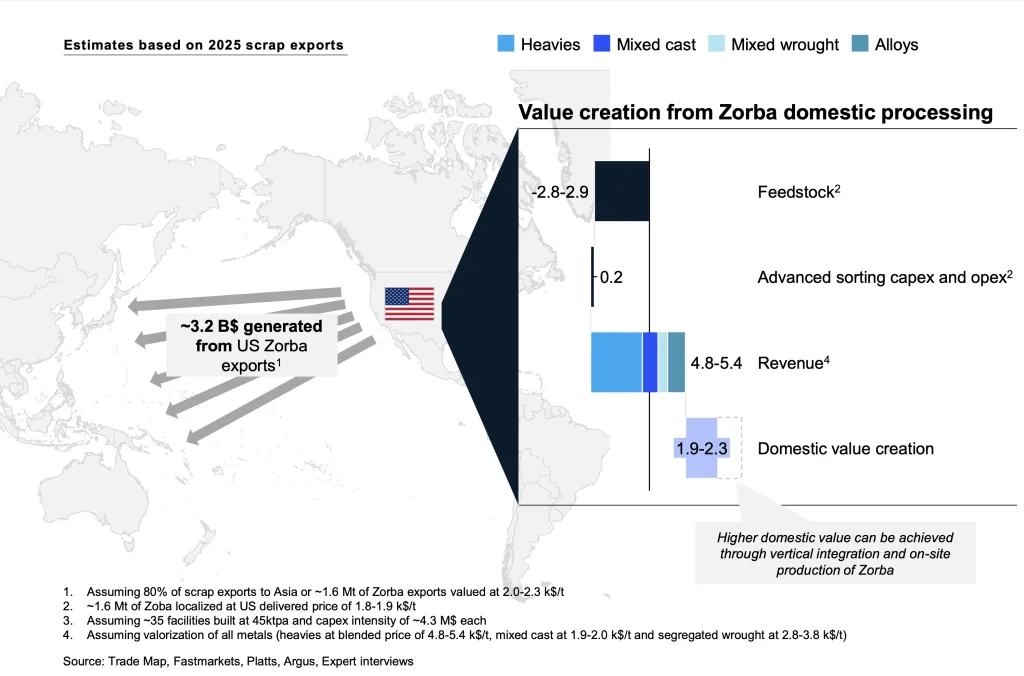
Value creation from domestic Zorba processing (McKinsey & Company analysis; estimates based on 2025 scrap exports)
ILLUSTRATIVE BUSINESS CASE SCENARIO
What the Modeled Demand Profile Showed
As an illustrative scenario, the initiative evaluated an anonymized profile of complementary demand interest across participating companies. The scenario used anonymized, aggregated data collected independently by McKinsey & Company under its clean-room protocol. The scenario was developed to explore how complementary downstream demand interest could influence investment in advanced sorting infrastructure and should not be interpreted as a committed demand pool, forecast, or expected transaction.
Under the market assumptions evaluated during the initiative, the analysis suggested that aggregated complementary demand could support improved domestic processing economics relative to current export pathways. The scenario helped test the relationship between diversified downstream demand and sorting infrastructure requirements; it was not intended to represent a committed volume, a finalized offtake structure, or a value opportunity expected to be realized by the participating companies.
The relevance of the scenario is therefore methodological rather than transactional. It illustrates how anonymized, alloy-specific demand information can help assess whether a diversified set of end markets could support investment in processing infrastructure. The scenario also highlights the importance of validating assumptions with recyclers, equipment providers, remelters, and individual downstream buyers before advancing any commercial pathway.
Four Enablers for Scaling Domestic Processing Value
Capturing a meaningful share of the national opportunity depends on progress across four interconnected areas. These conditions apply to the broader ~$2 billion system opportunity; the infrastructure requirement for any specific project would depend on its feedstock volume, product slate, location, and commercial structure.
| ENABLERS | KEY REQUIREMENTS |
|---|---|
| Infrastructure | Build out advanced sorting capacity—including XRT and LIBS—at a scale matched to available feedstock and end-market demand. At national scale, the analysis estimates approximately 35 facilities and ~$150M of capex for aluminum sorting infrastructure; individual projects would require site-specific validation. Processing capacity for other recovered material streams, including mixed and copper-bearing scrap, may also require expansion, as downstream processing capacity could become a constraint in scaling the broader system. |
| Feedstock | Increase collection, aggregation, and routing of end-of-life aluminum scrap; improve access to Zorba and other mixed streams; and characterize regional scrap composition and available volumes. |
| Market Demand | Develop reliable end markets for heavies, mixed cast, mixed wrought, and segregated alloys. Demand must exist across the full output portfolio rather than only for a single premium fraction. |
| Value-Chain Alignment | Clarify roles and incentives across recyclers, equipment providers, remelters, and manufacturers. Validate product specifications, qualification pathways, investment structures, and individual offtake arrangements without assuming collective commitments. |
THE PATH FORWARD
A Blueprint for Scaling Circular Supply
While initially focused on aluminum, the North America Aluminum Initiative offers a broader framework for increasing localized processing value through advanced sorting, curated complementary demand, and value-chain alignment. The work provides an illustrative proof point for a method of inquiry–not an endpoint or a confirmed commercial deployment. The framework is most relevant where strong scrap flows, growing industrial demand, and supportive policy conditions converge.
Potential next steps in North America may include further validation of the national opportunity with recyclers, equipment providers, and remelters; clarification of product qualification and market pathways; and exploration of individual offtake, financing, and investment structures. These activities could be pursued independently by relevant market participants and will benefit from being grounded in current site-level economics and commercial conditions.
One example of a market for future exploration is India. Domestic recycled-content regulations6, rising industrial demand, and large informal scrap volumes create several enabling conditions for applying this framework. However, any regional application should be adapted to local feedstock, policy, infrastructure, and market dynamics rather than treated as a direct replication of the North American cases.
Beyond geography, the same approach may also be relevant to other critical-material systems. Copper scrap also experiences fragmentation and value leakage when mixed streams are exported in bulk and upgraded elsewhere. Rare earth element recovery from end-of-life electronics and magnets is more technically complex, but similarly depends on coordination across collection, sorting, processing, qualification, and downstream demand.
Looking ahead, the initiative provides a practical framework for evaluating where advanced processing could retain more material value. Potential pathways include site-specific technical and economic validation, individual offtake arrangements, investment partnerships, and application of the framework in other regions or materials where fragmented markets and underinvestment constrain secondary supply.
Conclusion
The central challenge facing aluminum circularity is not simply one of technology—it is one of system design. XRT and LIBS can produce differentiated secondary aluminum streams, but technology alone does not determine whether those streams can be qualified, marketed, and processed at scale. The larger opportunity lies in aligning feedstock access, processing infrastructure, end-market demand, and incentives across the value chain.
The initiative’s most consequential finding is the scale of the national opportunity. McKinsey’s analysis indicates that domestic processing of Asia-bound Zorba could unlock approximately $1.9–2.3 billion in annual value through an estimated ~$150 million investment in advanced sorting infrastructure. This estimate is scenario-based and subject to market assumptions, but it demonstrates the magnitude of value currently embedded in material that is exported before full domestic valorization.
The two recycler configurations and the illustrative demand scenario provide supporting evidence for how that broader opportunity might be evaluated. They do not represent completed transactions, confirmed recycler returns, or committed deployment plans. Instead, they show that advanced sorting can be adapted to different operating models and that complementary demand information can help illuminate potential commercial pathways.
Ultimately, unlocking circular supply is not solely about recovering more material. It is about designing systems that retain more of the value already present in recovered materials. By combining advanced processing with market development and cross-value-chain collaboration, the North America Aluminum Initiative aims to provide a practical blueprint for strengthening manufacturing resilience, improving resource efficiency, and assessing where circular processing infrastructure can best be deployed.
Source: Unless otherwise noted, the analysis presented in this whitepaper was prepared by McKinsey & Company on behalf of the WBCSD Critical Materials Collective (CMC) North America Aluminum Initiative. Supporting data and analysis draw from public trade and market datasets, industry expert interviews, participating recyclers, technology providers, the Advanced Sorting Business Case Model v3, and anonymized data independently collected from participating CMC member companies, under a clean-room protocol, where applicable. See References for additional source information.
Footnotes
- International Aluminium Institute. Aluminium recycling saves 95% of the energy needed for primary aluminium production and a similar percentage of greenhouse gas emissions. ↩︎
- McKinsey & Company. (2026). North America Aluminum Initiative: Technical Analysis, Business Case, and Market Assessment. Prepared for the WBCSD Critical Materials Collective. Internal working analysis. ↩︎
- United States Geological Survey (USGS). Mineral Commodity Summaries: Aluminum (latest available edition); International Trade Centre (Trade Map). U.S. Aluminum Scrap Trade Statistics; United States International Trade Commission (USITC). U.S. Trade Data and Harmonized Tariff Schedule. Supporting analysis by McKinsey & Company for the WBCSD Critical Materials Collective (2026). ↩︎
- The estimate reflects the additional emissions-reduction opportunity associated with retaining more processing and upgrading within North America rather than
implying that exported scrap is not recycled. ↩︎ - McKinsey & Company. (2026). North America Aluminum Initiative: Technical Analysis and Business Case. Prepared for the WBCSD Critical Materials Collective.
Internal technical-economic analysis incorporating the Advanced Sorting Business Case Model v3. ↩︎ - Government of India, Ministry of Environment, Forest and Climate Change. Hazardous and Other Wastes (Management and Transboundary Movement) Amendment Rules, 2025, together with supporting analysis by McKinsey & Company for the WBCSD Critical Materials Collective. ↩︎
Outline