Understanding and navigating today’s evolving guidance on market instruments to enable action
As companies extend decarbonization efforts within their value chains, many face structural constraints on direct emission reductions, particularly in hard-to-abate sectors, while under growing pressure to demonstrate credible progress.
Market instruments are increasingly used to enable action where physical traceability isn’t yet achievable, complement mitigation where physical decarbonization isn’t yet feasible, and mobilize finance and demand signals for low-carbon solutions. But in the absence of clear rules from standard setters, a fragmented landscape of frameworks, methodologies, and sector-specific guidance has emerged, leaving companies without a clear way to act credibly and with confidence.
To help companies navigate this complexity and move forward with confidence, WBCSD has established the Market-Based Solutions Hub. The Hub provides a practical toolkit to help sustainability practitioners and decision makers act, whether that’s applying the right chain of custody model, such as mass balance or book-and-claim, or understanding current accounting and reporting practices.


Landscape Report
Understand current practices, explore key debates, and identify practical actions.

Industry Case Studies
Explore key applications to understand current accounting practices in context.

Glossary of Key Terms
Supports a shared undestanding across a fast-evolving landscape.
What is a market instrument?
A market instrument is defined as a “contractual arrangement between two or more parties that enables the creation, transfer, or claiming of greenhouse gas (GHG)-related environmental attributes” (GHG Protocol, 2025). They may be used in instances where a direct physical link between an emission source and the company making a claim about emission reductions in their GHG inventory is not possible or is constrained. To do this, market instruments rely on chain of custody models, such as mass balance or book-and-claim, to document and track the transfer of environmental attributes across a value chain.
Navigating the Market Instruments Landscape Report
This report examines the current guidance and standards landscape available to companies on the use of market instruments in corporate GHG accounting. It is authored by WBCSD in collaboration with the Exponential Roadmap Initiative, with technical support and contribution from Sustainable AG.
Through this report, you can:
- Understand how market instruments are currently recognized in GHG reporting and target implementation
- See where the landscape has converged, and where debate remains active (e.g., additionality, treatment of pooled interventions, physical connectivity requirements)
- Apply market instruments following a good practice action pathway, regardless of where you are starting from (see more below)
A 2025 WBCSD survey found that 93% of member companies surveyed plan to use market instruments beyond Scope 2 applications, despite limited clarity from key standard setters. This report explores why companies seek to expand the use of market instruments, what guidance or rules are available to them or under development, and how they can credibly start to test or scale their use of market instruments to procure low-carbon commodities as the guidance landscape continues to evolve.
The Practical Action Pathway
A phased approach helping companies assess, justify, and narrate their use of market instruments.
This report’s analysis, of where the landscape has converged, where debate remains, and what harmonization still requires, leads to one practical conclusion: companies don’t need every open question resolved to act credibly today. The Practical Action Pathway builds on that conclusion, providing a four-phase approach for translating insight into action.
Where in the organization’s value chain are emission hotspots for which physical decarbonization levers (electrification, renewable energy sourcing, low-carbon feedstock substitution, modal shift) are technically or economically constrained in the near term?
Given the nature of the constraint identified in Step 1, is a market instrument an appropriate bridging solution, and of what kind?
How much does the organization know about the specific origin of the product or commodity linked to the constraint? Does the organization know the individual supplier (or production site), or only the broader region or supply shed it is sourced from?
How can the organization’s disclosures be detailed and catalogued across instrument use, accounting choices, physical connectivity and resulting claims?
What are the implications of the emerging multi-statement reporting approach on the organization’s accounting and reporting?
Has the organization established criteria to evaluate potential suppliers of market instruments and assessed candidate suppliers against them?
Is the organization ready to initiate procurement of low-carbon commodities, goods or services using market instruments for the constraints identified above?
Is the organization systematically evaluating the quality, integrity and impact of the market instruments it is procuring?
Is the organization systematically monitoring the quality, integrity, and impact of the market instruments it has scaled, at both the supplier-specific and market-wide level?
What are the organization’s efforts to scale procurement of market instruments systematically, and are instrument quality criteria embedded in standard sourcing processes?
Is the organization supporting suppliers in meeting the data, certification and claims requirements associated with market instruments?
Are the use of market instruments, associated quality criteria and performance monitoring embedded in the organization’s governance structures, internal reporting and long-term climate strategy?
Senario based case studies
How do actors account for and report on their use of market instruments today?
Co-developed with Carbon Trust and WBCSD Members, these scenario-based case studies show practitioners how market instruments can be applied across key sectors, and surface where open questions remain on recognition, verification, and reporting.
A worked example of how to use, account for, and report market instrument use in practice
Stress-test current guidance and surface questions that remain unsettled
Explore chain of custody decisions, questions and challenges within realistic constraints
Dive into the Case Studies
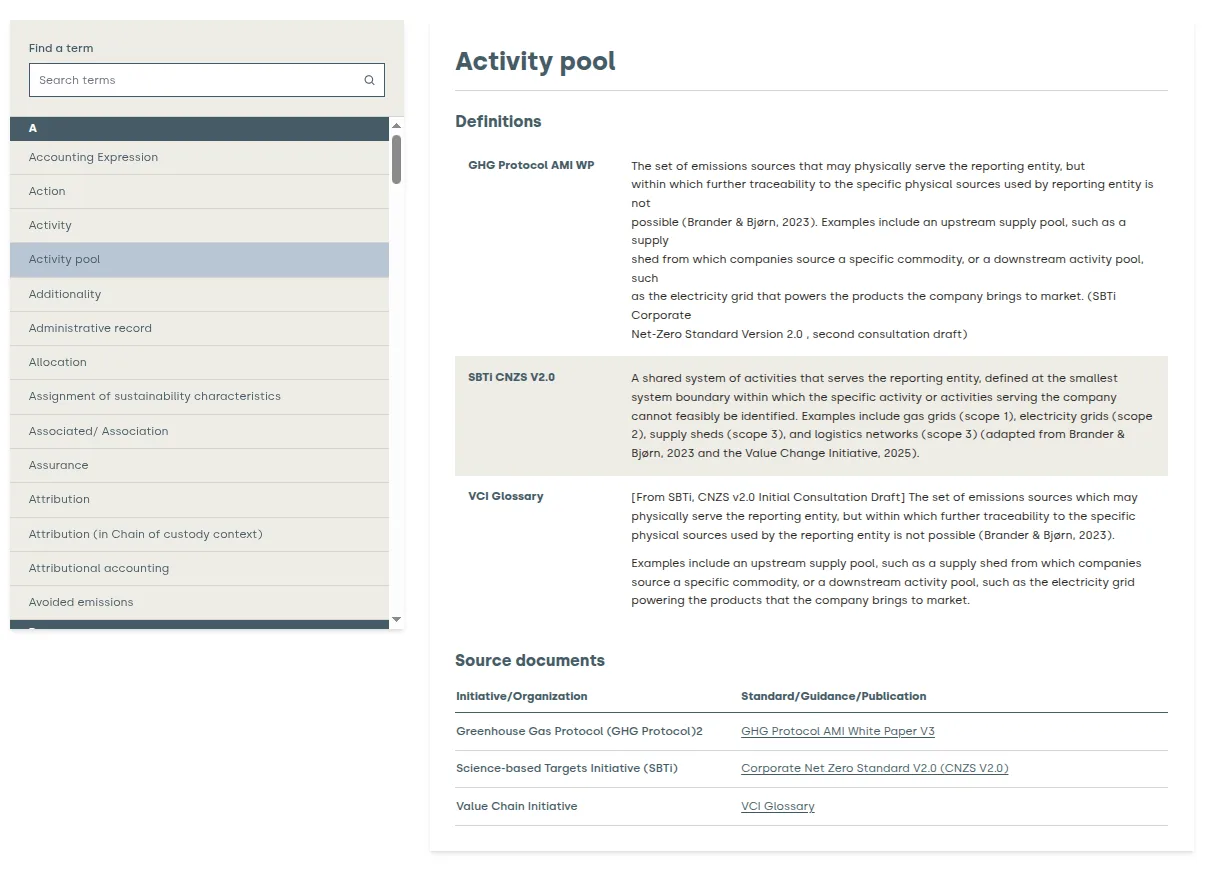
Same term, different meanings: a glossary to foster common language in an evolving landscape
Companies, experts, and standard setters consistently highlight a common challenge across the market instruments landscape: key terms are often used differently across stakeholders, organizations and initiatives, making productive discussions and alignment difficult.
To address this, WBCSD has compiled and compared definitions for key terms across relevant sources, and has turned that analysis into an interactive glossary that lets you look up a term, see how each source defines it, and trace every definition back to its original document.
Select a term from the glossary to see its definition
FAQ
What are market instruments and how do they contribute to corporate decarbonization strategies?
What is a chain of custody model?
Are market instruments eligible under the GHG Protocol for Scope 3?
What is the Practical Action Pathway?
What’s the difference between avoided emissions and market instruments?