Policies for Regenerative Landscape Action
A business-backed policy agenda
Published: August 11, 2026
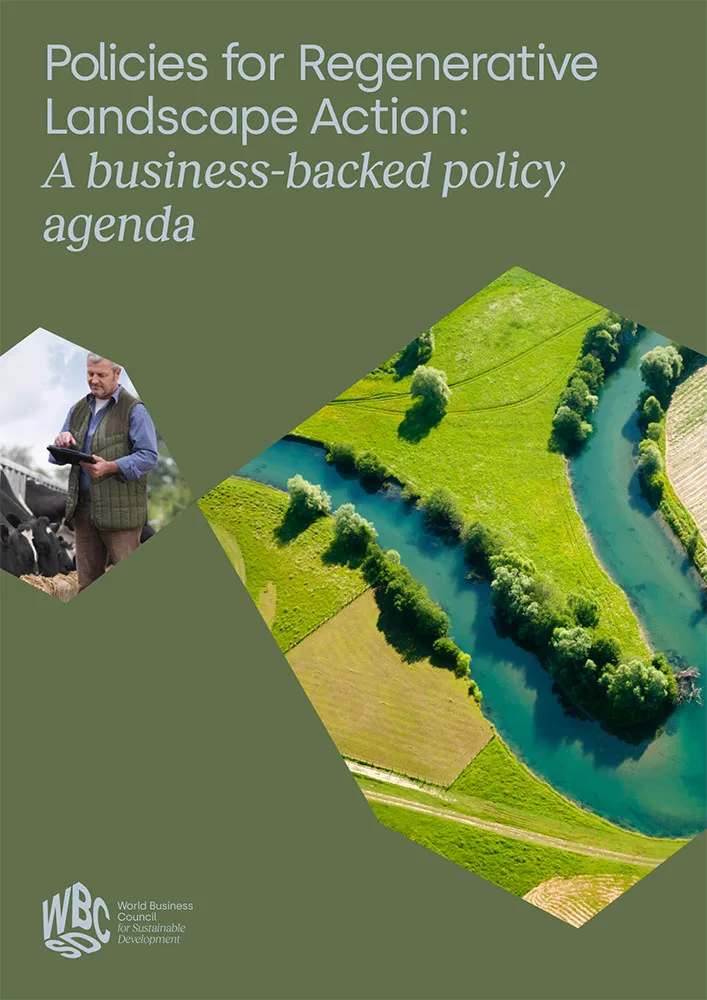
Regenerative landscapes – inclusive land management approaches that integrate regenerative agriculture and forestry, conservation, agroecology and ecosystem restoration – offer a path to renew rather than deplete natural resources. Our new paper sets out a business-backed policy agenda to accelerate the transition to regenerative landscapes. It identifies the policy actions governments can take to unlock private capital and scale this transition.
Why this agenda matters
The United Nations Convention to Combat Desertification (UNCCD) invited WBCSD to lead a private sector consultation process to elevate private sector contributions to the sustainable management of agricultural lands. The paper draws on input from 58 organizations active across land-based value chains, network partners, farmers’ representatives and financial institutions.
Our consultation brought organizations together to build a shared understanding of the key barriers and opportunities for investment in regenerative landscapes, and to identify potential policy solutions that can unlock investment. The paper highlights where policy can build on existing business action, as businesses are already investing in regenerative landscapes through land restoration, ecosystem protection and sustainable land management. But fragmented and misaligned policies still hold back investment at the speed and scale we need.
This paper comes at an important moment. Physical risks – degraded soil, water stress, nature loss – are driving up the cost, and threatening the availability, of the natural resources businesses depend on. At the same time, the opportunity is significant: it is estimated that a shift to regenerative agriculture alone could unlock USD $4.5 trillion in new investment each year and save USD $5.7 trillion in damage-related costs.1
Governments have a central role to play. Policy coherence, regulatory certainty, public finance, land governance and shared data systems all shape whether businesses can invest with confidence.
What readers can expect
The paper lays out four priorities, including three policy recommendation areas and a call for collaboration, that policymakers can act on to scale investment and impact:
- Create a coherent and stable policy environment
- Build a long-term investment vision, and de-risk investments so costs and benefits are shared fairly
- Strengthen trusted frameworks for accountability, target-setting and impact measurement
- Work with business to co-design solutions
Each policy recommendation area comes with specific actions and case studies, illustrating what works in practice.
Join us
Public and private actors, working together, can build sustainable, productive landscapes ready for the challenges ahead. We invite policymakers to work with leading businesses and key stakeholders to develop the policy and co-investment solutions that deliver sustainable land management globally.
Reach out to Tess to learn more.