Greenhouse Gas Emission Benefits from the Forest Products Industry
Access full report & executive summary by completing the download form
Published: April 23, 2026
The report “Greenhouse Gas Emission benefits from the Forest Products Industry” quantifies greenhouse gas emissions avoided by the global forest products industry through the use of biomass fuels, energy-efficient processes, recycling, and product substitution.
It concludes that the total GHG emission benefit of the activities studied is 2.27 Gigatons CO2e annually, i.e. the equivalent of the annual emissions of one billion homes.
Written by NCASI for the Forest Solutions Group, the report draws on the most recent available data, life-cycle assessment (LCA) methodologies and updated counterfactuals.
It examines several common forest products activities that generate significant GHG emission benefits within the global forest products sector:
A. Use of biomass fuels to generate steam and electricity at production facilities;
B. Industry use of combined heat and power (CHP);
C. Recovery and production of recycled paper and board;
D. Substitution effects from long-lived wood products; and
E. Substitution effects from textiles made from wood.
This work provides a robust basis for continued exploration of the potential of avoided emissions and the role of the forest sector in supporting decarbonization across the economy.
Why this report matters
In the “Forest Sector Net-Zero Roadmap – Phase I: Enabling the transition to a net-zero economy”, members of the WBCSD Forest Solutions Group identified three core levers to support the sector transition to net-zero:
A. Reducing greenhouse gas (GHG) gas emissions across operations and value chains;
B. Increasing carbon removals through sequestration in sustainably managed working forests and storage in forest products; and
C. Growing the circular bioeconomy through substitution of non-renewable, fossil-based materials.
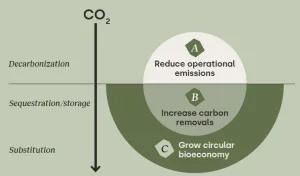
This report further positions the forest sector as a critical solutions provider – both within the sector itself and beyond, in the wider economy – in the global effort to reduce greenhouse gas emissions and move away from a linear, fossil-based model.
What readers can expect
- An updated, science-based assessment of the greenhouse gas emission benefits from the forest products industry;
- A clear articulation of the forest sector’s potential to decarbonize its own operations while enabling emissions reduction in other sectors through avoided emissions.
Let’s keep the conversation going
Looking ahead, this report will help inform continued conversations in the complex and evolving field of greenhouse gas accounting, with a particular focus on avoided emissions.