Executive Summary
Electrification is winning the tailpipe battle, unevenly across markets but decisively. European EV penetration reached 31% of new registrations in 2025, up from 25% in 2023, led by Norway and the Netherlands. This reflects real momentum: WBCSD’s 2026 Business Breakthrough Barometer, surveying 500+ leaders across 50 economies, finds 92% see sustainability as a competitive advantage and 89% grew transition investment this year.
But as powertrains decarbonize, the sector’s carbon challenge migrates upstream: embedded emissions in steel, aluminium, batteries, and plastics become the dominant share of lifecycle footprint. Carbon neutrality is therefore no longer a vehicle-technology question alone, but a procurement and value-chain one.
Reaching carbon neutrality requires pulling two complementary levers in concert: supply chain decarbonization and circularity.
Market and value-chain complexity, regulatory uncertainty, and the challenge of sectoral and cross-sectoral alignment all constrain the business case and the speed and scale needed to reach carbon neutrality. This briefing builds on the Business Breakthrough Barometer, the annual pulse-check from leading businesses on the pace of climate transition, and its deep-dives on Road Transport, Power, Hydrogen and Steel which detail the business case and policy needs for each of these solutions across the value chain. It outlines powerful mechanisms that can unlock the decarbonization potential of supply chain and circularity in the automotive value chain. Written for policymakers, businesses and standard setters, it focuses on passenger vehicles, where this shift is most pronounced and draws on examples of business action and emerging regulatory landscape in Europe.
Business leaders surveyed for WBCSD’s 2026 Business Breakthrough Barometer identified supply chain decarbonization and circularity as key levers for automotive carbon neutrality. Extending CO2 regulation beyond the tailpipe converts today’s frontier commitments into the capital deployment real transformation requires.
The Carbon Challenge Is Migrating Upstream
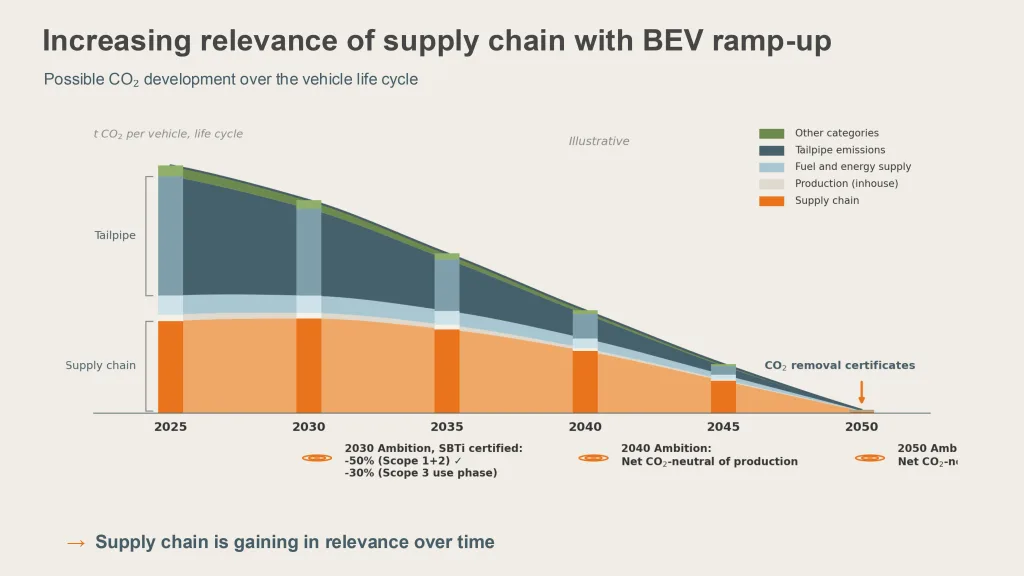
As grid electricity decarbonizes and use-phase emissions fall, embedded manufacturing emissions, particularly from battery cells, steel, aluminium, and plastics, represent a growing share of lifecycle footprint. Peer-reviewed battery electric vehicle supply chain analysis [MDPI, 2023] identifies battery cells as the largest hotspot (28 to 31%), followed by steel and aluminium, with textiles and plastics a further 28%.
This is not a temporary artefact of today’s grid mix, but the structural consequence of solving the tailpipe problem: the better the industry gets at zero-emission driving, the more visible and material the supply chain becomes.
The same research finds these hotspots’ emission intensities could fall 69 to 91% by 2050 through material efficiency, recycling, and process technology, but only if conditions enable faster adoption.
For light-duty vehicles specifically, supply chain emissions represent an estimated 20% of lifecycle footprint today, rising to 60 to 70% as electrification scales, making upstream decarbonization the central lever for the passenger segment.
Two Levers, Pulled in Concert
Supply Chain Decarbonization
Reducing the embedded carbon intensity of virgin material production, primarily through hydrogen-based direct reduction, electric arc furnace steelmaking, renewable-powered aluminum smelting, and low-carbon battery cell manufacturing.
Circularity
Keeping materials, particularly steel, aluminum, and battery-grade metals, in use at the highest value for the longest time, through design for disassembly and recycling, closed-loop scrap agreements, and battery second-life and recycling infrastructure.
Neither lever alone is sufficient. Supply chain decarbonization risks being priced out of the market; circularity has physical limits, as scrap availability cannot meet total demand as vehicle and battery production scale, given automotive-grade steel’s quality requirements. The two must be activated together.
Steel as the Proving Ground
Steel is where this challenge is most immediate and solvable near-term. The IEA projects the sector must cut GHG emissions 25% by 2030 toward net-zero by 2050 [IEA]. ICCT finds automotive the second-largest global steel consumer (12% globally, 17% EU, 26% US), mostly high-quality primary rather than recycled, well positioned to drive transformation through procurement alone. Cumulative low-emissions steel offtake agreements grew 22% year over year, with transport and manufacturing accounting for nearly two-thirds of deals, and automotive OEMs the strongest source of demand pull [ICCT, 2024].
Efforts to Address the Market Gaps
While the importance and opportunity in tackling supply chain decarbonization are clear, adoption is challenged by the business case, lack of harmonization, regulatory uncertainty, and supply-demand gaps.
- Regulatory uncertainty: Policy ambition continues to outpace delivery, with proposed measures still under negotiation. In WBCSD’s 2026 Business Breakthrough Barometer businesses call for predictable, strengthening policy over delay and resolving carbon-pricing trajectories to bring investment clarity.
- Lack of harmonization: No harmonized, technology-neutral definition of “low-carbon” or “near-zero” materials exists across buyers, suppliers, and regulators. A shared definition, with graduated recognition reflecting today’s range of production pathways, would let buyers contract with confidence.
- Cost premium: Green premiums remain a barrier, deeply uneven by region. European producers sustain premiums of EUR €200 to €300 per tonne for fossil-free steel, hard-won deal by deal, while in India and the US, cost parity remains the norm.
- Supply-demand gaps: Automotive OEMs are the strongest source of demand for low-emissions steel, but that concentration is itself a gap, as other sectors lag in binding offtake and individual commitments rarely match the scale needed to de-risk a facility. Encouragingly, buyers’ clubs and demand-aggregation platforms are pooling offtake into investment-grade volumes.
These four gaps are real, but business are not standing still. Rather than waiting for definitions, regulation, and demand signals to fully align, a growing number of businesses are moving to address them collectively by pooling offtake, committing capital and building the traceability and standards infrastructure the market still lacks.
A number of OEMs have already moved: equity stakes, long-term supply agreements, and public commitments spanning multiple continents and pathways. Buyers’ clubs are forming to bridge the supply-demand gaps. Yet business-led action alone cannot close every gap; it needs to be matched by supportive market and regulatory mechanisms to scale.
Enabling Market and Regulatory Mechanisms
Closing the gaps identified above does not require reinventing the regulations but can be addressed with mechanisms already in motion. Drawing primarily on emerging regulatory landscape in Europe, three are particularly well placed to accelerate supply chain decarbonization at the pace and scale the sector needs:

Fleet Emissions CO2 Compliance
Under the European Commission’s proposed Automotive Package (December 2025), manufacturers would be able to meet part of their fleet CO2 target through capped compliance credits, currently 7% for low-carbon steel and 3% for renewable fuels, rather than tailpipe reduction alone [EC Automotive package, 2025]. This is the only lever directly linking vehicle regulation to material decarbonization, but its scale limits impact: even at full uptake, the proposed cap would hold demand to roughly 1 million tonnes/year against a sector consuming roughly 36 million tonnes annually [ICCT, 2024], applying only from 2035.
Market-Based Mechanisms
A range of market-based mechanisms, including chain-of-custody, avoided-emissions accounting, and book & claim, is being explored to let buyers and producers recognize and transact low-carbon value where physical traceability is limited. Realizing this potential depends on getting the foundations right: a shared definition of what qualifies as low-carbon or near-zero material, robust chain-of-custody infrastructure to support credible claims, and alignment with broader GHG accounting approaches. As the value chain matures, governments, standard-setters, and industry should work together to determine which mechanisms can scale with confidence.
Carbon Pricing (ETS1 and ETS2)
A predictable carbon price is the demand-side anchor these mechanisms depend on, and the single most important lever for closing the business case gap. In Europe, ETS1 already drives industrial commodity costs, including steel, making it the clearest lever for a reliable price signal to justify investing in low-carbon commodities. ETS2 extends this upstream to road transport fuel, but its repeatedly delayed start is itself the shifting ground undermining confidence. Similar mechanisms are emerging elsewhere, including China’s national ETS and voluntary state-by-state US schemes such as California’s Low Carbon Fuel Standard. No single global solution yet exists, but the direction of travel is consistent.
While not exhaustive, mechanisms such as fleet CO2 compliance, market-based mechanisms, and carbon pricing can serve as powerful tools for scaling supply chain decarbonization. Governments, standard-setters, and industry can work together to get foundations right for these mechanisms to scale with confidence. Common standards and targeted supply side incentives need to complement this action.
Next Steps
The mechanisms above mark the start of a real opportunity for progress. WBCSD invites the business community and regulators to build on this momentum: testing these mechanisms against real decisions and shaping the policy positions that can turn shared ambition into system-wide action. Looking ahead, WBCSD’s Business Breakthrough Barometer will extend this analysis to materials and circularity in 2027, addressing the batteries, aluminium, and plastics dimensions this statement does not cover in depth. It will also release a Market-based mechanisms landscape report, helping companies to navigate the evolving standardization landscape.
Supply chain decarbonization at the pace and scale carbon neutrality requires will not be achieved by any single company or policy lever alone, but through sustained, collective engagement across the value chain and stable policy support.
Outline
Related
Content

#BuildingToCOP26 Coalition highlights 26 climate action initiatives on Cities, Regions and Built Environment Day
11 November, 2021
17 major concrete-consuming businesses pledge to use 100% net-zero concrete by 2050
5 July, 2022

A Journey of Change: How Fujitsu Uses PACT to Partner with Suppliers and Drive Value Chain Decarbonization
12 August, 2026