The Business Breakthrough Barometer provides a global pulse check on how businesses at the forefront of the transition are responding to climate risks, opportunities and market shifts.
It highlights where corporate strategies, investments, and risk perceptions are shifting — and identifies the critical conditions needed to unlock private-sector investment and accelerate delivery across energy, transport, industry (steel and cement), building, and food systems.
The Barometer provides business-led insights to guide where the COP31 Action Agenda and other international forums in 2026 can most effectively accelerate implementation.
The Research Behind the Barometer
senior business leaders surveyed
economies represented globally
in-depth executive interviews; and sectoral business convenings spanning all regions of the world
combined revenue represented

The 2026 Business Breakthrough Barometer sends a clear signal: sustainability is increasingly a source of competitive advantage, with 92% of business leaders identifying it as such. The findings show that companies are ready to invest, scale solutions and deliver real-world outcomes. The Barometer also highlights the importance of predictable and ambitious policy frameworks to unlock investment, strengthen competitiveness and accelerate progress. Continued collaboration between business and policymakers will be essential to turn ambition into action.
— Simon Stiell
Executive Secretary, UNFCCC

The Business Breakthrough Barometer 2026 shows that sustainability and competitiveness increasingly go hand in hand. At the same time, businesses are becoming more concerned about the risk of a disorderly transition as climate impacts and costs continue to rise. Governments and businesses must work together to deliver an orderly transition that strengthens resilience, drives growth and creates long-term value.
— Jayant Acharya
CEO, JSW Steel

The Business Breakthrough Barometer 2026 shows that the era of sustainability driven primarily by ambition is coming to an end. What is emerging is a new, more durable phase, where sustainability is increasingly paying its way as a source of resilience and competitiveness.
— Peter Bakker
President and CEO

What gives me confidence is that corporate investment in sustainability is a story of innovation and competitiveness as well as social well-being. That is the spirit in which we encourage businesses and policymakers to take heed of this year’s Business Breakthrough Barometer report: as a vision for how business and governments can together usher in a better future.
— Samed Ağırbaş
COP31 Climate High-Level Champion
The 2026 Business Breakthrough Barometer key insights:
The solutions driving the transition are no longer alternatives, they are becoming the most competitive, resilient and secure business choices.
- 92% of leaders expect sustainability to be a source of competitive advantage over the next 5-10 years, with 89% maintaining or increasing investments over the past year.
- This is translating into a shift in capital allocation: companies are scaling clean energy, electrification, circularity and regenerative agriculture because they deliver lower costs, greater supply-chain security and improved business resilience.
However, businesses warn that signals of a disorderly transition – one that is unplanned or poorly coordinated – are intensifying, as climate costs rise.
- 68% of leaders view a disorderly transition as more likely than a year ago, with 40% viewing this as a significant risk, and just 15% of businesses are confident that they are fully prepared to meet these challenges.
- 47% of companies experienced higher costs from physical climate impacts last year, driven by supply chain disruption, commodity price volatility, damage to infrastructure and rising insurance costs.
Businesses urge predictable policy strengthening to unlock investment and reduce inflation and price risks
- 85% of leaders prefer policy strengthening over delay, and 37% would accept higher near-term costs to reduce longer-term costs and climate disruption.
- This is already shaping investment choices, with clarity and stability of transition policy and regulation cited by over half (56%) of businesses as a key criterion in their investment choices.
Solution Deep-dives
COP Action Agenda Axis 1: Transitioning Energy, Industry and Transport
- Clean power is the most affordable and reliable option for all countries to meet their power needs efficiently by 2030
- Affordable renewable and low-carbon hydrogen globally available by 2030
- Zero-emissions vehicles are the new normal and accessible, affordable and sustainable in all regions by 2030
- Near-zero emissions steel is the preferred choice in global markets, with efficient use and production established and growing in every region by 2030
- Near-zero emission cement the preferred choice in global markets, with efficient use and near-zero emission cement production established and growing in every region of the world by 2030
- Achieve a global reduction in GHG emissions from production of fertilizers and optimize global nutrient use efficiency (NUE) by 2035
COP Action Agenda Axis 3: Transforming Agriculture & Food Systems
- Climate-resilient, sustainable agriculture is the most attractive and widely adopted option for farmers everywhere by 2030
- Climate-resilient, sustainable agriculture is the most attractive and widely adopted option for farmers everywhere by 2030
COP Action Agenda Axis 4: Building Resilience for Cities
- Near-zero emissions and resilient buildings are the new normal by 2030
Insights from Cate Hight and Jennie Dodson
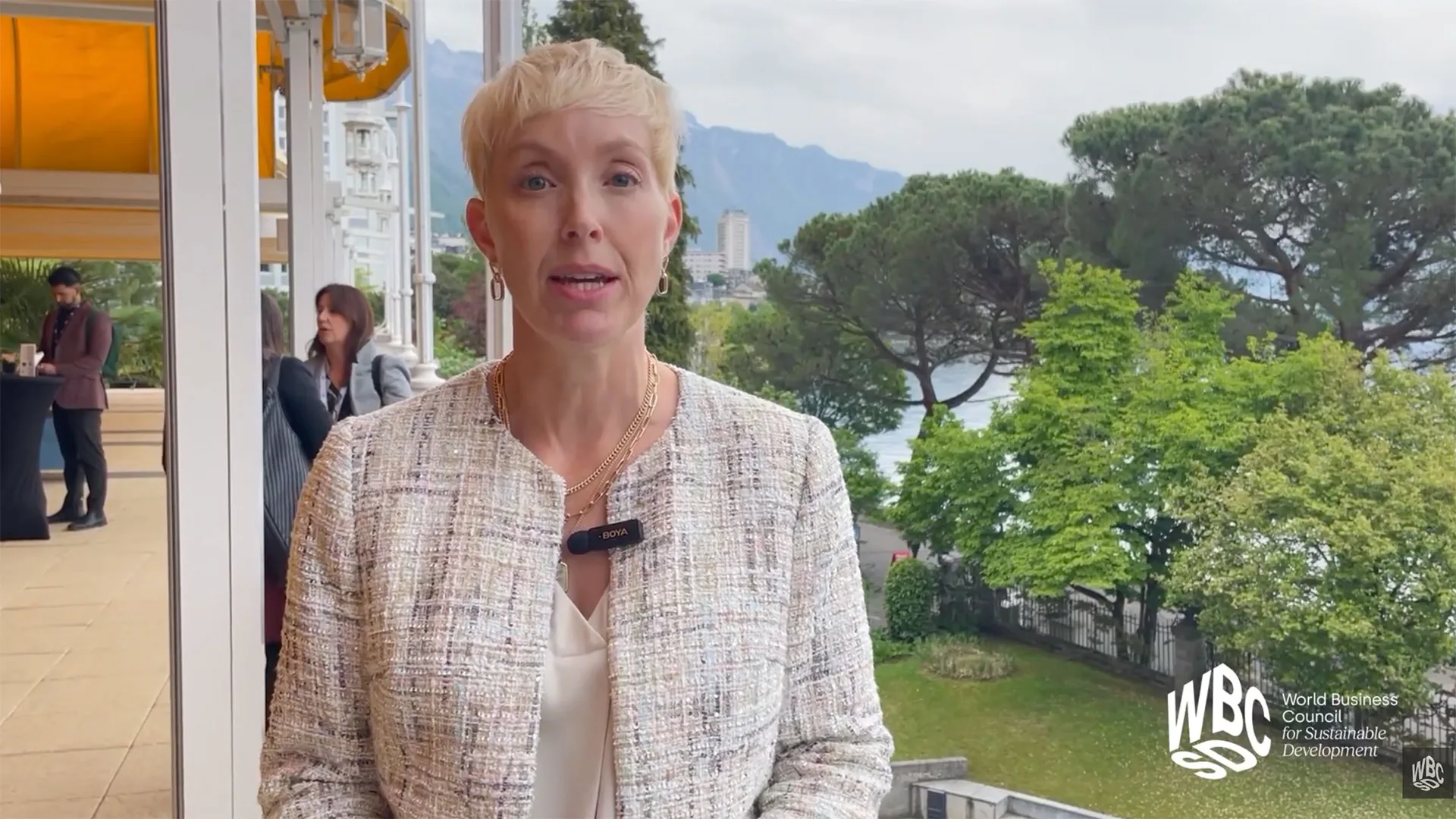
In this short video, hear from Cate Hight of Bain & Company and Jennie Dodson of WBCSD on why understanding business sentiment, priorities and progress has never been more important in a rapidly changing global landscape. Launched on 22 June during London Climate Action Week, the Business Breakthrough Barometer 2026 is the largest edition to date. Drawing on insights from more than 500 business leaders across 50 economies, it offers a global pulse check on how companies are responding to climate-related risks, opportunities and market shifts — and what is needed to accelerate progress.
Corporate supporters