From understanding climate risk exposure towards business adaptation and resilience
Climate change is increasingly shaping the operating environment for businesses, with rising temperatures, extreme weather and changing environmental conditions already affecting workforces, disrupting business continuity and competitiveness, and increasing overall vulnerabilities across the systems, assets, and communities businesses depend on.
Adaptation planning can help businesses anticipate and respond to these risks by embedding resilience considerations across strategy, governance, operations, and value chains.
This page introduces the role of adaptation planning in building business resilience and outlines the key considerations, approaches, and steps involved. It draws on our guide, Adaptation Planning for Business – Navigating uncertainty to build long-term resilience, which provides a detailed framework, practical tools, various company case studies and other key insights to support businesses in developing and implementing adaptation plans.
What is adaptation planning?
Adaptation planning refers to the strategic process of identifying and addressing immediate and long-term priorities for building resilience to climate change. Following the assessment and quantification of acute and chronic physical risks, adaptation planning provides a framework for business to take the next step: translating climate risk exposure into action, including:

Investing in adaptation solutions
to protect workforce, critical assets, infrastructure, and communities

Building capabilities
products and service offerings, and boosting innovation

Rolling out tools
to monitor and address current and emerging vulnerability to climate risks
Who should be involved in adaptation planning?
Adaptation planning is relevant to any organization exposed to physical risks. While adaptation planning is often led by sustainability, local site, and risk teams, success depends on collaboration, bringing together teams at the enterprise, business unit, and site levels, along with wider stakeholder groups across the value chain.
How does adaptation planning connect with transition planning?
Business transition plans have often focused primarily on mitigation activities. However, adaptation and mitigation should not be treated as separate or competing agendas. Both are integral to a credible and comprehensive transition plan, ensuring businesses are prepared for the transition to a low-carbon economy as well as the realities of a changing climate.
WBCSD therefore recommends that businesses integrate adaptation planning as a core component of their transition planning.
What is the role of business leaders in adaptation?
Business leaders have a key role in shaping how their organizations respond to physical climate risks by overseeing risk assessment, integrating resilience into core business processes, and setting the strategic direction to adaptation.
These activities are reflected in a nine-step adaptation journey proposed in the Business Leader's Guide to Climate Adaptation and Resilience, which sets out clear touchpoints for C-suite involvement throughout the process, including in adaptation planning.
Why does adaptation planning matter for business?
The business case for adaptation planning goes beyond managing climate risk. Embedded across operations, it can strengthen overall resilience against climate hazards, optimize investment decisions in adaptation solutions, unlock new business opportunities, and foster valuable collaboration with internal and external stakeholders.
The business case for adaptation planning

How does the adaptation planning framework look like?
Adaptation planning is a four-step process, starting with setting the scope and adaptation goals, then designing the adaptation solutions, building and implementing the plan, and monitoring and evaluating progress. Relevant stakeholders should be engaged throughout each step to bring different perspectives and ensure both business priorities and wider impacts are considered. Adaptation planning is also iterative. Insights from implementation and evaluation can inform the next cycle of adaptation planning as risks, conditions and business priorities evolve over time.
Set the scope and adaptation goals
Establish governance and resource needs. Secure internal buy-in to identify priority risks and opportunities and set adaptation goals.
Design adaptation solutions
Compare adaptation options to select short-, medium- and long-term solutions. Consider collaboration options for collective resilience.
Build the plan and implement adaptation solutions
Define an overall investment roadmap for adaptation. Build the Adaptation Plan and pilot solutions across the business.
Monitor and evaluate
Create a framework and metrics to monitor the effectiveness of adaptation solutions, trigger points, and overall business resilience. Integrate into the business' wider ERM system.
Adaptation planning
Integrating resilience into business strategy, operations and processes.
Refine and integrate
Continuously refine adaptation approach and integrate into existing business processes and strategy.
How does adaptation planning work in practice?
To support businesses in applying the adaptation planning framework in practice, the WBCSD team created the Adaptation Planning Program Accelerator. Running from 2024 to 2026, the program brought companies together to translate adaptation into actionable plans through peer learning, simulation exercises, expert insights, and real-world implementation sharing.
What our members learned from the Accelerator Program
#1 Adaptation must be embedded in core business processes, not treated as a standalone initiative
- Integrate adaptation into enterprise risk management, insurance, business continuity, procurement, and capital planning. Adaptation plans should be embedded into relevant business processes, budgets, and ownership structures, depending on the resilience objectives identified in the adaptation plan.
#2 Most organizations are still in early stages; however common challenges converge fast
- Whether building a first adaptation plan or scaling existing efforts, success requires narrowing scope and focusing on material exposures (top risks, sites, suppliers, communities, etc.)
- Use broad risk mapping to identify and rank priority sites, suppliers, and operations, then focus adaptation efforts and capital investment on the highest-priority areas first rather than trying to address all identified risks at once. This gives leadership a concrete set of priorities to fund and act on
#3 Quantification is a key challenge, but it improves decision quality
- Use available indicators (downtime, disruption, safety incidents, insurance impacts) to evidence avoided losses and build the business case, turning adaptation from a cost center into a funded priority in the eyes of finance and the board.
- Pair quantitative signals with qualitative narratives; perfect data is not a prerequisite for action, and waiting for it typically just delays decisions that could be made now with directional evidence.
#4 Adaptation solutions should reflect operating context
- Legal requirements, physical constraints, and existing infrastructure shape which solutions are viable. It is important to work across the organization when designing or evaluating solutions, as ignoring context produces solutions that look good on paper but can't be implemented, or that create hidden compliance and retrofit costs later.
- A balanced portfolio of adaptation solutions (combining nature-based, behavioural, technological, financial, and other types of solutions) can maximize synergies and co-benefits while reducing reliance on any single type of intervention. This diversified approach can strengthen resilience across multiple dimensions and help address different aspects of a climate risk.
#5 Adaptation extends beyond the fenceline
- Supplier engagement and downstream customer risks are increasingly strategic, especially for shared or systemic exposures. A company's own sites can be fully resilient, and operations still halt if a key supplier or customer isn't resilient.
- Nature-based solutions and community partnerships can deliver resilience alongside social and ecological co-benefits, building local trust and goodwill that lowers long-term operating and reputational risk.
#6 Governance, ownership, and financing must be explicit for adaptation to move from plan to action
- Clear ownership by function and geography is essential, particularly where costs are local and benefits accrue at group level.
- Phased implementation (start small, pilot and learn, then scale) reduces risk and builds organizational capability before larger capital commitments are made.
#7 Monitoring and metrics are an emerging frontier
- Organizations often have substantial climate and risk data available but may lack clarity on which indicators are most relevant for tracking adaptation progress and outcomes. Establishing clear adaptation metrics and key indicators can help identify data gaps, including gaps in areas such as supplier and operational data, and focus efforts on collecting the information needed to support decision-making.
- Start with simple, process-focused metrics; evolve toward outcome-based indicators as organizational maturity grows, so measurement doesn't become the blocker to getting started.
Take adaptation planning forward
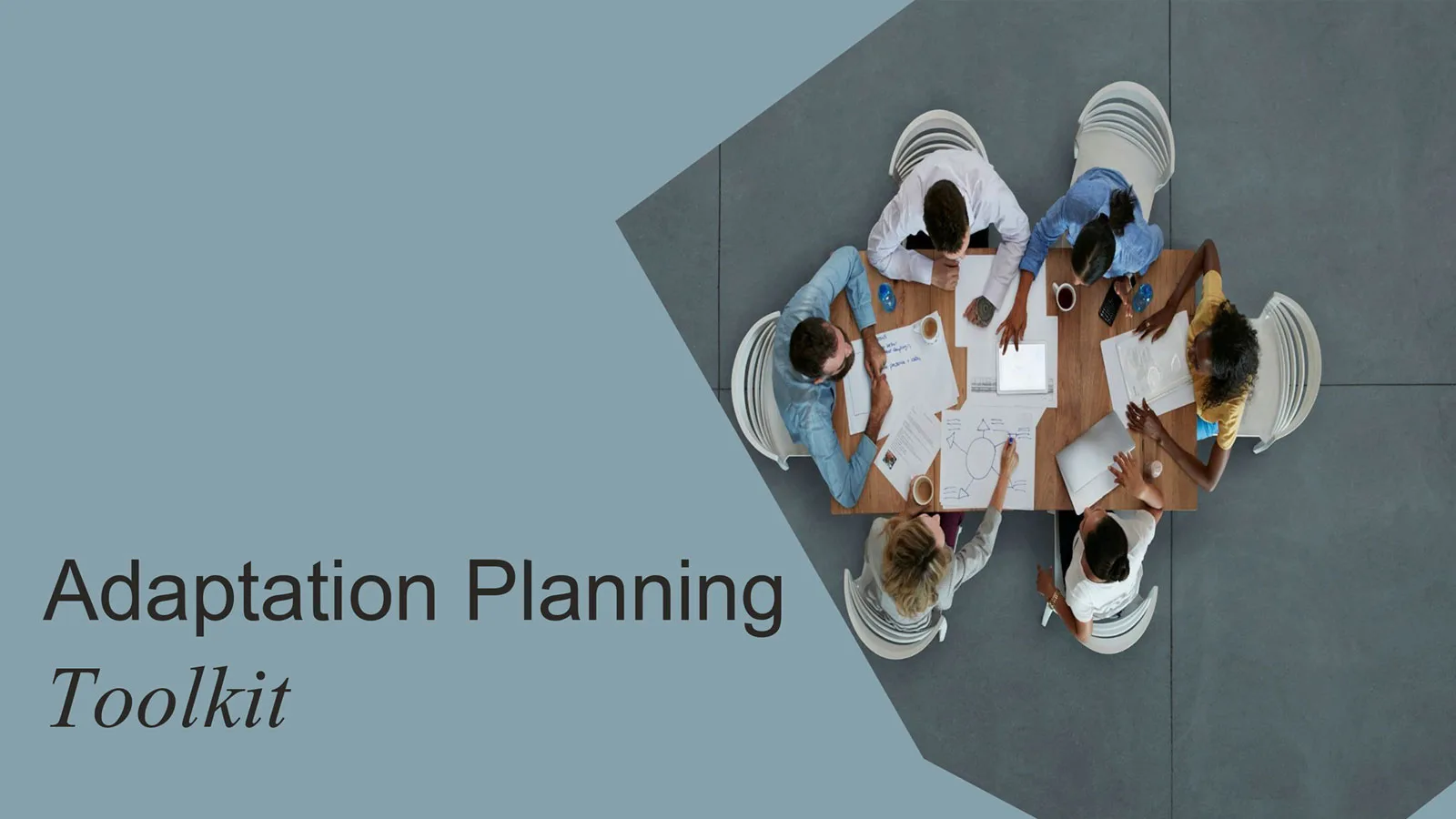
Building on the Accelerator Program sessions, company insights and the Adaptation Planning Guide for Business, this toolkit guides users through the steps of adaptation planning using practical worksheets and exercises. The worksheets can be used by sustainability, or risk leads to support the adaptation planning process, or shared across the organization to build internal capacity and broader engagement on adaptation.