Reflections from the Global Nature Positive Summit 2026 held in Kumamoto, Japan, alongside insights from discussions, including a leaders’ dinner co-hosted with WBCSD member SOMPO and supplemented by business case studies from the WBCSD member community.
The adoption of the Kunming-Montreal Global Biodiversity Framework created a shared global direction. Almost four years on, the focus is shifting from commitment to implementation: how governments, businesses, finance, civil society and academia can translate goals into action.
For businesses, that means a more practical question is coming into focus: what will it take to turn existing commitments into decisions, investments and business activity? The discussions at the Global Nature Positive Summit in Kumamoto, highlighted why this matters.
Japan’s philosophy of living in harmony with nature (kyōsei), finds a particularly relevant expression in Kumamoto, where nature underpins economic activity, local livelihoods, food security, cultural heritage, disaster risk reduction and community resilience. This reflects a wider reality across Asia, where economies and communities are deeply connected to natural systems and resources.
The Asia Pacific (APAC) is home to some of the world’s most biodiverse ecosystems, major global supply chains, rapidly growing economies and important financial centres. Many countries across the region also face significant exposure to climate and natural hazards, resource constraints and ecosystem degradation. Nature loss therefore has direct implications for economic resilience.
At the same time, there is no single APAC pathway to nature-positive implementation. Economic conditions, regulatory systems, market structures and institutional capacity vary significantly. This diversity makes it important to understand what works in different markets, under what conditions, and what can be adapted elsewhere.
Nature as a business decision
One of the clearest developments is that nature-related risks are moving into mainstream business discussions. Companies are looking beyond their direct environmental footprint to understand where they depend on natural systems, where those dependencies create exposure, and what this could mean for operations, supply chains and long-term performance.
Examples from the region show how this is beginning to translate into practice. Across 2025 and 2026, WBCSD led a regional Nature Reporting Preparer Forum cohort, supporting Southeast Asian companies with building capabilities to use TNFD’s LEAP approach to assess nature-related dependencies. We see that companies are using those assessments to inform business decisions and structure nature-positive action.
In real estate, we see that leading developers are integrating nature-related risks and opportunities into enterprise risk management, using these decisions to guide development, procurement of materials, operations and resilience. In the agriculture and food sector, some companies are applying similar approaches across operations and supply chains, connecting nature-related risks with enterprise risk management and capital deployment while assessing the financial value and returns associated with nature-related investments.
These approaches demonstrate an important shift. Nature-related information has value when it changes decisions: where a business is exposed, what that exposure means, and what action follows.
From better information to better economics
That shift also highlights what needs to happen next. Businesses need better information to make better decisions. Discussions in Kumamoto emphasised that “nature positive” is measurable, and in practice, will need to be supported by consistent metrics and a reliable picture of the ecosystems being measured.
The Nature Positive Initiative is working to harmonise approaches to measuring the State of Nature, while the Global Ecosystem Atlas is bringing national ecosystem data into a common global reference covering 110 ecosystem types. Together, these initiatives aim to improve consistency in how change is measured and where that change is taking place.
For companies and investors, the priority is making this information usable at scale. Data needs to be scientifically robust, comparable across markets and sufficiently accessible to support decisions. Interoperability and cost matter alongside the metrics themselves: simplifying tools, reducing duplication and lowering the cost of collecting and using nature-related information will support wider adoption.
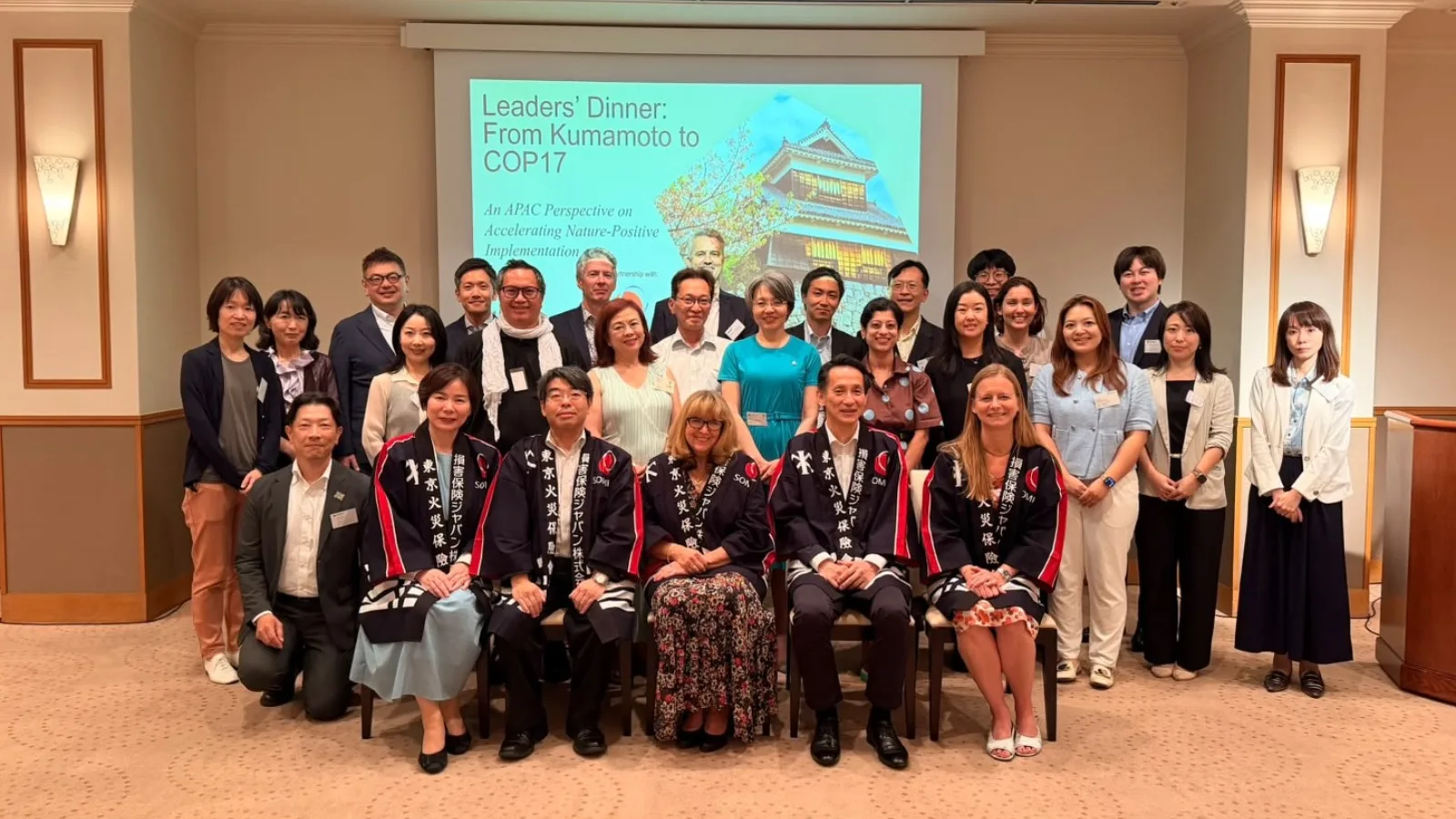
Together with WBCSD member SOMPO, we co-convened a Leaders’ Dinner in Kumamoto on the closing night of the Global Nature Positive Summit. We had 25 participants representing the private sector, international organisations, finance and government. It was clear that information alone will not deliver implementation at scale. Business action also depends on viable models, access to finance and incentives that reward better outcomes for nature.
Business for Nature’s work on incentives reform highlights the importance of changing wider market signals: redirecting public support towards activities that protect and restore nature and reforming incentives that continue to drive nature loss. For businesses, this means creating conditions in which nature-positive outcomes can create or protect economic value, while giving companies confidence that markets will reward those investments.
Building towards COP17
The direction of travel is becoming clearer. Business can demonstrate workable models, finance can help scale them, stronger data can improve decisions and governments can shape the conditions that support investment. Progress depends on these pieces moving together.
Kumamoto showed that APAC’s diversity can contribute practical lessons to that effort. Approaches developed in one market will not transfer unchanged, but the lessons behind successful implementation can.
Ahead of COP17, the opportunity for APAC is therefore to build on the examples already emerging, identify what is preventing wider adoption and bring practical evidence to the global discussion on how implementation can accelerate.
The next phase is about turning shared ambition into action at scale. For businesses, that means continuing to understand dependencies and risks, strengthening the information that supports decisions, and helping build the business models, finance and policy conditions needed for nature-positive action to become more widely achievable.
Outline