Reporting

Reporting involves the systematic collection, measurement, and disclosure of data related to a company’s carbon emissions, carbon credit purchases, and their impact on reducing the company’s overall carbon footprint.


These resources were curated with help from Bain & Company.


The topics Claims, Reporting and Communication are all interlinked, however the scope can be clarified as follows:

  • Claiming is the act of announcing the effort and result of voluntary mitigation action.
  • Reporting generally requires transparent, intelligible, and sufficient disclosure on not only usage of carbon credits, but also its connection with overall decarbonization journey (e.g. direct and indirect emissions, SBTi targets, emissions reduction measures and the results, and support for beyond value chain mitigation action).
  • Communication involve sharing information about sustainability initiatives with internal and external audiences to build trust and demonstrate commitment to environmental responsibility.

There are limited authoritative guidelines and standards related to the reporting and claiming of carbon credits, therefore, corporates now have the flexibility in how to report and claim their efforts. As government regulations and VCMI come into the field, corporates will have more guidance to follow.


Key Principles to Consider:

Compliant with Regulations and Standards

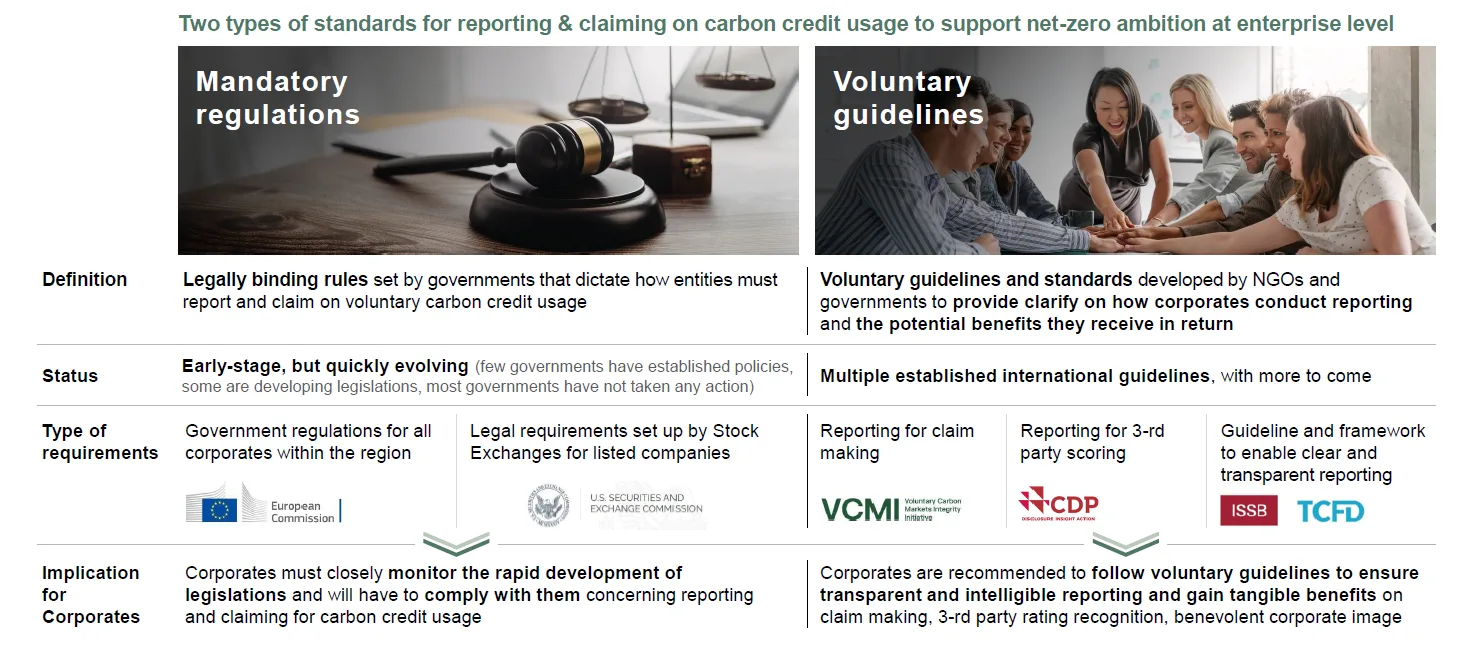
Corporates must abide by governmental regulations, such as EU Commission, to meet mandatory requirements Corporates should aim to follow leading standards, such as ISSB, CDP and VCMI, to report and claim with confidence and integrity.

Sufficient and Regular Communication

Backed by high integrity credit purchases and claims, corporates should aspire to leverage transparent and regular reporting as means to set the example for corporate contribution to societal targets, facilitate improvements to quality and disclosure standards, and avoid the pitfall of green-hushing.

Cohesive Storytelling

Corporates should, where possible, make the linkage between carbon credit purchases with overall net zero strategy and transition plan in the report narrative, and highlight how such purchases help to serve broader brand purpose.

Mandatory regulations and voluntary guidelines.

RESOURCES

  • For corporates to comply with governmental regulations. Proposal for legislation to require corporates to mandatorily disclose the usage of carbon removal credits. EU will require corporates in the region to publicly communicate the usage of carbon removal credits, and receive certification to prove the quality of credits.
  • For listed companies to report to investors responsibly. Proposal for rules on the use of carbon credits and rules for disclosure and reporting. Recent SEC proposal requires large public US companies to disclose scope 1/2/3 emissions and discuss the role of offsetting and display volumes separate from emissions.
  • For listed companies to report to investors responsibly. The Climate-related Disclosure requires companies to link corporates’ transition plan with carbon credit usage. Company required to disclose the number of carbon credits necessary to reach the company’s net zero goals.
  • For corporates to obtain a rating as recognition. A detailed section on carbon credits added into corporate climate change questionnaire, which serves as important input for the CDP scoring.
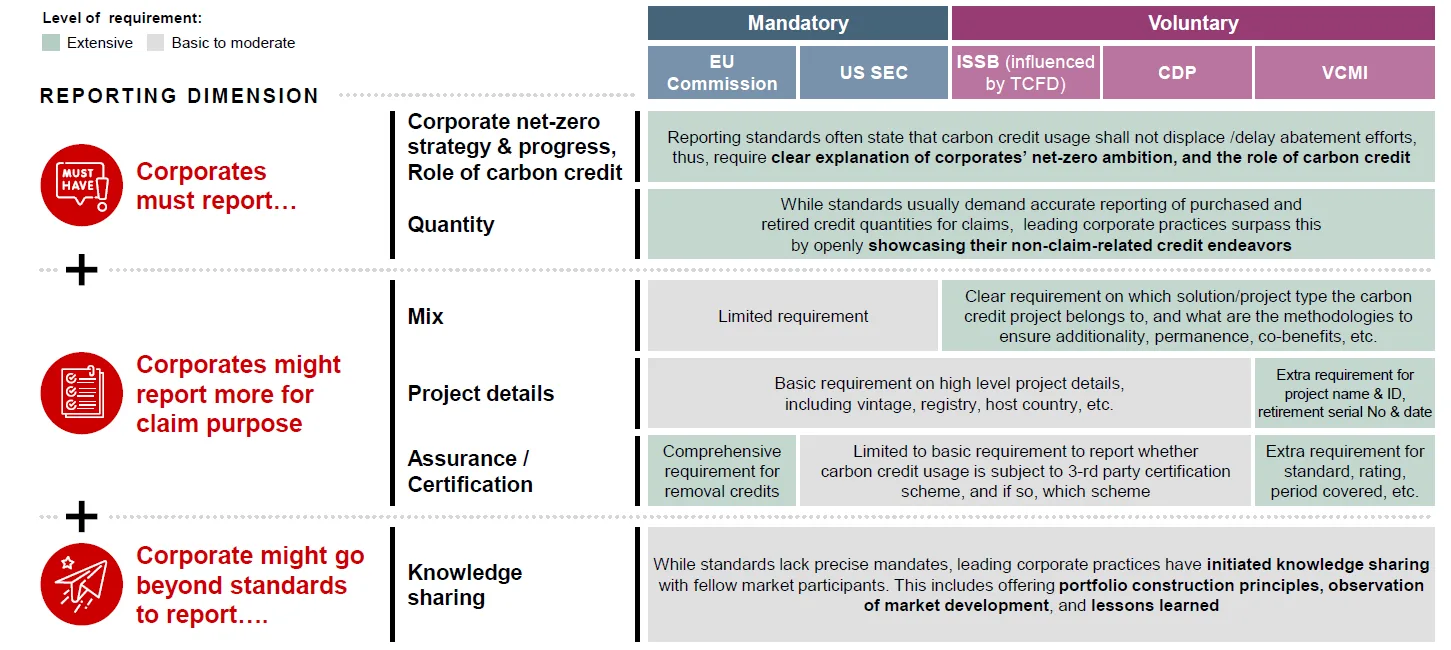
Mandatory and voluntary reporting.