Integrated Transition Planning Tool
Published: October 26, 2026
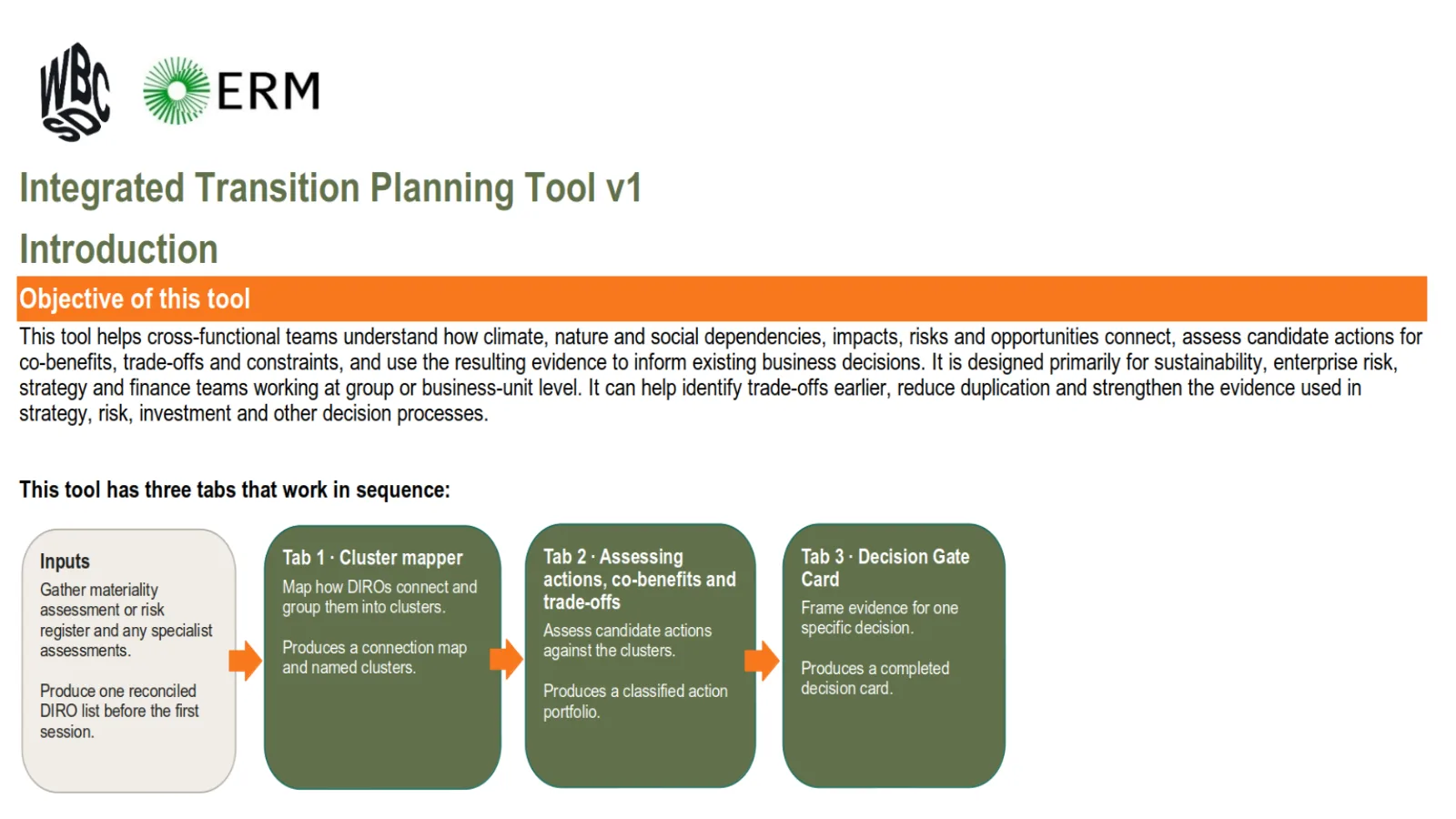
Companies increasingly need to consider climate, nature and social factors together, rather than through separate plans and processes. The Integrated Transition Planning Tool, developed by WBCSD and ERM, provides a way to connect these issues and use the resulting evidence in business decision-making.
This first version provides a practical starting point for integrated transition planning and will be strengthened over time with company application, emerging practice and landscape developments.
This resource builds on our earlier primer, Integrated Transition Planning: A Short Introduction. The primer explains why climate, nature and social considerations need to be connected, the value that integration can create, and the governance foundations, KPIs and decision rules that can help companies begin. The new tool takes the next step by translating that framing into a practical, three-part process that teams can apply within existing business decisions.
Designed for sustainability, risk, strategy and finance teams, the tool helps companies build a shared view of material dependencies, impacts, risks and opportunities across climate, nature and social dimensions. It supports earlier identification of co-benefits and trade-offs, reduces the risk of fragmented action, and creates a structured input to existing strategy, risk, capital and governance processes.
The tool is intended as practical guidance and capacity building. It does not replace a company’s materiality assessment, financial appraisal, business case, technical assessment or formal approval process, and should be adapted to existing enterprise risk management, capital planning, strategy and governance arrangements.
What’s inside
- Tab 1 – Cluster Mapper: map connections between material dependencies, impacts, risks and opportunities, then group them into business-relevant clusters
- Tab 2 – Actions assessment: assess candidate actions and distinguish bundled benefits, managed trade-offs and red lines
- Tab 3 – Decision Gate Card: carry the reviewed evidence into a specific decision, including assumptions, conditions, owners, residual exposure and revisit triggers
- Optional AI Assist prompts: support initial drafting while keeping validation and judgement with management and subject-matter experts
- Meridia Chemicals and Northstar Digital Infrastructure worked examples: demonstrate the full process through fictional companies, including applications to risk appetite, strategy and target-setting, capital investment, and sourcing and procurement
Supporting introductory and walkthrough videos are also provided, offering an overview of the approach and practical guidance on completing each part.
How the tool helps
- Creates a connected view of climate, nature and social issues without treating connection density as a proxy for materiality
- Makes co-benefits, trade-offs and hard constraints visible before actions are approved
- Links sustainability evidence to the business issue, accountable owner and decision forum
- Supports more consistent discussion across sustainability, risk, strategy, finance, operations and procurement
- Records what was known, accepted and committed to, while preserving uncertainty and evidence gaps
Used together, the tool and worked examples provide a practical starting point for companies seeking to strengthen integrated thinking and consider the connected implications of a changing world within existing business decisions.