The work supports the development of aligned measurement and accountability systems that enable decision-making and investment across agrifood value chains.
By strengthening how sustainability performance is measured, reported, and used, we help businesses, investors, and policymakers move from fragmented signals to shared success criteria. This creates conditions for credible action, effective collaboration, and capital allocation that supports resilient and regenerative land use at scale.
The Challenge
The Business Case
The Solution
We are building the accountability systems needed for decision-making and investment:
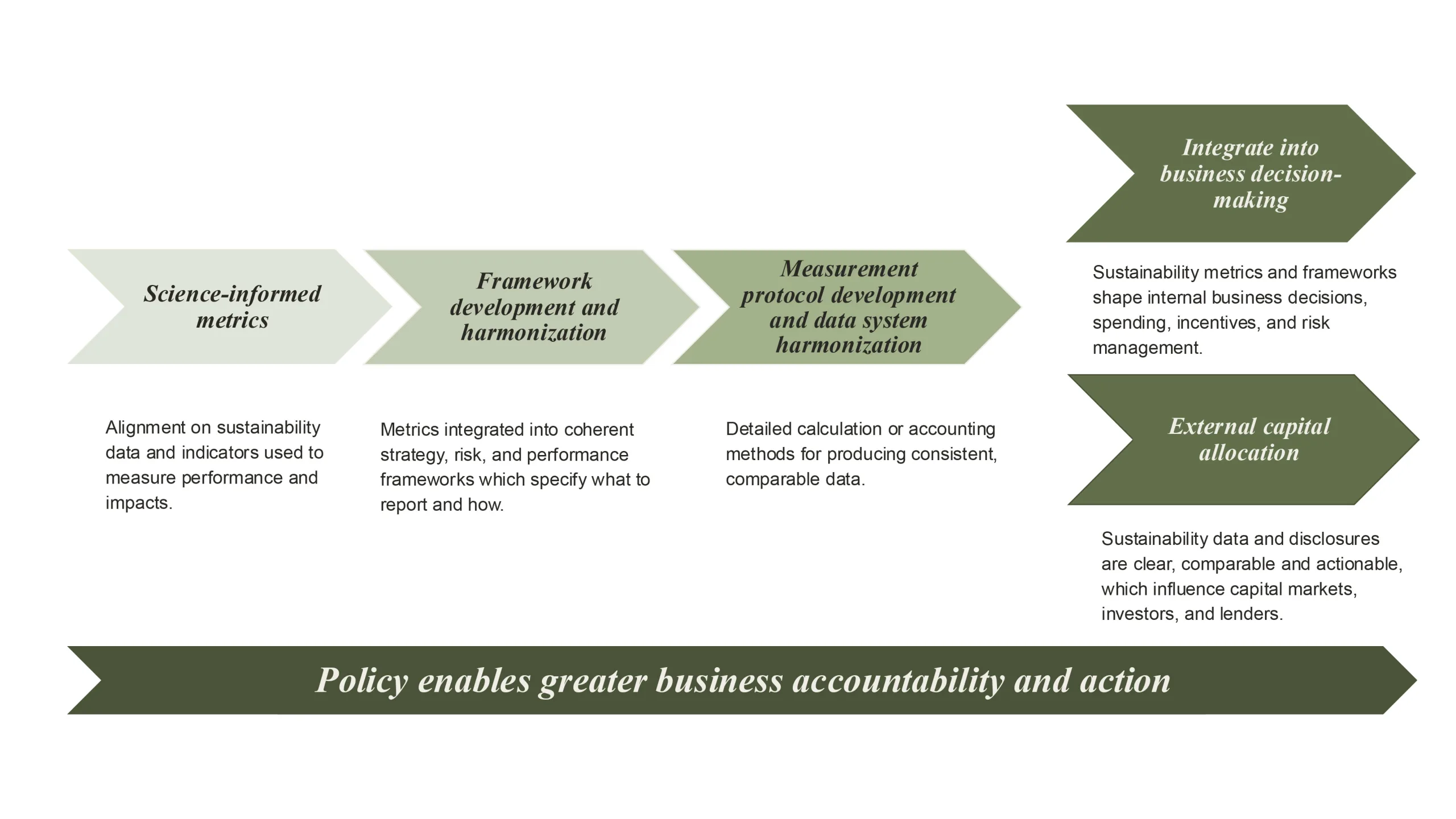
Our work focuses on the following connected areas:

We actively engage with standards and frameworks to ensure they incentivize sector-specific outcomes in agriculture and land use.

We develop and communicate clear policy asks that enable business accountability and action.

We facilitate peer exchange so companies can learn from each other as they integrate sustainability outcomes into strategy, procurement, and performance management.

We drive ecosystem convergence around a holistic set of core outcomes and indicators for regenerative agriculture and sustainable land use.

We support investors and financial markets to integrate these outcomes into valuation and capital allocation.

We advocate for harmonized and effective measurement and accounting approaches that enable consistent, comparable, and decision-useful data.
Related Areas
Driving Convergence and Action on Regenerative Agriculture Outcomes
WBCSD brought together businesses, standard-setters, and experts to define and align on a shared set of regenerative agriculture outcomes. By establishing a common language and measurement approach, it helps companies and value-chain partners scale implementation and track progress consistently.
Scope 3 Action in Land-Based Value Chains
WBCSD supports companies in moving from Scope 3 commitments to practical implementation across land-based value chains. The Scope 3 Toolkit provides guidance and tools to reduce emissions, engage suppliers, and connect climate action with nature, livelihoods, and resilience.
Rice Methane Action Alliance (RMA)
WBCSD has launched the Rice Methane Action Alliance (RMA) in 2025, which aims to mobilize and scale business-driven actions and co-investments to accelerate the global transition to low-emission and climate-resilient rice cultivation at field-level.