Insurability and Resilience to Physical Risk
Published: November 5, 2026
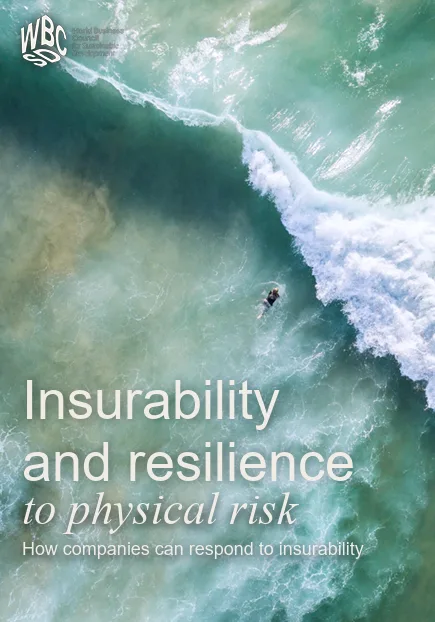
Physical risks are reshaping the cost and availability of insurance cover, with implications for asset values, financing and business continuity. Insurability and resilience to physical risk provides practical guidance for companies responding to this changing risk environment.
Designed for business leaders and teams across sustainability, finance, risk, insurance, operations and procurement, the report explains why insurance should increasingly be treated as a strategic variable rather than a routine procurement issue. It shows how insurance market signals can inform physical risk assessment, adaptation planning, capital allocation, site and supply-chain decisions, and engagement with lenders and investors.
The report complements WBCSD’s Physical risk and resilience in value chains: A CEO handbook and Adaptation Planning for Business, and looks ahead to the forthcoming guide Value Chain Visibility: Navigating Risk, Integration, and Growth. Together, these publications help companies identify physical risks, build decision-relevant insight across suppliers, shared infrastructure and downstream markets, and develop resilience strategies; this report focuses on how changing insurance conditions translate those risks into strategic, financial and capital-allocation consequences.
What’s inside
- Risk assessment: enhance physical-risk data, modelling, scenario analysis and early-warning systems
- Risk transfer: monitor insurance market conditions and optimize risk financing and transfer strategies
- Risk reduction: use insurers’ risk-advisory capabilities and invest in resilience across the business model and value chain
- Financing: deepen engagement with lenders and investors as resilience and insurability become more prominent in financing decisions
- Collaboration: participate in wider efforts to improve prevention, systemic resilience and public-private risk sharing
How the framework helps
- Helps companies interpret insurance pricing, coverage and terms as forward-looking signals of vulnerability
- Connects physical-risk and adaptation analysis to financial planning, risk financing and capital-allocation decisions
- Clarifies that resilience can create value through avoided losses, improved business continuity, maintained insurance access and potentially better financing conditions
- Supports closer coordination across sustainability, finance, risk, insurance, operations and procurement
- Provides practical examples of emerging approaches, including parametric cover, captives, catastrophe bonds and insurer-supported resilience measures
Taken together, the recommendations provide a practical roadmap for companies to combine adaptation planning with an insurance-informed view of resilience, helping them protect enterprise value, maintain access to affordable risk transfer and capital, and contribute to wider long-term resilience.
To find out more about WBCSD’s work on physical risk and resilience and/or to get involved, please contact cp-a@wbcsd.org.