Explore the business case for nature at a hydropower plant (by Engie)
Disclaimer
The case study presents a conceptual assessment of how nature-related interventions may contribute to the long-term resilience and value of hydropower assets. Hydropower generation is influenced by multiple factors, including system-wide dispatch decisions, regulatory frameworks, market conditions and operational constraints, so electrical generation outcomes cannot be attributed solely to local environmental conditions or restoration activities.
Any projected energy generation or financial benefits should therefore be regarded as illustrative and indicative in nature, rather than as forecasts or assurances of future operational performance. As such, the results presented are intended as hypothetical scenario analysis and for exploratory purposes only. They are based on conceptual scenarios and assumptions designed to assess potential linkages between nature-related interventions, watershed resilience, and long-term asset value.
The interventions considered form part of this exploratory assessment and were examined to better understand these potential linkages and the possible benefits under different scenarios. Their inclusion in the study does not indicate a decision regarding future implementation.
In addition, the potential outcomes described may depend on actions undertaken by multiple stakeholders across the watershed and should not be attributed solely to actions undertaken by ENGIE.
The findings presented in this case study are specific to the assumptions and context considered and should not be interpreted as representative of a broader hydropower portfolio. Any application of the methodology to other assets would require asset-specific and basin-specific analyses. In addition, the information and figures presented in this case study should not be interpreted as financial guidance, investment commitments or statements regarding ENGIE’s expected future performance.
KPIs
- +5.84% — maximum potential NPV uplift under max restoration scenario in 20 years
- +26.6% in habitats supporting water purification and flow regulation
Solution summary
An exploratory practical example on how to translate in financial terms the potential business case for Nature and Water restoration on a hydropower plant.
Context
ENGIE is a French multinational energy company operating in 30 countries. As a large infrastructure owner and operator, the company faces relevant challenges from climate and nature disruption, including physical risks and changing environmental conditions that may affect the operational viability and resilience of assets across its activities.
ENGIE has established commitments and policies addressing climate, biodiversity, water and forests, aligned with international frameworks such as the Paris Agreement and the Kunming‑Montreal Global Biodiversity Framework. The company’s targets are validated through SBTi, and it contributes to the SBTN and TNFD initiatives.
Within WBCSD’s work on “Building the business case for nature interventions”, ENGIE has contributed to the development of an exploratory case study based on a hydropower plant. The study assesses the potential financial viability of nature and water‑related interventions, under specific modelled assumptions, aimed at maintaining the plant’s long‑term operational performance. It provides estimates of the potential financial effects of selected interventions and examines how they could support operational resilience.
Location withheld for confidentiality
Solution
The case study asset is based on a hydroelectric plant and sought to quantify the potential additional benefits from bespoke interventions on immediate cashflow, long-term protected asset value, and the avoided costs of inaction. Additionally, it also explored the potential broader socio-economic benefits for local communities and other economic activities within the water basin, as a responsible corporate actor. At this stage, these potential benefits are modelled and have not been verified through implementation or monitoring.
This analysis has:
- Mapped the asset’s value chain and lifecycle, to locate its nature-related dependencies, impacts, risks and opportunities
- Mapped the asset’s contributing catchment and wider water basin
- Conducted geospatial mapping and analysis of the different land-use types across the basin
- Mapped plausible Nature & Water interventions against material dependencies and impacts
- Tested each Nature & Water intervention for potential cash-flow or asset value relevance, and technical viability
- Estimated the modelled positive benefits from each relevant intervention over the asset’s remaining lifecycle
- Estimated the potential costs of the intervention set
The interventions that have been modelled include:
- Restoration / reforestation of areas identified as previously forested savannah and grassland: up to 265.6 KM2 (Max)
- Conservation of existing non-commercial forest-lands and wetlands: up to 731.5 KM2 (Max)
This analysis suggests that, based on the assumptions applied in the model, these interventions could deliver the following benefits for ENGIE’s hydropower plant over a 20-year timeframe depending on the scale of intervention selected.
The table hereafter represents the breakdown of additional revenue generation across the timeframe and Net Present Value uplift based on the different scenarios:
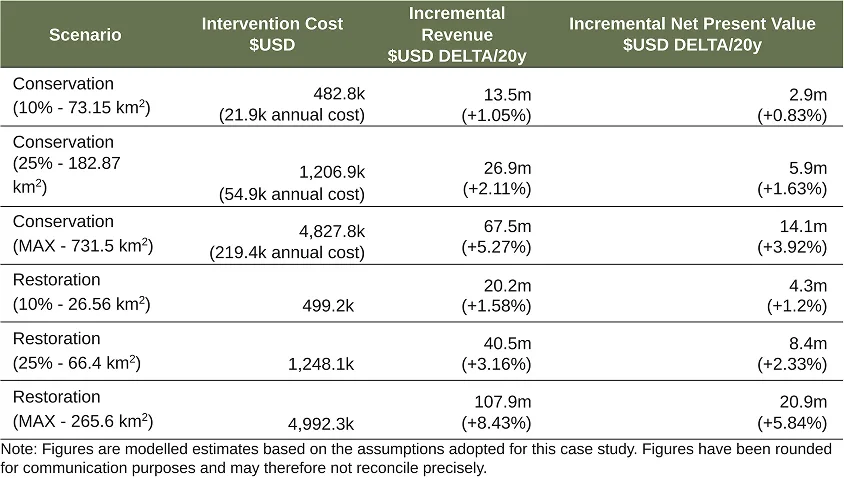
This analysis suggests that these interventions could potentially deliver the following benefits for communities and other stakeholders within the sub-basin:
- Increase in habitats from baseline supporting water purification and flow regulation ecosystem services: 26.6%
- Local populations’ water consumption supported: ~860,000
Impact
Sustainability impact
- Nature: preserved and enhanced ecosystem services, including water provision and water flow regulation, soil erosion prevention, supporting local ecosystem biodiversity;
- Climate: direct adaptation measures to protect against destabilising climate regulation ecosystem services;
- Social: secondary collective economic benefits for 3rd party stakeholders – such as neighbouring agricultural landholders, local employment in restoration and monitoring – providing increased long-term stability of water purification and flow regulation ecosystem services
Business impact
- Benefits, net revenue generation over remaining concession lifespan: increased energy generation, improved revenues and cash-flows
- Benefits, long-term asset viability and NPV: embedded asset resiliency through protecting assured energy generation, maintaining long-term asset valuation;
- Benefits, collective and basin-scale: longer-term stability of Nature-related dependencies, preserving operational viability and asset productivity;
- Benefits, social and stakeholder: proactive maintenance of concession license, social-license-to-operate, increased climate and water flow regulation for local 3rd party stakeholders, contribution to stakeholder engagement and to broader watershed resilience for communities and other stakeholders;
- Costs: implementation CAPEX required, implementation and maintenance expenditures, subject to the scope, scale, and design of the interventions.
Implementation
Typical business profile
Most relevant for organizations in: energy, infrastructure. More specifically relevant for hydropower asset owners and operators and other water-dependent assets.
The applicability and results of the approach will vary depending on the asset, location, basin characteristics, regulatory framework, operational conditions and stakeholder context.
Approach
Step-by-step implementation
- Map the asset’s value chain and lifecycle and identify the contributing catchment. In a cascade, work out which catchment area delivers to the relevant asset.
- Locate the nature-related dependencies and impacts for the asset, then map them to specific measurable physical mechanisms, e.g. sediment dynamics, water flow regulation, and local nature.
- Test the viability of financial transmission route for each mechanism, i.e. what physical element needs to be measured, contractual or regulatory drivers relating to each element, that can translate to cash flow. Some mechanisms will prove to be non-viable at this stage.
- Develop a series of potential Nature & Water interventions against each mechanism. These are actions that could substantively alter a measurable input for each mechanism.
- Segment the intervention set by agency. What the company can do alone on land or assets it controls; what would require cooperation with other stakeholders across its own sub-basin; and what requires large-scale collective action, i.e. the whole basin acting together. These will introduce confidence boundaries for the effectiveness of interventions.
- Establish the observable baseline for all mechanisms and financial transmission routes that appear viable. This forms the evidence base for building the business case.
- Financialise each mechanism and intervention over the asset’s remaining life, not a standard payback horizon. For example, these could include avoided OPEX, deferred capital replacement, avoided cost of inaction and existing value protected. Apply cashflow discounting, and state what the benefit lag does to present value.
- Cost the intervention set across the full maintenance period. Compare these costs against the conventional engineering approaches where one exists. The cost estimates include the implementation, maintenance and monitoring. Additional costs associated with stakeholder engagement and applicable environmental and social regulations would be asset-and-jurisdiction-specific.
- Apply a unilateral viability test to each intervention – calculate the maximum share of intervention cost the company could bear alone while remaining NPV-positive – i.e. where the positive effects of the intervention, even on collective-scale actions, are worth implementing even if the company were to bear all costs. This is to reframe the problem of ‘free-riding’, whereby other stakeholders also benefit from interventions, to emphasise that interventions may be viable even if the company does not capture ALL benefits accruing from the intervention, if the benefit captured is still greater than company expenditure. Partner contribution then becomes an additional upside rather than a precondition for acting.
- Summarise and report the magnitude of both financial and impact benefits by intervention to relevant company stakeholders. Seek internal alignment and approval for budgetary allocation on relevant interventions. Note: It is likely that a single asset may return a modest benefit in the short-term while the same method applied across a portfolio, or across the remaining life of a concession, returns a significantly larger one.
- Develop the monitoring framework by intervention as a critical element during implementation planning. At a minimum, an assured verifiable baseline, the attribution method, data capture cadence and the reporting interval.
Stakeholders involved
Project Leads: Group and regional sustainability teams, Asset environmental management and sustainability teams
Internal Functions: Operations and maintenance, asset management, energy management and regulatory affairs (for the assured-energy implications), finance, procurement, community relations, environmental compliance, risk management
Main Providers: Upstream landholders and agricultural producers in the contributing catchment; restoration and soil bioengineering contractors; native seedling nurseries
Other Stakeholders: Water basin committee and relevant water authorities; other cascade operators upstream and downstream, whose reservoirs both buffer and share the effects; the environmental agencies and forest institutes; municipalities and rural producers’ associations; the relevant regulators and public authorities.