Drive nature action in your supply chain
Supported by | PwC Switzerland
Summary
Downstream companies do not need to wait for perfect supply chain data to take credible action on nature. Drawing on discussions with WBCSD members, we show how companies – particularly those sourcing from agri-food and forest-product value chains – can build on information they already collect.
By selecting metrics that support clear decisions, combining complementary data to build a fuller picture of sourcing risks, and embedding insights into supplier engagement and procurement processes, companies can prioritize action where it matters most. These approaches can strengthen accountability and help companies target engagement, investment and sourcing decisions, with the aim of progressively improving supply chain visibility, data availability and supplier performance over time.
Here, we focus on driving supply chain action on nature. We consider how downstream companies can encourage and support action beyond their direct operations, particularly at the sourcing locations where many impacts on nature occur. We explore the challenges businesses face and the emerging approaches they are using to identify, apply and disclose nature-related metrics.

Context
We are publishing a series of Business Primers presenting insights and case studies that show how businesses are applying metrics in practice to measure progress on their nature-related actions. The Primers contribute to WBCSD’s efforts to drive further consistency in how companies measure progress, in the absence of an agreed set of methodologies that would enable harmonization at scale and reliable comparability between peers.
They provide practical recommendations for practitioners on how to apply metrics for different purposes: prioritizing action, measuring the results of interventions, building the internal case and comparing nature interventions with other investments, engaging suppliers, or identifying contributions to global goals such as the Global Biodiversity Framework. Externally, they can help a company to explain, with evidence, its progress in addressing significant nature-related dependencies, impacts, risks and opportunities to stakeholders.
The Primers also support companies that wish to use the Nature Action Portal as a tool to identify sector-specific actions and related metrics to disclose progress in alignment with key frameworks.

Our target audiences
We aim to reach sustainability and procurement practitioners in downstream companies working across complex supply chains.
The challenge
Why this matters to downstream companies
Our Insights into Nature-related Metrics and Target-setting along the Value Chain report, published in 2025, identifies three key challenges for downstream companies:
- Selecting metrics that are feasible and relevant for indirect spheres of influence;
- Moving beyond proxy metrics when supply chain visibility is limited; and
- Defining credible pathways to set nature targets.
These challenges remain particularly relevant for companies operating far from the sourcing locations where impacts on nature occur. Here, we build on these findings and ask a more practical question: Where are companies making progress and what can others learn from their experience?
Drawing on the experience of companies participating in the WBCSD working group, we provide practical insights into how nature-related metrics can:
- Support procurement and sourcing decisions;
- Improve supply chain visibility; and
- Strengthen supplier engagement.
How the Nature Action Portal can help
The WBCSD Nature Action Portal helps practitioners identify the most relevant metrics to measure and report on their actions to halt and reverse nature loss, in alignment with major voluntary and regulatory frameworks.
From a supply chain perspective, these metrics fall into four categories:
- Supply chain visibility and prioritization;
- Certification and standards;
- Supplier engagement for action;
- Conservation and restoration.
These four categories provide a simple structure for exploring how companies can move from understanding risks to taking and measuring action.
| Category | Description | Example of metrics (Nature Action Portal) | ||
|---|---|---|---|---|
 |
Supply chain visibility & prioritization | Metrics that help identify high-risk commodities, traceability to origin, deforestation alerts and priority sourcing areas. | Natural ecosystem presence | |
 |
Certification & standards | Metrics that track certified volumes, certification type, certified sourcing areas and incidents of non-compliance. | Area (and share) of FMUs/sourcing areas certified by forest certification standards | |
 |
Supplier engagement for action | Metrics that capture supplier commitments, nature disclosures, agreed improvements and implementation of supplier action plans. | Proportion of suppliers engaged on priority nature issues identified during assessments by spend or volume | |
 |
Conservation & restoration | Metrics that measure ecosystems under sustainable management, conserved or restored areas and restoration-related outcomes. | Area (and share) of degraded land restored |
Certification, supplier engagement and area-based metrics (for example, area restored or certified) show where action has been taken or processes are in place. On their own they do not show ecological recovery, which requires condition or species data measured against a baseline.
Applying the categories in practice
The four categories provide a useful structure for thinking about how metrics can support supply chain action. Discussions with WBCSD members indicate that, in practice, companies do not use these metrics in isolation or follow a fixed sequence. Instead, they often combine metrics from several categories at the same time, depending on the decision they need to make, the information already available, and the level of supplier engagement they are seeking.
The insights below explore what this looks like in practice: starting with the decision to be supported, combining complementary sources of information, and linking metrics more clearly to supplier follow-up and procurement processes.
Discussions with WBCSD members also highlighted the importance of greater alignment and harmonization across supplier requests, questionnaires and metrics. More consistent approaches can help reduce duplication, improve comparability and enable companies and suppliers to use information across reporting, due diligence, and procurement processes.
Practical insights for downstream companies
Downstream companies already collect a wide range of nature-related information through certifications, supplier questionnaires, audits, traceability systems and due diligence processes. However, this information is often fragmented and relies on proxy indicators rather than direct measurements of nature-related outcomes.
Expectations regarding supply chain information are also increasing. Reporting frameworks, certification requirements and emerging due diligence and traceability regulations (for example, the EU Deforestation Regulation) are driving companies to collect more consistent, decision-useful information and improve visibility across their supply chains. Yet, many companies still face challenges in identifying the metrics and information that are most useful for prioritization, supplier engagement and procurement decisions.
In this context, companies are looking for metrics that can support decision-making in addition to fulfilling reporting and due-diligence obligations. They are asking how the information they already collect can help identify priority risks, strengthen supply chain resilience, engage suppliers and guide action on nature.
Leading companies are increasingly using nature-related information, such as traceability data, supplier assessments, and certification data, to identify priority impacts, dependencies, risks and opportunities across their supply chains and to inform sourcing, supplier engagement and investment decisions. Rather than relying on a single source, they are bringing together different datasets and connecting them more directly to supplier engagement and procurement processes. The insights below show how businesses can do this in practice.
Insight #1 – Decision-usefulness matters more than granularity
Discussions with WBCSD members suggest that, for downstream companies, the most useful nature-related metrics are not necessarily the most detailed, but the ones that help guide decisions. In complex supply chains, companies often need to decide where to focus supplier engagement, which sourcing regions require closer attention, and where to direct resources or investment. This suggests that metrics are most useful when selected based on the action or decision they are intended to support.
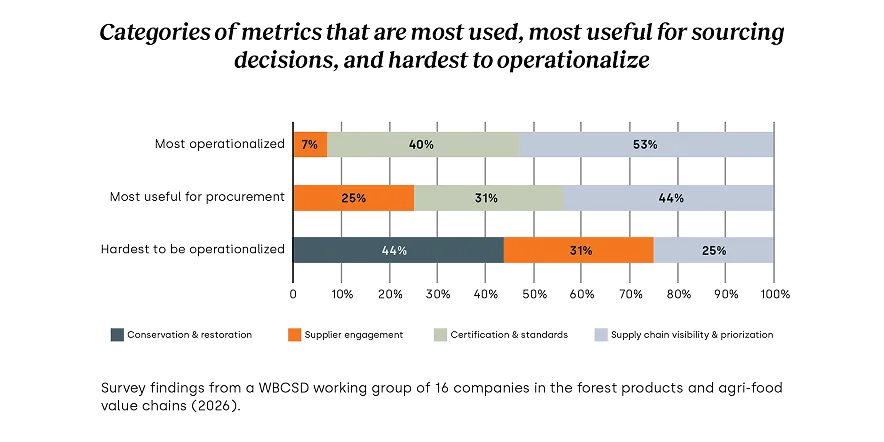
This is also reflected in the feedback from WBCSD members (see Categories of metrics that are most used, most useful for sourcing decisions and hardest to operationalize below), which shows that supply chain visibility and prioritization metrics are seen as both the most operationalized and the most useful for procurement. Certification and standards metrics also appear to be relatively well established in practice. Businesses can often integrate both into existing due diligence, traceability and sourcing processes.
Feedback from members also suggests that metrics related to supplier engagement, conservation and restoration can be harder to operationalize consistently across complex supply chains. Their use often depends on more granular data, stronger supplier relationships and longer timeframes for tracking progress.
Taken together, these insights suggest that companies are starting by asking what decisions they need to make and what level of information they need to support them. For example, country- or regional-level information may be enough to prioritize sourcing hotspots, while more detailed supplier- or farm-level data may be needed to guide engagement or assess performance.
WBCSD member example
Nestlé combines footprint data with state of nature metrics (those that measure the quality of the environment in relation to the functions that it fulfils), including ecoregion intactness, species extinction risk and proximity to protected areas. These metrics describe conditions at sourcing locations to guide prioritization, allowing the company to rank sourcing regions and identify priority ecosystems, helping sourcing teams focus engagement and investment where nature-related risks and opportunities are the most significant.
What this means for practitioners: Prioritize metrics that support decisions
- Start with the decision: Select metrics based on the decision or action they need to support.
- Focus efforts: Prioritize commodities, sourcing regions and suppliers based on the significance of nature-related issues, not only on data availability or ease of engagement.
- Move from visibility to action: Use improved visibility to guide supplier engagement and investment.
- Build over time: Introduce more granular metrics as supply chain information and engagement improve.
Insight #2 – Combining data sources builds a fuller picture
WBCSD members highlight that no single source is generally sufficient on its own to understand nature-related issues across complex supply chains. Certification remains an important foundation for responsible sourcing and supplier assurance. However, leading companies increasingly complement certification with traceability, due diligence, geospatial information and other data sources to support decision-making and gain a better understanding of whether their actions are delivering the intended outcomes.
Different sources play different roles. For example:
- Certification data can provide a common baseline on supplier practices.
- Traceability data can improve visibility into sourcing origins.
- Supplier questionnaires and due diligence can provide information on practices and actions.
- Geospatial data can add context on nature-related risks in sourcing locations.
- Procurement and sourcing data can help connect these insights to business decisions.
A-Track’s Integrating nature information into decision-making and Building narratives through nature data provide further guidance on how businesses can bring such sources together.
These sources mostly show practices and pressures: whether standards, controls and engagement are in place, and whether drivers such as conversion are decreasing. They do not, on their own, show that ecosystems have recovered. Hectares certified, restored or covered by supplier engagement indicate where action has been taken; showing recovery requires condition or species data measured against a baseline. Supplier declarations are useful inputs but are rarely sufficient on their own to support an external statement.
Combining these sources can provide a clearer basis for identifying where risks are concentrated and where further supplier engagement or investigation is needed. The appropriate combination will depend on the commodity, the maturity of available certification and traceability approaches, and the decision the information needs to support. Companies can build on existing information and refine their approach as supply chain visibility and data availability improve.
WBCSD member example
One company has implemented a risk-based due diligence approach across forest-risk commodities, building on certification as an important baseline whilst complementing it with additional tools and sources of information where needed. Alongside certification systems, the company draws on supplier declarations, independent verification processes, audits, traceability data and, where appropriate, geospatial monitoring to strengthen visibility across its supply chain in high-risk areas.
The company also noted that effectiveness could be further enhanced through the development of common definitions, methodologies and data standards across the sector. Greater alignment in these areas would facilitate more consistent interpretation of information, improve interoperability between systems, and support more efficient data sharing and verification across value chains.
The company’s approach combines multiple sources of information to assess and manage risk, enabling resources and engagement efforts to be directed where they are needed most.
TNFD’s Guidance on value chains similarly emphasizes that the required level of traceability depends on the decision being made. Country- or regional-level information may be sufficient for initial screening and sourcing prioritization, while supplier- or farm-level information may be needed to assess performance or guide targeted action.
What this means for practitioners: Combine complementary information to guide action
- Build on existing information: Start with data already collected through sourcing, certification, due diligence and external datasets.
- Know what each metric shows: Distinguish between actions (response), pressures and ecological state, and avoid presenting action metrics as evidence of recovery.
- Combine complementary sources: Use different types of information to address gaps and add context.
- Adapt the approach: Select the combination of information that is appropriate for the commodity and sourcing context.
- Link data collection to action: Only request additional information when its intended use is clear, including what evidence would be needed to support any external statement.
- Improve over time: Refine the metrics and information used as visibility and supplier engagement increase.
Insight #3 – Integration into procurement is what turns metrics into action
Discussions with WBCSD members suggest that nature-related metrics are most useful when the information collected informs supplier follow-up and procurement decisions. In practice, that often means integrating metrics into existing processes, such as supplier onboarding, sourcing criteria, scorecards, corrective action plans and supplier reviews.
This also requires clarity on how the company will use the information. A metric may lead to further supplier dialogue, a corrective action or remediation plan, additional support, or a change in sourcing decisions. Without a clear link to follow-up, additional data collection can increase the reporting burden for suppliers without influencing action.
WBCSD member example
Tetra Pak embeds sustainability expectations, including on nature, into supplier scorecards, category planning and other procurement routines through its Join Us in Protecting the Planet program. Strategic and high-impact suppliers complete a yearly questionnaire adapted to their category, responses are reviewed and gaps followed up, and suppliers receive a scorecard and tailored support. Sustainability, procurement and category management teams collaborate on delivery, and requests are tailored to stay relevant.
What this means for practitioners: Make supplier metrics actionable
- Use existing processes: Integrate nature-related expectations into supplier onboarding, reviews and sourcing criteria.
- Define the follow-up: Establish how the information collected will influence supplier engagement or procurement decisions.
- Reduce duplication: Build on existing supplier information, align requests across internal teams and support common approaches that make evidence easier to reuse across customers and reporting processes.
- Clarify responsibilities: Align on how metrics will be applied, agree shared ownership of the data, analysis and follow-up across procurement, sustainability, operations and finance.
- Support improvement: Where appropriate, use metrics to define corrective actions and pathways for suppliers to demonstrate progress.
Four principles for practitioners
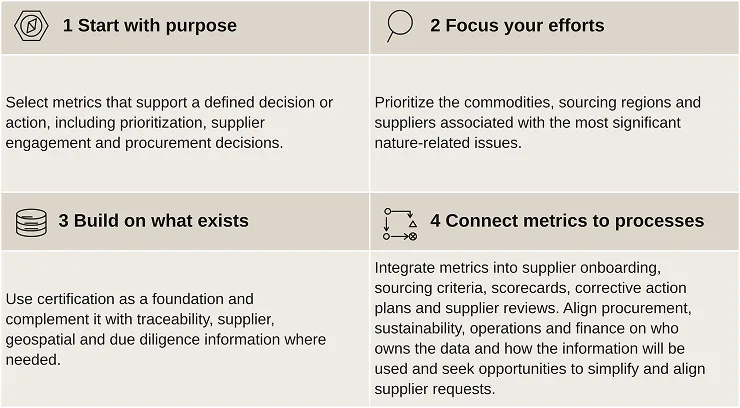
The insights above point to four practical principles for sustainability and procurement teams seeking to make nature-related metrics more useful in supply chain decision-making.
The next frontier: Driving harmonisation at scale
Insights shared through the WBCSD working group show that existing metrics can already support prioritization, supplier engagement and procurement decisions. At the same time, members highlighted the need for more consistent and scalable approaches, including common metrics and more harmonized data requests across value chains.
By helping companies identify relevant metrics and connect them to priority nature actions, the Nature Action Portal supports greater alignment on how businesses measure and report progress. Companies can build on this foundation, refining their approach as supply chain visibility, data availability and supplier engagement develop. Additional efforts to clarify and harmonize methodologies and definitions for each metric are needed to support companies in their data requests and reduce supplier fatigue.
Outline