Map business contributions to the Global Biodiversity Framework
Supported by | KPMG
Summary
Most companies have already defined priorities, actions and metrics shaped by their own nature-related dependencies and impacts. The Global Biodiversity Framework (GBF) and National Biodiversity Strategies and Action Plans (NBSAPs) are a useful reference to help companies strengthen, explain and scale this work. This Primer gives practical recommendations for companies that want to understand and show how their current actions contribute to GBF targets and NBSAPs.
Showing a contribution is not the same as proving attribution. Biodiversity outcomes depend on many actors and factors, so companies can rarely prove that a change in nature came from their actions alone. They can, however, build credible and transparent evidence that links their actions, metrics and outcomes to relevant GBF targets. This evidence also gives policymakers a clearer view of private sector activity already underway, and of where enabling policies, incentives or shared infrastructure could speed up progress.

Context
We are publishing a series of Business Primers presenting insights and case studies that show how businesses are applying metrics in practice to measure progress on their nature-related actions. The Primers contribute to WBCSD’s efforts to drive further consistency in how companies measure progress, in the absence of an agreed set of methodologies that would enable harmonization at scale and reliable comparability between peers.
They provide practical recommendations for practitioners on how to apply metrics for different purposes: prioritizing action, measuring the results of interventions, building the internal case and comparing nature interventions with other investments, engaging suppliers, or identifying contributions to global goals such as the Global Biodiversity Framework. Externally, they can help a company to explain, with evidence, its progress in addressing significant nature-related dependencies, impacts, risks and opportunities to stakeholders.
The Primers also support companies that wish to use the Nature Action Portal as a tool to identify sector-specific actions and related metrics to disclose progress in alignment with key frameworks.

Our target audiences
We aim to reach sustainability practitioners who want to understand:
- How to move beyond high-level commitments to the Global Biodiversity Framework (GBF) and National Biodiversity Strategies and Action Plans (NBSAPs);
- How to demonstrate the ways in which existing actions, investments and decisions contribute to biodiversity outcomes in a credible and actionable way.
We also aim to reach policymakers seeking to understand the role of businesses in the GBF and national governments seeking practical approaches to engage businesses in NBSAP implementation.
The challenge
Why aligning business contributions matters
The Convention on Biological Diversity, established at the Rio Earth Summit in 1992, sets out three objectives: the conservation of biodiversity, its sustainable use, and the fair and equitable sharing of benefits arising from genetic resources. Under the Convention, the Strategic Plan for Biodiversity 2011–2020 and its 20 Aichi Biodiversity Targets provided a first global framework. Although they helped build policy, knowledge and action, progress was insufficient to achieve successful implementation.
In the end, it was effective in informing the development of a more integrated and implementation-focused framework: the Kunming–Montreal Global Biodiversity Framework (GBF). Adopted in 2022, the GBF set a shared pathway for societies to live in harmony with nature by 2050. Its four long-term goals and 23 targets for 2030 address the drivers of biodiversity loss, the sustainable use of biodiversity and nature’s contributions to people, and the means of implementation.
Governments translate the framework into National Biodiversity Strategies and Action Plans (NBSAPs) and associated national targets. Businesses, financial institutions and other non-state actors are invited to develop and communicate commitments that support implementation. While national governments drive its application, non-state actors play a critical role in steering initiatives that ensure the successful implementation and achievement of the goals.
For business, multilateral agreements provide guiding direction that can translate into strategy. The GBF provides a framework for halting and reversing biodiversity loss. The NBSAPs transform this ambition into national priorities and action. Connecting private sector efforts to these plans supports consistency on implementation and policy incentives. It also drives a shared language between business and governments.
While the GBF is not the starting point for corporate action, it can serve as a reference framework to strengthen, explain and scale transition priorities and actions that are relevant for businesses that are actively managing their nature-related dependencies and impacts.
For example, the number of companies that have adopted the recommendations of the Taskforce on Nature-related Financial Disclosures (TNFD) is a good proxy to understand progress on the implementation of GBF’s Target 15 on business assessment and disclosure. TNFD 2026 Status Report found that more than 100 organizations across 56 countries have now published TNFD-aligned disclosures, double the number identified a year earlier. In addition to this, 802 organization formally registered as TNFD Adopters, including financial institutions representing USD 26.6 trillion in assets under management. As of November 2025, publicly listed adopters represented over USD 9.4 trillion in market capitalization.
This momentum is extending into mainstream financial reporting. The International Sustainability Standards Board (ISSB) has published an exposure draft of a proposed IFRS Practice Statement on nature-related disclosures for public consultation. Drawing on TNFD material, it is intended to support companies in applying the existing requirement under IFRS S1 to disclose material information on nature-related risks and opportunities. For companies working to understand and communicate their GBF contributions, this reinforces the direction of travel: the information used to manage nature-related dependencies and impacts is increasingly the same information expected by investors and, in time, by regulators.
What we heard from WBCSD members
A survey of businesses validates these challenges and opportunities. The survey took place during stakeholder roundtables held by KPMG International and a WBCSD member workshop. It involved a total of 54 survey respondents spanning 46 companies (including 18 WBCSD member representatives) across sectors such as forestry, consumer goods, chemicals, energy, infrastructure and finance. KPMG and WBCSD complemented the discussions and survey findings with interviews with selected companies.
The results highlight recurring pain points:
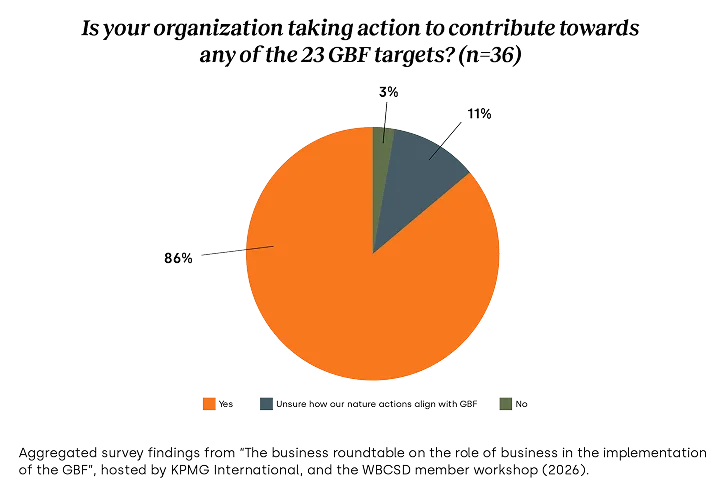
- There is a disconnect between business action and GBF contributions: The vast majority of companies asked are already taking actions that align with GBF targets, but struggle to identify which targets their existing work supports or how it relates to NBSAP priorities in the geographies where they operate.
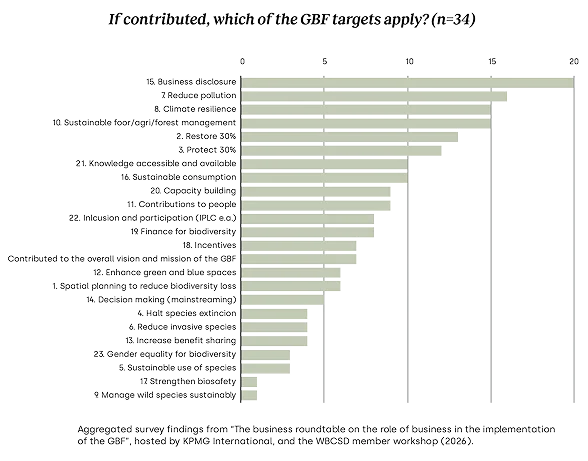
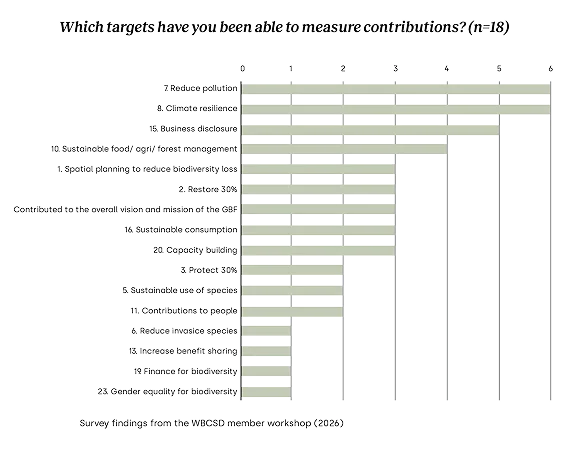
- Measurement is not keeping pace with action: Companies identified business actions across a broad range of GBF targets, but indicated their ability to measure contributions is concentrated on a smaller set – disclosure, pollution and climate resilience. Available metrics do not yet support some targets companies see themselves contributing to.
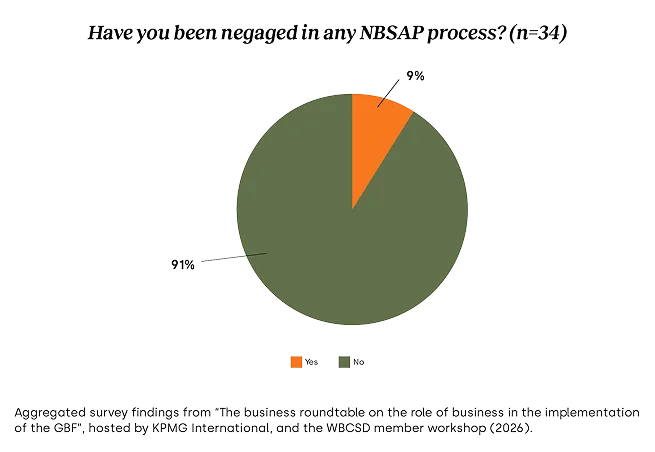
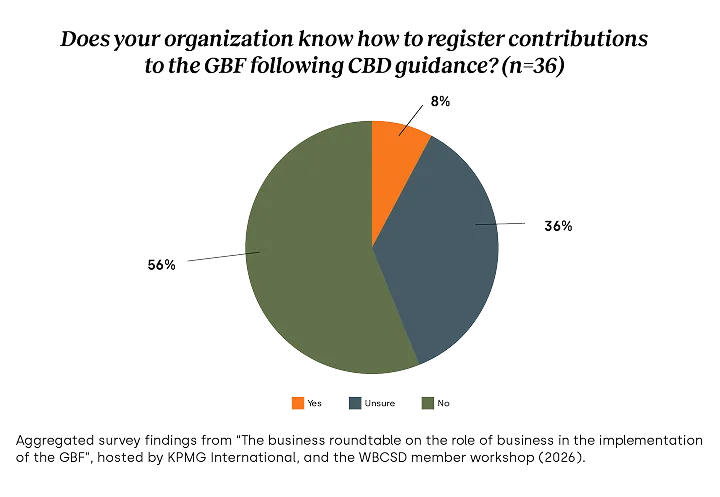
- Uncertainty about claims and lack of business engagement: Even where data exists, companies are unsure how far it supports a contribution claim, and the risk of overclaiming makes them reluctant to communicate progress. Most companies have also not been engaged in NBSAP processes and are unsure how to formally register commitments and contributions through Convention on Biological Diversity (CBD) reporting mechanisms. The result is a disconnect between action and recognition.
Underlying these challenges is a critical structural issue. The GBF is an intergovernmental framework, which means its indicators primarily support national-level monitoring. Companies collect data at the site, project, asset, product, supplier or company level, and many operate across multiple jurisdictions.
Therefore, alignment with 50 NBSAPs (for a business operating in 50 countries) can be very challenging. There are therefore two practical questions. Which targets are relevant? How can businesses build a credible connection between business strategy and actions, company-level metrics and biodiversity outcomes so that they can better understand where there is alignment and meaningfully contribute to wider implementation efforts?
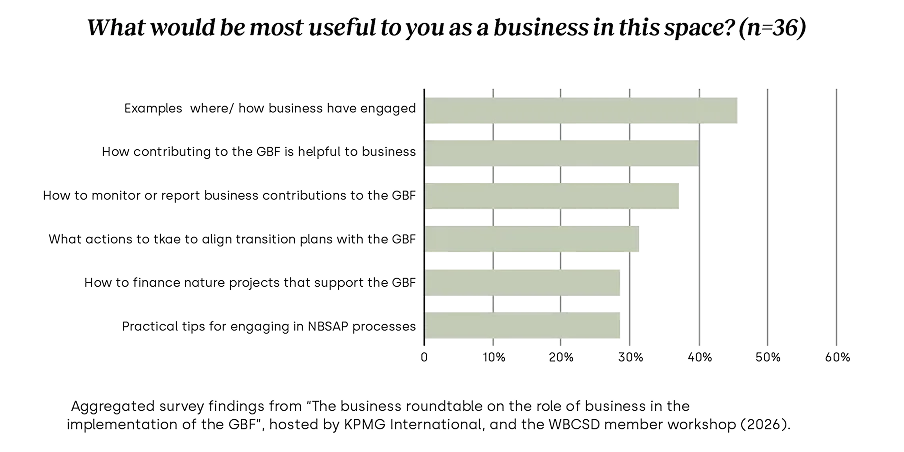
When asked what would be most useful, companies indicated practical examples based on good practice by other corporates, clarify business case for contributions, closely followed by support to monitor and report on those contributions. The practical insights that follow offer some useful recommendations to deliver on this.
Practical insights
Insight #1 – Identifying areas for contribution starts with existing efforts and priorities
Companies are already taking action to address nature-related dependencies, impacts, risks and opportunities. Examples include reducing pollution, improving water stewardship, restoring habitats, and strengthening sourcing requirements. The GBF isn’t usually the starting point for companies to decide where to act. What requires improvement is making the connection and identifying instances where existing and planned action already align with GBF targets and NBSAP priorities in geographies where the potential for positive contributions is most material.
Mapping priorities to relevant GBF targets helps companies understand where they may already be contributing, identify gaps and strengthen action where their influence is greatest. Reviewing NBSAPs in those same priority geographies adds the national picture: policy direction and priorities where business action can support and contribute to wider implementation. This is also a critical step in identifying other opportunities and risks.
The result is a focused set of transition priorities that reflect where the organization can most effectively contribute to nature-positive outcomes and that are connected to several relevant GBF targets. The objective is to recognize, strengthen and scale existing efforts by connecting them to broader biodiversity goals and implementation priorities.
What this means for practitioners: Start from material issues and actions already underway
- Begin with existing assessments of dependencies, impacts, risks and opportunities: Work from the materiality, TNFD’s LEAP (locate, evaluate, assess and prepare) or another assessment already available, focusing on the locations and activities where impacts and dependencies are greatest. Use the company’s materiality assessment, site-level environmental data, and sourcing and supplier risk data. Where no assessment exists, ENCORE and the Nature Action Portal provide a sector-level starting point. Tools such as the WWF Biodiversity Risk Filter, WWF Water Risk Filter, Global Nature Watch and WRI Water Risk Atlas help screen where physical exposure may arise at sites.
- Build an inventory of existing actions and map them to GBF targets: List what is already running – restoration, sourcing standards, water stewardship, pollution controls, partnerships – and identify which GBF targets each action can support. Many companies are likely contributing to more targets than they currently report. Before claiming a contribution, check that the evidence you hold supports it. The mapping of priority actions against GBF targets and Sustainable Development Goals can help identify areas of alignment. Internally, environmental management systems, procurement policies, sustainability reporting and community investment records will hold most of the inventory. Engage procurement, operations, finance and sustainability teams to build the inventory.
- Identify where the potential for positive outcomes is greatest: From that inventory, focus on the actions and locations where the company has the most influence and where strengthening or scaling would deliver the largest positive outcomes. Use the Nature Action Portal to explore a range of actions associated with the greatest outcome potential for the company’s sector, and emerging sector transition pathways, such as WWF’s national nature-positive pathways to guide policy and private sector action, which includes an agriculture sector pathway developed for the UK, to sense-check ambition.
- Check NBSAPs in your priority geographies: Review national plans in the jurisdictions where your company has the most material impacts and dependencies. This shows where business action aligns with stated national priorities and can uncover policy direction, incentives, opportunities and potential risks. The CBD NBSAP portal holds submitted plans and national targets. Local operating teams and industry associations are often well placed to interpret implementation status and identify and support engagement routes.
Insight #2 – Existing metrics can support a proportionate contribution claim when the intended outcome is clear
Companies do not need to report directly against GBF indicators to disclose contributions. The starting point is to define the intended biodiversity outcome that a priority action is expected to support – what is meant to change, where and by when.
Companies are already applying various metrics and collecting information for management, compliance or reporting purposes that can serve as evidence: hectares restored or managed, land-conversion and traceability data, water use and quality, nutrient or pollution loads, supplier performance data, habitat condition assessments, species observations or remote-sensing data.
These show different things. Hectares restored or managed show that an action has been taken, while showing recovery requires condition or species data measured against a baseline.
The company can then check those metrics against the CBD’s monitoring framework for the targets it intends to show contributions to. Reviewing the headline, component and complementary indicators for a target clarifies what national monitoring is actually tracking and often reveals that a company metric measures the same underlying pressure or outcome at a different scale. Where the metric maps to an indicator, the company can state the contribution with more confidence; where it does not, the gap is visible and the company can address it over time.
Response metrics demonstrate that planned actions, controls or management systems are in place; pressure metrics show whether drivers such as pollution or habitat conversion are being reduced; state of nature metrics provide more direct evidence of ecological change. However, these should be applied carefully, as change may result from the combined actions of multiple parties and other external factors. An implementation metric (for example, hectares restored) can show an action has been completed but is not proof of an ecological outcome; an observed improvement in ecosystem condition may support a contribution claim but will not necessarily demonstrate direct attribution.
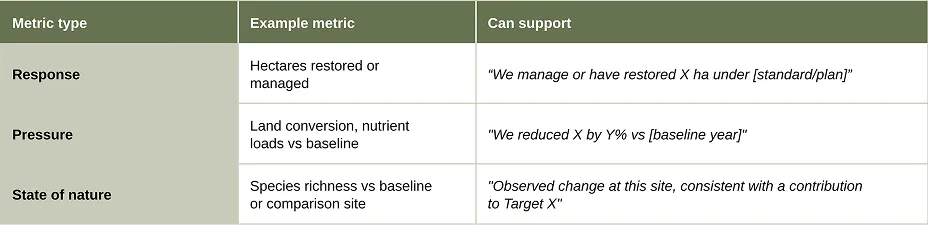
Presenting these distinctions explicitly is what allows companies to make commitments proportionate to the evidence available. Where state of nature outcome data is not yet available, pressure, response or well-explained proxy metrics can support a statement about the action taken or the pressure reduced, but not about changes in nature, while plans are established to strengthen the evidence base over time.
In October 2026, the Nature Positive Initiative published the State of Nature Indicators and Metrics: a minimum set of four core indicators, with associated metrics for site and landscape, covering ecosystem extent, ecosystem condition, species extinction risk and species populations. They were developed through a two-year consensus-building process and are designed to complement, rather than replace, pressure and response metrics. The Taskforce on Nature-related Financial Disclosures (TNFD) and the Science Based Targets Network (SBTN) have integrated them into their frameworks, with GRI moving towards integration, creating greater consistency across assessment, target-setting and reporting. They will also be integrated into WBCSD’s Nature Action Portal by the end of 2026.
For companies mapping contributions to the GBF, this provides greater confidence to use state of nature metrics alongside the pressure and response metrics they already apply. Companies can use the indicators as a reference when establishing baselines and describing changes in the state of nature, while continuing to be explicit about what each metric demonstrates and what it does not. There’s ongoing work demonstrating alignment between these state of nature metrics and the headline indicators of the Monitoring Framework for the Kunming-Montreal Global Biodiversity Framework. To support public-private sector reporting efforts, the CBD has published as an information paper ahead of COP17.
WBCSD member example
City Developments Limited (CDL) agreed a monitoring protocol with ecologists from the National University of Singapore and planted a 260 m² regenerative microforest in central Singapore. Combining eDNA sampling, bioacoustics and temperature transects, first-year results indicate approximately 70% more species richness than in a grass patch outside the microforest, and temperatures up to 5°C lower than surrounding and roadside areas. CDL published these as preliminary findings from a single-site pilot. The case illustrates how a documented action with a comparison site and monitoring protocol can support a contribution to GBF Target 12 – Enhance Green Spaces and Urban Planning for Human Well-Being and Biodiversity; the evidence is preliminary and does not demonstrate attribution.
What this means for practitioners: Demonstrate contributions by building on the metrics the company already uses
- Define intended outcome: For each priority action, define the expected nature-related outcome, and identify the relevant GBF targets it supports and, where applicable, the national priorities/goals that it might contribute to.
- Review the metrics already applied: Start from existing operational, supplier and environmental data, including baselines, locations and time periods. Distinguish between response, pressure and state of nature metrics, and be transparent about what the metrics demonstrate. Record assumptions, limitations and external influences. Agree which function owns each metric and its underlying data.
- Map contributions and strengthen evidence over time: Be explicit about what each metric demonstrates and what it does not. Use credible proxy metrics where necessary and adopt emerging approaches, such as state of nature metrics, to progressively strengthen evidence.
- Align new measurement with the State of Nature Indicators and Metrics: Where the company is establishing a baseline or designing monitoring for a priority action, use the newly published indicators as the reference point rather than building a bespoke approach.
Examples of business actions and metrics mapped to GBF targets and national priorities, to illustrate where companies can find alignment and communicate contributions
| Action area | Example business actions (adapted from the Nature Action Portal) | Example Portal metrics (including metric types – pressure, response and state) | GBF targets supported | Example NBSAP contribution |
|---|---|---|---|---|
 Land use and habitat |
Avoid conversion of natural ecosystems in owned and leased areas; restore degraded land and freshwater ecosystems in priority locations | Extent of land/freshwater ecosystem use change (pressure); Extent of land/freshwater ecosystem restored (response); Area of loss, gain and net change in habitat extent (state) | 1 Plan and manage all areas to reduce biodiversity loss 2 Restore 30% 3 Protect 30% 12 Enhance green and blue spaces |
In Japan, a company-managed forest certified by the Ministry of the Environment as a Nationally Certified Sustainably Managed Natural Sites and registered in the international database as an Other Effective Area-Based Conservation Measure (OECM) contributes to Japan’s Target 3 commitment. |
 Water |
Reduce water use and wastage in water-stressed areas; support basin-level watershed restoration, including through nature-based solutions | Water withdrawal and consumption from areas of water scarcity, including identification of water source (pressure); Bluewater withdrawals, split by level of water stress (pressure) | 7 Reduce pollution 8 Minimize impacts of climate change 11 Contributions to people 12 Enhance green and blue spaces |
In the United Kingdom, the Environmental Improvement Plan is England’s cl biodiversity strategy. It includes a £10.5 billion investmentin flood defenses, including nature-based solutions. The FloodAction Coalition of insurers, investors,rs aims to mobilize private capital alongside public funding fornatural flood management, targeting a £1 billion water resilience market by 2028. |
 Pollution and resource use |
Prevent pollution or contamination of water bodies; reduce excess nutrient losses through more efficient nutrient use and reduce pesticide risk, including through integrated pest management and precision pract | Total emissions to water of nitrates, phosphates, pesticides, and other priority substances (pressure); Rate of nutrient (nitrogen or phosphorus) application in soil or, where possible, nutrient discharge to fr); Instream nitrogen or phosphorus concentrations in the basin,where nutrient loading has been quantified (state) | 7 Reduce pollution | In Canada, the 2030 Nature Strategy adopts GBF Target 7, whitrient losses and the overall risk from pesticides and highlyhazardous chemicals by 2030, including through integrated pest management, based on science and taking into account food security and livelihoods. Companies can align their nutrient and pesticide targets with th |
 Sourcing and value chain |
Commit to and implement deforestation- and conversion-free pce and traceability systems in place for raw materials | Proportion of production volume that is determined to be deforestation and conversion free (DCF), by product (response); Proportion of production, consumption, and sourcing of raw materials that is traceable to e); Quantity of high-risk natural commodities sourced fromland/freshwater, split into types (pressure) |
10 Sustainable food/agriculture/forest management 15 BuSustainable consumption |
In the European Union, in-scope companies will be required to comply with the EUDeforestation Regulation, one of the measures needed to combat biodiversity loss and meet the EU’s commitments under the Convention on Biological Diversity. Beyond this and for a wider scope of materials, volunon or traceability (e.g. DNA barcoding) can help to acceleratesustainable sourcing. |
 Species and ecological connectivity |
Avoid siting and operations in or adjacent to areas of significant biodiversity value; prevent, manage and control invasive species; restore connectivity between habitats |
Species abundance (state); Number of sites in or near protected areas or key biodiversity areas (pressure); Share of the total area under remediation against invasive alien species (response) |
3 Protect 30% 4 Halt species extinction 6 Reduce invasive species 12 Enhance green and blue spaces |
In Australia, the nationalbiodiversity strategy includes targets for no new extinctions and for eradicating or controlling invasive species in priority landscapes. Companies that manage land can register projects under the voluntary Nature Repair Market (Nature Repair Act 2023) and earn biodiversity certificates. The scheme is at an early stage with its first approved method covering replanting native vegetationto support ecological connectivity. |
Actions are condensed from the Portal’s action library, which has sector-specific versions; see the Portal for exact titles. Examples are illustrative, not exhaustive, and are based on the actions and metrics currently available in the Nature Action Portal. Metric types (pressure, response, state) follow the Portal’s classification, and some GBF target elements do not yet have a corresponding metric in the Portal.
Insight #3 – Leverage existing routes for recognition to accelerate implementation
WBCSD member example
Companies that understand and demonstrate their contributions still face a recurring challenge: making it visible and credibly demonstrating how it supports GBF implementation efforts.
The CBD’s Online Reporting Tool allows non-state actors, including businesses, to publish commitments that support GBF implementation. By registering, companies can make a contribution visible to parties and to the wider implementation community. It also gives governments a clearer view of private sector activity already underway in their jurisdictions. A registered commitment does not require reporting against GBF indicators. It does require a statement recognized by the company’s leadership explaining what the company intends to do, where and how it will track progress. Registering a commitment is a disclosure to Parties. If a commitment is later used in consumer-facing communications, EU rules on claims about future environmental performance may apply. These generally require a detailed, realistic implementation plan with measurable, time-bound targets, and regular independent third-party verification.
Direct engagement with national implementation is another route. NBSAPs are a source of intelligence, but this does not replace active business participation: responding to consultations, contributing to sector dialogues convened by environment ministries, offering data and operational experience to national monitoring efforts. NBSAP revision and reporting cycles create specific windows for this. Local operating teams and industry associations are key players in ensuring they leverage these opportunities and flag them to corporate headquarters.
Beyond national processes, contributions can also flow through sector and value chain initiatives, landscape or seascape programs, public-private partnerships, finance initiatives, disclosure frameworks, and biodiversity data-sharing infrastructure. The appropriate route depends on geography, sector, the type of action, and the maturity of national implementation. In each case, companies should assess eligibility requirements and governance arrangements and be clear about the role they intend to play.
WBCSD member example
Oji Holdings, a Japanese manufacturer of paper products, manages 188,000 hectares of company-owned forest in Japan. One of these forests, the 259-hectare Koyagauchi Forest in Kochi Prefecture, was certified by Japan’s Ministry of the Environment as a Nature Coexistence Site in 2023 and registered as an Other Effective Area-Based Conservation Measure (OECM) in the international database in 2024. The site is habitat for the Fairy Pitta, an endangered migratory bird, which Oji has been protecting since 2016 under an agreement with the Ecosystem Trust Association, including habitat surveys and conservation activities. In 2026, Oji was selected for a Ministry of the Environment tourism model project to develop visitor programmes at the forest. The management was already in place; the contribution to GBF Target 3 – Conserve 30% of Land, Waters and Seas – relates to the registered area, not to the estate as a whole, and comes from its formal recognition.
What this means for practitioners: Make your contribution count towards implementation
- Register commitments: Publish commitments through the CBD Online Reporting Tool and through annual reporting, so contributions are visible to parties and stakeholders. State the action, the intended outcome and how progress will be tracked. Engage with CBD’s mainstreaming efforts, such as the Community of Practice webinars. Keep public statements within the scope of the commitment (what, where, by when), and avoid wording that implies broader or more certain results than the plan supports.
- Find national engagement windows: Identify NBSAP revision and reporting cycles, consultations and sector dialogues in priority geographies. To do this, leverage local operating teams and industry associations.
- Select mechanisms that fit: Assess relevance, eligibility, governance arrangements and data requirements. Be clear on what the mechanism delivers for the organization as well as for biodiversity.
- Clarify roles before committing: Identify relevant functions internally (procurement, operations, finance, sustainability, and legal or communications for public wording) and external stakeholders, such as authorities, rights holders and implementation partners, and agree who owns the data and the evidence behind each statement, and what can be shared.
- Keep engagement additional: Ensure participation complements, rather than substitutes for, actively managing the company’s own impacts and dependencies.
Examples of implementation mechanisms mapped to GBF targets and potential business contributions
| GBF target | Implementation mechanism | Potential business contribution |
|---|---|---|
| Target 3 – Conserved areas | Other effective area-based conservation measures (OECMs) | Companies that own, manage or influence land or seascapes can explore with relevant authorities, rights holders and conservation partners whether areas that deliver long-term, effective conservation of biodiversity on the ground may qualify as OECMs. Recognition depends on national processes, which are not yet in place in every country. |
| Target 13 – Benefit-sharing | Cali Fund
Multilateral mechanism for benefit-sharing from the use of digital sequence information on genetic resources |
Companies using digital sequence information can assess how the mechanism applies to their activities and contribute to fair and equitable benefit-sharing in line with applicable requirements. |
| Target 15 – Business assessment and disclosure | Nature-related assessment, disclosure and target-setting processes; CBD Online Reporting Tool (ORT) | Companies can assess and disclose biodiversity-related dependencies, impacts, risks and opportunities across operations, value chains and portfolios. They can use the findings to inform decision-making, including capital allocation, and to prioritize actions that reduce negative impacts and strengthen positive impacts. Companies can report progress in their annual reports and register commitments through the CBD Online Reporting Tool to make their contribution more visible. Frameworks such as the Taskforce on Nature-related Financial Disclosures (TNFD) and the Science Based Targets Network (SBTN) can help structure their process. |
| Target 19 – Biodiversity finance | Increasing finance for biodiversity
Redirecting finance that has a negative impact on biodiversity |
Companies can finance nature and support biodiversity conservation and restoration activities, help to develop new and innovative nature finance mechanisms and can put in place internal policies aimed at redirecting finance that has a negative impact on nature and biodiversity. |
| Target 21 – Knowledge and data | Global Biodiversity Information Facility (GBIF)
Ocean Biodiversity Information System (OBIS) Other biodiversity data infrastructures |
Companies can use recognized biodiversity data sources and, where appropriate, share suitable species-occurrence or monitoring data using established standards, while applying safeguards for sensitive data and respecting rights and consent requirements. |
Enabling contribution at scale: Shared responsibility for implementation
Companies can demonstrate contributions by starting from material issues and action already underway, providing evidence of their contribution with information already gathered, registering, and connecting that action so it counts towards wider implementation. The GBF and NBSAPs serve as reference points in explaining where company action supports national and global priorities.
Businesses have a key role to play in supporting the necessary pace of implementation between now and 2030. Yet, the conditions for success are not set by business alone. Most companies have not been engaged in NBSAP development or implementation. Few know how their contributions can be formally recognized.
Governments, as parties to the Convention, are best placed to accelerate the pace at scale by:
- Building structured business engagement into NBSAP revision and implementation;
- Making the routes for registering and recognizing private-sector contributions clearer and more accessible;
- Aligning national reporting expectations – and, over time, the GBF’s own monitoring framework and indicators – with the frameworks, data and metrics companies are already using to avoid parallel systems.
Measurement is where this matters most. Building credible evidence of biodiversity outcomes is expensive – baselines, control sites, monitoring protocols and multi-year data collection incur heavy costs, and they fall disproportionately on the first movers. That burden should not rest with individual companies alone.
Public monitoring infrastructure, shared data platforms, research partnerships and targeted funding for measurement all lower the threshold for participation. They also determine whether contributions remain the preserve of a well-resourced few or become something the wider market can reach.
Public and private sector efforts are complementary: national monitoring gains from company-level data and company claims gain credibility from national context.
Metrics are valuable when they improve decisions, accountability and knowledge. Companies are equipped to move from broad statements of alignment to focused action, supported by evidence and purpose. Governments that create the conditions for that work will find far more of it to build on.
Outline
Related insight pieces