Build the business case for nature interventions
Supported by | ERM
Summary
This publication shows how practitioners can build a credible business case for investing in nature by translating exposure into the financial terms their boards already use. It is not trying to ‘put a value on nature’ but, building on experience of WBCSD members, this piece recommends how a sustainability practitioner can begin to develop a financialized business case for nature-related interventions.
Nature-related risk is already a material financial threat. Nature has affected companies’ finances for decades but methods to value nature’s effects in financials are still immature, and this is holding corporate action back. Structural barriers include incoherence in regulatory frameworks, financial regulators moving at different speeds, and no consensus on the method for valuing nature. Encouragingly, a growing number of asset owners and managers have publicly committed to integrating nature into their stewardship approach and collaboration between standards and reporting bodies points towards consolidated disclosure.
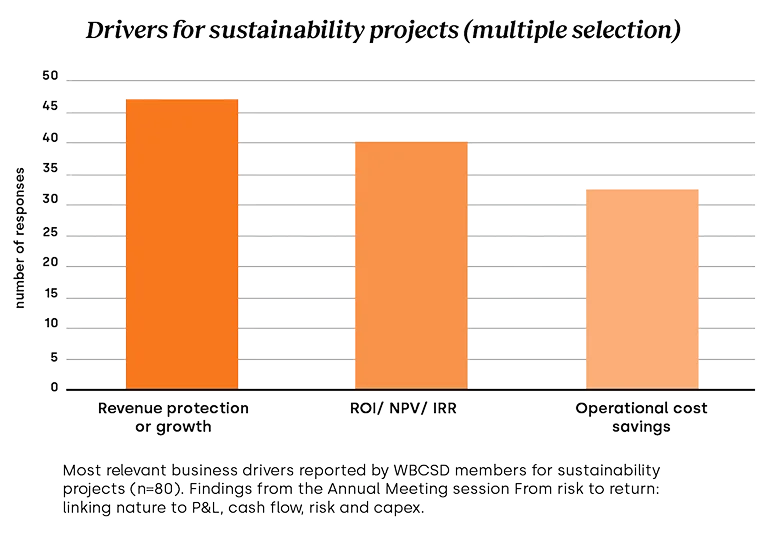
The main challenges for companies include linking nature to financial performance, a language gap between nature experts and executive teams, board short-termism, and the complexity and granularity of nature measurement. But sustainability practitioners can build a credible business case for investing in nature through these practical recommendations on how to translate nature interventions into the language of finance and executive decision-making functions. The proposed approach connects nature actions to the business drivers that members rank highest, specifically revenue protection, ROI and operational cost savings.
WBCSD’s Financing Nature-based Solutions work extends the case for investing beyond the value chain, in the landscapes where companies operate and source from. It covers risk valuation, accounting and targets, metrics, financial instruments and enabling policy.

Context
We are publishing a series of Business Primers presenting insights and case studies that show how businesses are applying metrics in practice to measure progress on their nature-related interventions.
These Primers provide practical recommendations for practitioners, aiming to drive further consistency in how companies measure actions and report on their impacts – in the absence of an agreed set of methodologies to drive harmonization at scale.
For practitioners, they strengthen the case for investment internally by providing a basis for comparing nature interventions against other investments. Externally, they allow a company to demonstrate progress against its peers, while providing evidence to stakeholders on how the company is managing exposure to risks related to nature loss.
The Primers also support companies that wish to use the Nature Action Portal as a tool to identify sector-specific actions and related metrics to disclose progress in alignment with key frameworks.

Our target audiences
We aim to reach sustainability practitioners in corporate enterprises and asset owners to aid them in making the business case for sustainability actions with finance colleagues and executive decision-makers.
The challenge
The global economy is increasingly exposed to nature-related risks
The state of nature worldwide is on a trajectory towards, “a critical systemic risk threatening the economy, financial stability and human well-being.” This exposure is universal – every business depends on nature and impacts nature. Even companies that appear far-removed from nature rely, directly or indirectly, on material inputs and on the regulation of environmental conditions.
These were the core findings of the Intergovernmental Science-Policy Platform on Biodiversity and Ecosystem Services (IPBES) Business and Biodiversity Assessment, presented at the 12th Plenary in early 2026.
Numerous international bodies and research reports have identified the scale of economic dependencies at a macro level:
- The European Central Bank estimated that almost 75% of euro-area bank loans are to companies highly dependent on at least one nature-related driver.
- In its Economics of Water: Valuing the Hydrological Cycle as a Global Common Good report, the Global Commission on the Economics of Water projected that, based on current trends, the water crisis could cut global GDP by an average of 8% by 2050.
- The IPBES Nexus Assessment estimates the unaccounted-for impacts of current economic approaches to biodiversity, water, food and health at USD $10–25 trillion per year.
There is growing awareness that the scale and scope of ongoing degradation will have profound implications for businesses. However, as highlighted in the World Economic Forum’s Global Risks Report 2026, there is a gap regarding how imminently these risks will mature and how they will materialize for individual companies. Typical pathways include:
- Water scarcity and drought disrupt operations, cutting output and revenue;
- Degraded ecosystems destabilize raw material supply, driving up procurement costs;
- Loss of ecosystem services reduces asset productivity, lowering the NPV of nature-dependent assets;
- Loss of natural buffers (e.g. against flooding) raises insurance costs and can make exposed assets uninsurable, and so harder to finance.
Structural barriers make it more challenging for businesses to plan, budget for and implement actions that reduce their exposure to nature impacts and risks. Three of the most severe are:
1) Regulatory incoherence: The divergences between the myriad of frameworks across the regulatory landscape hinders business efforts to take substantive actions on nature.
- Landmark instruments such as the EU Nature Restoration Regulation (2024), the Conservation and Sustainable Use of Marine Biological Diversity of Areas beyond National Jurisdiction Agreement (BBNJ High Seas Treaty – 2026) and the Kunming-Montreal Global Biodiversity Framework 2030 Targets (2022) have advanced, while others have stalled or been diluted.
- The EU Deforestation Regulation is delayed to end-2026.
- The global plastics treaty talks collapsed in August 2025: Intergovernmental Negotiating Committee on Plastic Pollution — INC-5.2, Geneva (adjourned without consensus).
- Recent changes introduced through the EU’s Omnibus have significantly altered the scope of mandatory European Sustainability Reporting Standards (ESRS) disclosures, requiring companies to rely more heavily on materiality assessments. This shift, combined with the proliferation of non‑interoperable frameworks, contributes to a changing and fragmented reporting landscape.
2) Financial regulators are moving at different speeds: Institutions responsible for financial stability are at varying stages of maturity and are hindering financial actors’ efforts to take action to address exposure.
- The Financial Stability Board’s July 2024 stock take, commissioned by G20 finance ministers, determined that authorities were at different stages: some had already concluded there is material financial nature-related risk, others were only monitoring, and a few had chosen not to work on the topic given data gaps and the priority of climate.
3) No agreed valuation methodology: There is currently no broadly accepted consensus or accounting standard on how businesses, investors and governments calculate an auditable figure for “the value of nature”, or regulatory framework that requires them to do so.
- The IPBES-12 Business and Biodiversity Assessment characterizes this as a fundamental market failure: businesses often bear little to no financial cost from the negative impacts of their operations; there are few public or private market drivers to reward positive impacts.
These issues continue to show little progress on rising up the corporate agenda. The IPBES-12 Business and Biodiversity Assessment estimated global public and private capital flows with direct negative impacts on biodiversity at USD ~$7.3 trillion in 2023, compared to just USD ~$220 billion directed to conservation and restoration, a 33-fold imbalance.
The lack of awareness is also denoted by how business leaders have ranked these issues over time: the World Economic Forum’s Global Risks Report 2026 finds that executives perceive “Biodiversity loss and ecosystem collapse” and “Critical change to Earth systems” as the second and third most severe long-term risks over the next 10 years, yet neither made it into the short-term horizon (2 years) top-10, falling to the 26th and 24th places respectively.
The Panama Canal has announced it will reduce transits by over 10% due to drought. A previous drought in 2023 reduced transits by over 40%, triggering multi-million-dollar bidding wars for transit slots. The USD $1.6 billion reservoir project intended to support the waterway will not be operational until 2031.
During Europe’s 2026 drought, Romania shut down Cernavodă, its only nuclear plant and source of ~20% of national electricity, for nearly two weeks, halting production at Ford and Dacia plants to reduce consumption. The output of Hungary’s Paks nuclear plant, which normally supplies nearly half its electricity, fell to 10% of capacity. This created an estimated cost of USD $320–640 million in imported power.
The Swiss Re Institute estimates the natural-catastrophe protection gap at USD $424 billion in 2025, with roughly three-quarters (72.7%) of exposure uninsured.
It should be apparent that the financial impacts of nature degradation are no longer a future concern but a mature risk that is affecting businesses across sectors.
Yet, some structural indicators give cause for optimism.
- There is economic demand for investible action on nature. Since the start of 2024, an ERM research initiative has identified more than $41.3 trillion of assets-under-management that have formally and publicly adopted nature as part of their asset management and stewardship approach. This corresponds to approximately 28% of all global AUM (as of end-2025). This figure doesn’t represent capital allocated to nature but capital that is actively considering nature in its allocation, and it only counts public Taskforce on Nature-related Financial Disclosures (TNFD) adopters and BlackRock. If this trend continues at the same pace, the integration of nature considerations could reach 50% of global AUM by 2029, if not sooner.
- There is a real prospect of greater consolidation in the nature-related regulatory and reporting landscape. In April 2025, the International Financial Reporting Standards (IFRS) Foundation and TNFD signed a memorandum of understanding to deepen their collaboration and support the International Sustainability Standards Board (ISSB)’s consideration of the TNFD recommendations in its work on nature-related financial disclosures. In November 2025, the ISSB went further, deciding to undertake standard-setting on nature-related risks and opportunities, building on IFRS S1 and drawing on the TNFD framework, including its recommendations, metrics and guidance. The ISSB is releasing an Exposure Draft of incremental nature-related disclosure requirements during CBD COP17 on 22 October 2026. This direction of travel could help reduce fragmentation by bringing nature-related disclosure more firmly within the emerging global baseline for sustainability-related financial reporting. Market practice is also developing rapidly: the TNFD’s 2026 Status Report identified more than 1,000 organizations across 56 countries or areas that have now published some level of TNFD-aligned disclosure.
Given the above, an ERM research initiative identified that nearly two-thirds to three-quarters of global GDP are in jurisdictions that are likely to mandate nature disclosures for large listed entities in the next 2-3 years. This would go a long way toward resolving the structural problem of regulatory and reporting divergence.
What we heard from WBCSD members
These structural barriers are compounded by company-level challenges in making the case to executives. WBCSD’s 2026 annual meeting and the interviews we conducted highlighted four recurring challenges.
- Linking nature to financial performance: Over half of respondents named difficulty linking nature-related exposure to financial performance as the single largest blocker to crafting a business case. All interviewees highlighted the challenge of an inability to express nature in monetary terms.
- An internal knowledge gap: Most respondents acknowledged a lack of organizational understanding on nature, especially compared to climate. This was particularly pronounced in finance and executive functions: “colleagues see ‘only climate’ and cannot make the link between nature and our business activities.” They argue that they “are not dependent on nature until reminded of water and raw materials.” Each interviewee described nature as years behind climate in structured data, tools and internal understanding.
- Short-termism: Interviewees described recurring pushbacks from executive boards, including demands for payback inside a year to the need to justify a modest outlay against a large, long-term risk.
- Water as the entry point: All respondents agreed that water is the most accessible entry point for executives or investors, as it is easier to measure, explain and connect to business continuity. They consistently highlighted biodiversity as a more complex topic and therefore more immature.
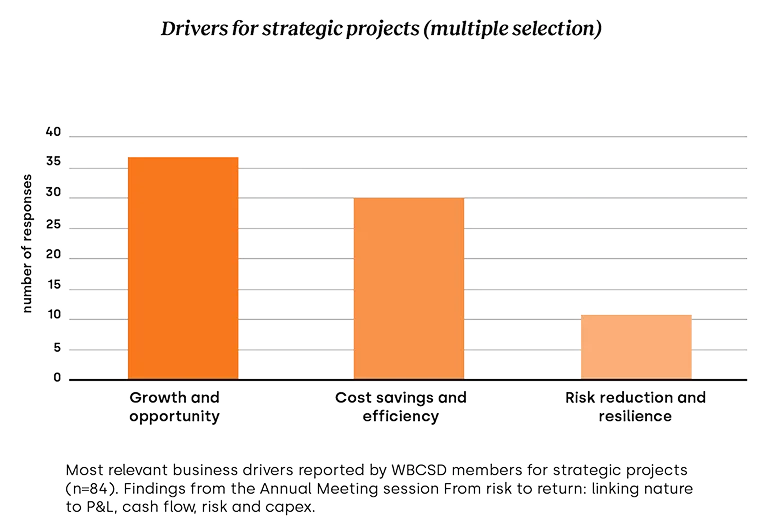
When asked which business drivers carry the most weight internally, results point to where a nature business case needs to land – revenue and return, ahead of risk. This is not unique to nature: growth is more visible in capital allocation metrics, while risk reduction is more probabilistic and long-term, and executive incentives generally reward short-term results.
From exposure to investment case: practical insights for practitioners
Companies’ exposure to nature arises from two directions: their dependencies on nature (e.g. water availability for operations) and their impacts on it (e.g. land-use change or water withdrawals in their value chains). Both can mature into risks for businesses and be translated into financial exposure, but through different routes: dependencies mainly through operational disruption, supply and asset value; impacts mainly through regulatory, market-access, cost-of-capital consequences, and degradation to the underlying state of nature or ecosystem services that regulate the natural capital flows that underpin dependencies. The recommended approach in this primer, tracing each potential nature-related intervention to physical mechanisms and then to a financial transmission route and comparing the cost of intervention with the cost of inaction, applies to both. The examples draw mostly on dependency-led cases, where the link to cash flow is most direct; impact-led cases follow the same steps but typically rely on more indirect routes.
In this primer, exposure means the financially material risks arising from a company’s dependencies and impacts on nature. Nature interventions are actions that reduce this exposure by changing a dependency condition or reducing a pressure.
Insight #1 – Expressing nature exposure in financial terms supports board-level oversight
Discussions with WBCSD members suggest that the main barrier to investing in nature action is a translation gap: the exposure needs to be expressed in terms that finance functions and the board understand.
Members suggested aligning company-level metrics that express exposure in financial terms: revenues or procurement expenditure exposed, asset NPV, capital expenditure (CapEx) or operating expenditure (OpEx). In addition to making executive decision-making easier, this reframes the perception that sustainability data costs too much, positioning it instead as a critical risk and revenue driver for which it is easier for executives to allocate budget. It also means that when the investment case is eventually made, the performance framework is already expressed in the same units.
WBCSD member example
A world-leading provider of specialty chemicals wanted to understand the extent of its nature exposure to raise the topic for board level oversight. The member had not previously engaged with nature as a topic and thus a broad-spectrum of exposure was evaluated: total proportion of raw materials, operations, products, end-of-life – that were exposed to nature-related dependencies and impacts – that could- and in many cases were likely to – mature into material financial risks.
The assessment identified USD $924 million in annual spending and USD $1.92 billion in annual revenues with material nature dependencies and impact exposed to nature-related risks. This uncovered the largest single accumulation of unmanaged risk for the company. These results informed a complete strategic assessment to shape its future product portfolio.
What this means for practitioners: Translate nature into financial language
For companies and asset owners
- Locate nature-related dependencies and impacts for operations and value chains: Start with a sector-level screen such as ENCORE to see where dependencies are likely to be material, then use location-specific tools where the screening indicates higher likelihood of material risks, for example WRI Aqueduct for water, WWF Risk Filter Suite for water and biodiversity, or IBAT for site-level biodiversity. No single tool maps directly to financial metrics, so combine tools with internal data and expert judgment, and choose them based on the decision the assessment needs to inform.
- Quantify exposure in gross financial terms: Express exposure as proportions of CapEx, OpEx, revenue and procurement. Tool outputs are usually hazard scores or qualitative ratings, so translate them into revenue at risk, cost escalation and stranded assets using your own financial data.
- Connect exposure to risks at the macro level: Link gross dependencies and impact exposure to global trends such as the freshwater deficit. While imperfect, this intermediate step can raise the profile of the issue at company level and unlock the budget for more granular investigation.
- Prioritize nature-related topics that breach the enterprise risk threshold: Align with double-materiality assessment principles, e.g., Corporate Sustainability Reporting Directive (CSRD) and TNFD. There are likely to be harmful impacts that do not necessarily breach the financial risk threshold. These elements should also be considered carefully by an organization, however, may be more challenging for a board to engage with initially.
- Match the response to the exposure: Whether the risk sits in your own assets or your value chain and how soon it will materialize all shape the appropriate response. Options range from operational efficiency and on-site nature-based solutions to supplier engagement and traceability, and, where the dependency is long-term and shared, landscape investment and collective action.
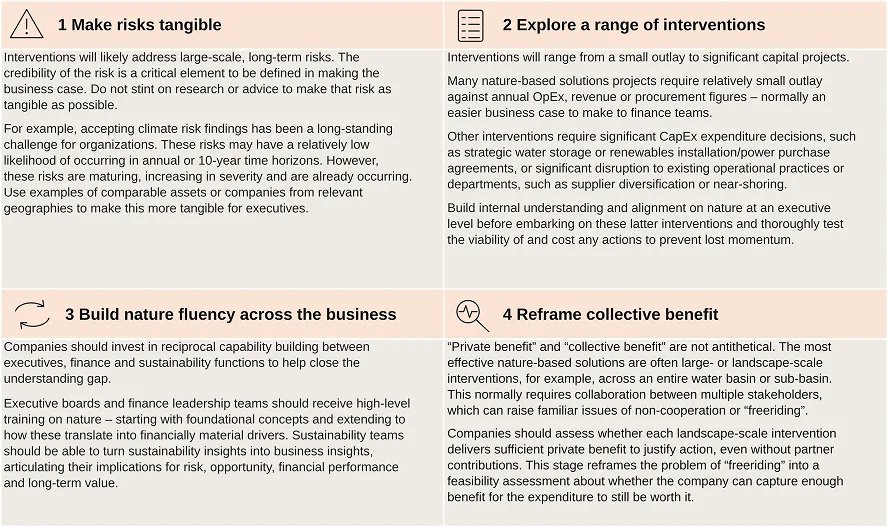
- Make the risk tangible: Use examples of comparable assets or companies in relevant geographies rather than abstract projections. Members reported that credibility of the risk is a critical element in making the case.
- Act despite uncertainty: Tools rely on proxies and carry model uncertainty and data gaps, so cross-check results. Uncertainty is a reason to calibrate, not to wait. Leading companies already invest in nature-based solutions without a full financial model where a dependency is undeniable and cannot be substituted.
- Brief executives and other internal stakeholders after quantifying: Present findings to the finance function and board to build internal awareness of the scale of material exposure and use training to build on that.
For financial institutions
- Locate nature-related dependencies and impacts across portfolio segments for both operations and value chains: Start with a sector-level screen such as ENCORE, then add portfolio tools such as the WWF Risk Filter Suite (basin-level water and biodiversity risk) or UNEP FI’s PIAT (portfolio-level impact analysis). PIAT is not a location-risk screen, so pair it with spatial tools for higher-risk holdings.
- Quantify exposure across portfolios: Delineate total proportions of AUM with higher or lower dependencies or impacts. While imperfect, this intermediate step can help make the business case for nature at a gross portfolio level. The aim is to raise the profile of this issue among investment committees and risk executives and increase budgetary allocation to more granular investigation. More advanced organizations can augment this step with supplementary datasets on specific nature sub-topics.
- Present these findings to investment and risk committees: Build internal awareness of the scale of material exposure.
Insight #2 – Nature interventions are investable if the company has properly measured their financial value
Members consistently pointed to barriers in building the investment case for nature interventions in terms of finance once exposure is quantified. Specifically, the problem is how to present an attractive return on investment to gain board approval. The time horizon emerged as one of the key challenges in building a strong business case for nature interventions.
Interviewees reported responses to proposed initiatives requiring “payback within one year” or that “present a large-scale long-term risk against a small outlay.” Most nature interventions require years to mature before they yield positive benefits. Costed over a standard accounting period, they may not clear an internal hurdle rate that a comparable capital project would pass.
Getting to a defensible number involves several key steps, including:
- Map dependencies and impacts to specific measurable mechanisms, such as water flow, raw materials supply, energy supply. For physical risks, structure each mechanism in three layersiii: the hazard (the frequency, intensity and location of relevant climate and nature events), what is exposed (the value, volume and location of the assets or supply flows at risk) and the vulnerability (how much loss a given hazard causes). Include nature-driven hazards such as pollinator loss, soil degradation and watershed disruption alongside climate hazards, as standard sectoral impact models typically leave them out.
- Map these mechanisms to a cash flow-relevant financial transmission route for the business – how each translates to CapEx, OpEx, revenue or spending – and the contractual or regulatory drivers relating to each.
- Develop a series of candidate interventions or actions that substantively alter a measurable input, such as nature restoration or rewilding of proximate non-operational land- or asset-relevant landscapes, regenerative agri-commodity production, constructing reservoirs or strategic water stores, or raw material supply diversification or vertical integration.
- Segment by stakeholder – what the company can do alone and what requires cooperation with other stakeholders. This underpins intervention viability.
- Establish the observable baseline for all mechanisms and financial transmission routes. This forms the evidence base for the business case.
- Conduct scenario analysis to calculate the benefits and costs of inaction. Model a business-as-usual scenario and projected range of outcomes depending upon a variety of climate and nature degradation scenarios. Compare these outcomes with modelled results from interventions based on the same scenarios to calculate the relative benefits and avoided costs of inaction.
These set the foundations to be able to measure each mechanism in financial terms and determine the cost of each intervention over long-term horizons or the asset’s entire remaining lifespan. It is important to apply cash flow discounting, state explicitly what the benefit lag does to present value – for example, to avoided OpEx, deferred capital replacement, NPV of protected revenues, avoided cost of inaction, asset value protected – and avoid double-counting the benefits.
These financial drivers can then be set against the scale of the long-term financial risk and the potential cost of inaction. This ensures that the comparison executives are asked to make is between two long-horizon numbers rather than a long-horizon risk and a short-horizon return.
There is a growing body of evidence to support the effectiveness of nature-based solutions for climate adaptation, driven by the cost-benefit ratio. Swiss Re found that NbS adaptation projects have a median benefit-cost ratio of 1.86, with specific interventions ranging as high as 9.63. Similarly, the Global Center on Adaptation has concluded that well-designed nature-based solutions can deliver benefit-cost ratios of between 2:1 and 8:1.
WBCSD member example
ENGIE quantified the potential benefits of nature conservation and restoration interventions for its infrastructure asset against asset revenue generation and net present value. The findings indicated that an outlay of USD ~$5 million could return up to USD ~$108 million in incremental revenue and deliver an asset‑lifetime NPV uplift of USD ~$21 million, as the maximum expected outcome over a 20-year period.
Read the full case study: Explore the business case for nature at a hydropower plant
What this means for practitioners: Quantify the cost and return of nature interventions over the asset’s lifespan
- Work through the mechanism first: Establish the measurable mechanism and its financial transmission route before costing anything.
- Extend the horizon: Determine cost across the intervention’s full life cycle and delineate clearly between short-, mid- and long-term returns. Most nature interventions are not short-term projects. They require years to mature to full effectiveness. Highlight this upfront to executives and finance teams, contrasting the intervention cost against large-scale, long-term financial risks. Clearly delineate between expected benefit maturation timelines and the financial impacts of these estimates across the intervention’s entire life cycle, not just standard accounting periods.
- Build the monitoring framework at the start: Treat performance monitoring as a critical element of implementation planning. At a minimum, ensure an assured verifiable baseline, the attribution method, data capture cadence and reporting interval.
Insight #3 – Nature data cannot be simplified into one metric, but it can be consolidated for boards
Translating exposure into financial terms and costing interventions both rest on granular underlying data, which members reported as one of the most persistent challenges.
Almost all respondents struggled to reconcile the unavoidable location specificity of nature metrics with company or portfolio-level standardization. Many highlighted a demand for a single nature metric to drive board alignment but found these were not granular enough. Others suggested a preference for dependency or pressure metrics (such as water use, nitrogen, pesticides, deforestation and land use) rather than state-of-nature metrics (such as mean species abundance, ecosystem integrity, or ecosystem services stability) that are more complex and harder to communicate to executives.
This complexity is a critical hurdle for businesses to address, because it is precisely the state of nature – the stability of ecosystems and their capacity to keep delivering natural capital flows – that determines whether a company’s nature-related dependencies remain viable and, ultimately, whether its assets can keep operating.
These frustrations are partially caused by methodological immaturity, but they are also linked to the fact that nature cannot be simplified into a single datapoint in the way that emissions can. There is no metric-tons-of-CO2-equivalent for nature, because the thing being measured is not a single global stock but a set of locally determined conditions: water availability in one basin, soil condition in one landscape, pollinator presence in one sourcing region.
Companies will need to work with different kinds of datapoints depending on sector, operations, location and the type of interface being measured. A metric that aggregates across all of them loses the location specificity that makes it decision-useful.
The recommended resolution is not to simplify the data but to consolidate above it. The financial translation described in Insight #1 is what the board engages with; the granular data stays with the sustainability function and relevant procurement or site-level operations teams, where nature intersection specificity and location specificity are assets rather than obstacles. This means the two demands are not opposed: executives are not asked to engage with granular nature datasets and the company does not discard the detail it needs to select, cost and monitor interventions.
Robust materiality assessments make this more manageable for sustainability professionals. Locating dependencies and impacts across operations and the value chain establishes which datapoints are most relevant for the company. Everything behind that – the mechanisms, the baseline, the monitoring framework – draws on that same body of data. The granular work is no longer a reporting overhead; it becomes the evidence base the investment case is built from.
WBCSD member example
ENGIE quantified the potential benefits of nature conservation and restoration interventions for its infrastructure asset. The nature data required to do so included dependency and pressure metrics across over 15 types of land use and 11 types of water use across an entire water basin. These datasets and the calculation model are too granular for the oversight of most boards. However, translating these factors into three financial metrics – net revenues, net present value and cost of interventions – enabled the sustainability function to raise these considerations to an executive decision-making audience.
Read the full case study: Explore the business case for nature at a hydropower plant
What this means for practitioners: Embrace the complexity of nature data
- Accept that there is no single nature metric: Acknowledge that different nature intersections require different datapoints and let materiality assessments determine which ones the company tracks for specific business units or assets.
- Hold the complexity in the sustainability function: Keep granular data where it is useful and consolidate to financial terms for board-level reporting.
- Measure a robust baseline: A granular baseline serves as the evidence base for any intervention case and the monitoring framework.
Four enablers for practitioners
The insights above point to four practical principles for sustainability practitioners seeking to build or strengthen the business case for nature interventions.
Moving from exposure to investment
Insights shared through this work suggest that companies do not need a settled valuation of nature to begin building a credible investment case. By using only the information most companies already hold, it is possible to express gross exposure in financial terms alongside relevant nature-related indicators. It is also possible to quantify an intervention’s benefits and cost across an asset’s remaining life rather than a standard accounting period. Despite the systemic challenges companies face, it is already feasible to create an attractive business case for nature, even with conservative assumptions. The scale of the positive return from nature interventions will only grow as datasets become more complete, metrics and calculation methodologies advance, and regulatory regimes mature.