Partnership by design: How public programs can unlock private co-investment in regenerative agriculture
Published: November 9, 2026
European agriculture is increasingly exposed to climate change, extreme weather and geopolitical instability. These pressures make yields more volatile and threaten the resilience of the supply chains that depend on them. Adverse weather already costs EU agriculture an estimated €28.3 billion a year, and these losses are expected to rise. The consequences extend beyond the farm, affecting food security, rural economies and public budgets. Regenerative agriculture is part of the solution: it makes farming systems more resilient while protecting and restoring soil, biodiversity and water and reducing greenhouse gas emissions.
Members of One Planet Business for Biodiversity (OP2B), including Danone, FrieslandCampina, Nestlé, and PepsiCo, have set ambitious targets to scale regenerative agriculture across Europe and beyond. Earlier publication by Deloitte ‘Closing the gap: An analysis of the costs and incentives for regenerative agriculture in Europe’, identified the lack of a viable business case for farmers as a major bottleneck to adoption. It also showed that the incentives currently available do not cover the costs of transition. Public and private funding for regenerative agriculture exists, but the two rarely come together in a way that meets farmers’ financing needs.
This report, prepared by Schuttelaar & Partners and Deloitte, builds on that work. It examines whether targeted changes to existing public programs could reduce the risks that deter private investment and attract additional co-investment alongside public support.
Key findings
The strongest example: outcome-based price premiums (Tier B). Of the three redesigns tested, combining outcome-based public payments with a private price premium of €50 per hectare per year delivers the strongest and most consistent improvement in farmers’ business case, and turns it positive for some crops. France gives the clearest illustration: on identical dairy farms, Tier B improves the business case by €334/ha, against €22/ha under blended finance (Tier C). Because the premium is paid every year, its value holds over the full investment period.
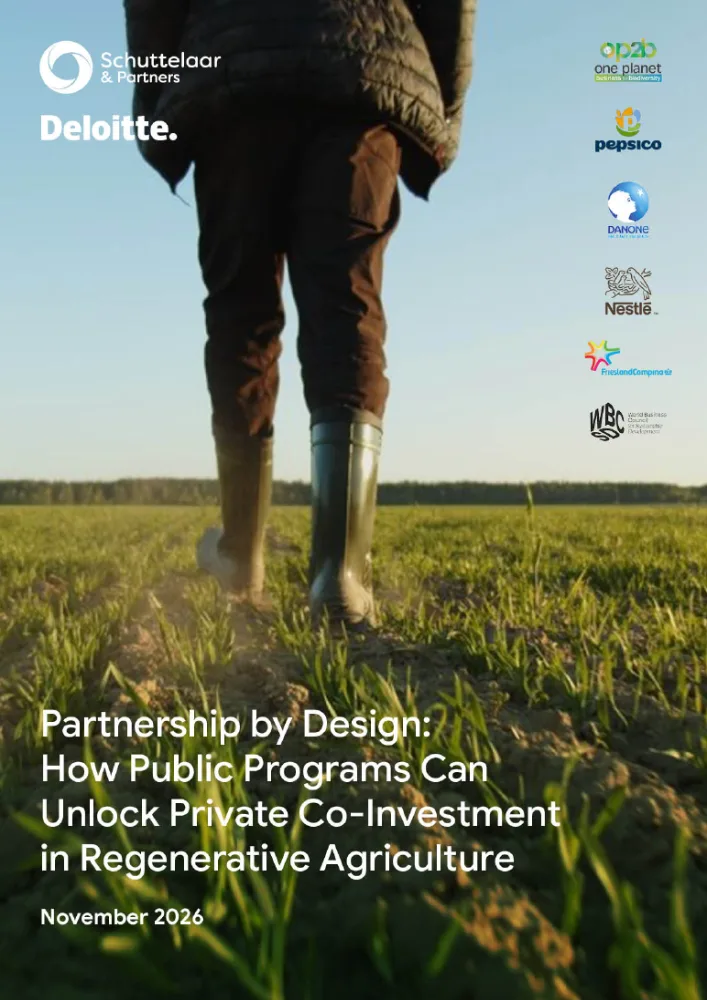
What this means for policy and business. Governments should use the post-2027 CAP and their National and Regional Partnership Plans to introduce outcome-based payment models coupled with private support (Recommendation 6), phasing in outcome-based elements as monitoring matures so that farmers do not carry all the risk (Recommendation 3). The Transition Payments proposed for the post-2027 CAP offer a near-term test bed (Recommendation 9), and EU-level clarity on State aid is needed so that public and private incentives can be combined with confidence (Recommendation 2).
As a result of the report’s analysis, the report recommends the following: