Recently WBCSD had the pleasure of hosting two webinars with our members Accenture, CMS and UL Solutions on the role of AI and AI governance in the day-to-day work of sustainability professionals, and on how that role is changing.
Freeing up capacity for impact
Sustainability professionals face a growing capacity gap, as their teams and budgets are shrinking while their tasks and responsibilities keep increasing. AI can help to create efficiency, although it may first add to the workload of sustainability teams, since they need to upskill and build AI into their day-to-day processes.
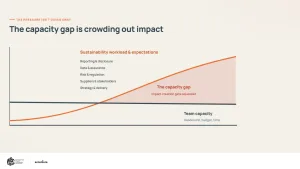
Based on its client work, Accenture estimates that AI could eventually free up 30–40% of sustainability team capacity, mainly in repetitive and structured tasks. This would be a welcome improvement, given that a recent Ipsos study found that 45% of its ESG Council members spend more time on reporting requirements than on delivering ESG priorities.i Our webinar participants recognized this picture, with 31 of the 48 respondents naming data collection and reconciliation among the most time-consuming parts of their week. Every hour that AI frees up there can be redirected toward strategy and real impact.
AI can create these efficiency gains by automating repetitive and structured activities such as data collection, and by augmenting other activities such as analyzing large volumes of data to identify patterns and trends. For some tasks, however, humans remain in the lead, including the actual decision-making on strategy and investments.
New responsibilities for sustainability professionals
At the same time, AI is expanding the scope of work for sustainability professionals. Does your company have insight into the environmental footprint of its AI use, both in its own operations and across the AI value chain? Few companies currently measure this, but investor scrutiny is growing, and building standardized metrics will require a collective effort. And what are the social risks and impacts for workers, suppliers, communities and consumers? Answering that means managing workforce transitions and ensuring fair access to AI training, while also guarding against bias and privacy breaches.
Like any other colleague using AI, sustainability professionals also need to use it responsibly, and four questions are worth asking: do you use AI proportionately, do you use it safely, can you trust the output, and do you still own your decisions? The last question matters most, because accountability for decision-making does not transfer from a person to a tool. The professional remains responsible for validating the assumptions used and approving the final recommendations and should keep a record of how the conclusions were reached.
A seat at the AI governance table
The webinars also made clear that sustainability professionals have a role to play in the governance of responsible AI. Do you have a seat in your company’s internal governance structure where you can bring in your knowledge and expertise? Are you in the room when AI models are selected, so that sustainability requirements are taken into account during procurement? Do you have a voice to raise environmental or social risks when decisions are made on specific use cases? And can you help close the data gaps on these risks, for example by asking AI providers for footprint information? Your CFO is a natural ally on cost and emissions, since not every task needs the most powerful model and matching the model to the task reduces both. When it comes to social risks, make sure that Human Resources and Legal are at the table early on.
AI governance in practice
CMS showed how their GUARD model (Governance, Use, Adoption, Risk, Data) applies to the work of sustainability professionals and shared three key insights:
First, AI adoption is more than deploying platforms and training people, as it requires redesigning day-to-day workflows with AI at the center, in a collaborative and inclusive way that draws on the knowledge and experience of individuals and teams. Sustainability professionals can help identify risks and monitor and follow up on them.
Second, CMS pointed to the need for balanced, informed decision-making when it comes to measuring and managing AI risks while taking full advantage of technology’s potential. Sustainability professionals must be part of this conversation on risks and opportunities, including at board level.
Third, AI agents are expected to redefine the paradigm further. While earlier AI technologies, ranging from machine learning to computer vision and large language models (LLMs), have delivered efficiency and are already deployed across a range of processes, the rollout of AI agents is only just beginning. Agents are radically different from these earlier technologies, because they can make decisions and act on them, and can collaborate with other AI agents both inside and outside the organization. CMS expects their adoption to raise complex questions about liability and ethical decision-making, as well as about the role of humans in corporate teams, with a direct impact on sustainability professionals.
UL Solutions made clear that responsible AI is far from a dry, theoretical concept, as there is strong market demand for assessing whether AI is used safely in real-world products. AI safety is no longer only a technical issue but has become foundational to trust and risk management, and with that to sustainable growth. For organizations adopting AI systems, the key question has shifted from “can it work?” to “is it safe and trustworthy?”
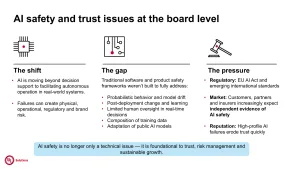
UL Solutions developed UL 3115, the Outline of Investigation for Safety of AI-Based Products, to evaluate the technical, ethical and governance dimensions of AI safety at product level. Using practical examples, they showed that AI safety is about more than policies and intentions, since evaluating it requires evidence that potential risks such as bias have been properly considered and that human oversight can work meaningfully and effectively in the context in which the AI is used.
UL Solutions also highlighted the strategic role that sustainability professionals can play by bringing the same discipline they apply to sustainability claims to the monitoring of responsible AI use.
Stay tuned on this topic
Webinar series “The AI-enabled sustainability professional” with Accenture:
- The AI tool landscape, November 24 and 25
- The AI workbench, December 15 and 16
Introduction to our new Action Theme “Put AI to work, responsibly,” December 3, WBCSD members only.
Reach out to peopleaction@wbcsd.org to express interest.
Outline